
Batumi from Tbilisi — 380 km, 5 hours by train (25–45 GEL / $9–16), 1 hour by plane (80–200 GEL / $29–73). Minimum stay for a proper visit: 2 nights. The city sits on the Black Sea in Georgia's Adjara region, surrounded by subtropical vegetation, and feels like a completely different country from Tbilisi. Palm trees, a 7 km Batumi boulevard, an old town with three religions in three blocks — and the original Adjarian khachapuri, the boat-shaped kind, made exactly as it was invented here. Entry rule since 2026: every visitor needs health cover — see our Georgia travel insurance guide.
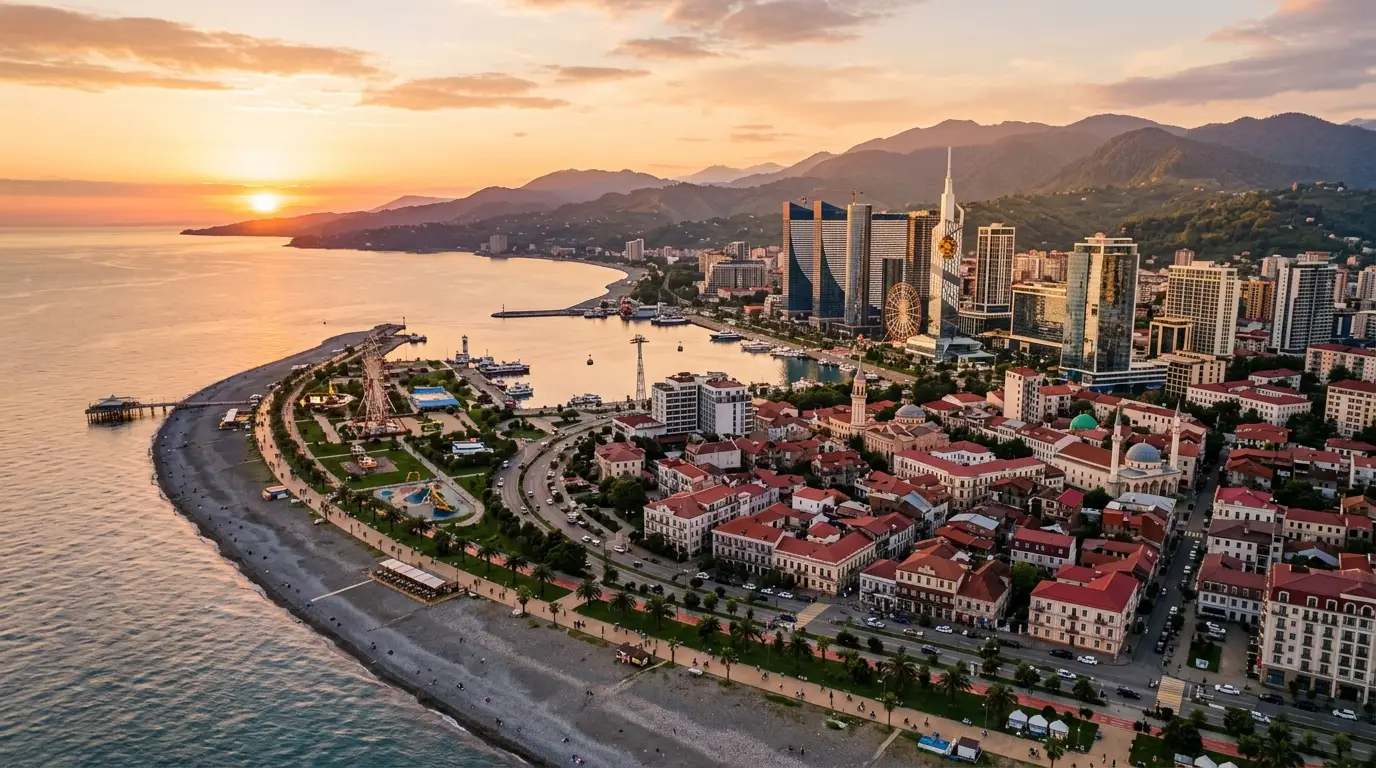
Batumi is 380 km from Tbilisi on Georgia's Black Sea coast. The overnight train takes 5.5 hours and costs ₾25-60 ($9-22), the bus runs 5-6 hours for ₾30-35 ($11-13), and a domestic flight covers the distance in 1 hour for ₾80-150 ($29-55). Plan at least 2 nights to properly see the 7 km seaside boulevard, the Botanical Garden (₾15 entry), the subtropical Old Town, and try Adjarian cuisine — including the original boat-shaped khachapuri invented here.
This guide is based on dozens of trips I have made to Batumi with tourists and on my own. The prices are 2026. The opinions are honest — including the part where I tell you that a batumi day trip from Tbilisi is not worth it, and you should plan for at least two nights.
Getting from Tbilisi to Batumi: all transport options compared
There are four ways to travel the 380 km between Tbilisi and Batumi. Each has a different balance of time, cost, and comfort. Here is the honest comparison for 2026.
| Option | Duration | GEL | USD | Comfort | Best for |
|---|---|---|---|---|---|
| Overnight train | 5.5 h | 25–60 ₾ | $9–22 | ★★★★★ | Best overall — sleep en route |
| Daytime train | 5 h | 25–45 ₾ | $9–16 | ★★★★ | Scenic, arrives daytime |
| Bus / marshrutka | 5–6 h | 30–35 ₾ | $11–13 | ★★ | Budget travellers only |
| Flight | 1 h | 80–200 ₾ | $29–73 | ★★★★★ | Time-poor, short trip |
| Car rental / taxi | 5–6 h | 200–300 ₾ (car) | $73–109 | ★★★ | Groups of 3–4, flexible stops |
Tbilisi to Batumi train — the recommended choice
The tbilisi to batumi train is operated by Georgian Railway (railway.ge). The overnight service departs Tbilisi around 22:15–23:00 and arrives in Batumi at 5:00–5:30 AM. You board in Tbilisi, sleep, and wake up by the sea — saving yourself the cost and hassle of an extra night's accommodation. This is how I recommend almost everyone travel if they have any flexibility at all.
A 4-berth coupé costs 25–35 GEL per person ($9–13). The 2-berth SV compartment runs 45–60 GEL ($16–22). Book on railway.ge or the Georgian Railway app. In summer (June–August), book 5–7 days ahead — tickets sell out quickly, especially on Friday and Sunday nights.
The daytime train is equally good for the journey itself — the route passes through Kutaisi and along river valleys — but you lose half a day of useful time. Departure is usually around 08:00–10:00, arrival around 13:00–15:00.
Tbilisi to Batumi bus — the budget option
Shared minibuses (marshrutkas) depart from Tbilisi's Isani bus station several times daily. The tbilisi to batumi bus costs 30–35 GEL ($11–13) and takes 5–6 hours depending on traffic and border. The seats are narrow and there are no scheduled toilet stops, which makes this a reasonable choice only for very budget-conscious travellers. Not recommended for anyone carrying luggage, travelling as a couple, or with any sensitivity to long uncomfortable journeys.
Batumi to Tbilisi flight — for time-constrained travellers
Georgian Airways operates daily flights between Tbilisi International Airport and Batumi International Airport. The batumi to tbilisi flight takes 50–55 minutes. One-way fares range from 80 to 200 GEL ($29–73) depending on season and booking lead time. Batumi airport is approximately 2 km from the city centre — a taxi into town costs 15–20 GEL. This option makes sense if you are working with 3–4 days total and want to maximise time in Batumi rather than on the road.
Is a Batumi day trip from Tbilisi worth it?
No. A batumi day trip is not worth it, and I say this having watched tourists attempt it and return to Tbilisi exhausted and disappointed. The math does not work: the fastest round-trip by train is 5 hours each way, leaving you roughly 3–4 hours in the city if you travel in both directions by day. That is not enough time to do anything properly — not the boulevard, not the old town, not the Botanical Garden, and certainly not the mountain villages of Adjara.
By flight, you could technically do a day trip — depart at 07:30, arrive by 08:30, fly back at 19:00. But you would spend 160–400 GEL on flights alone, add airport transfers on both ends, and still have only about 9 usable hours in the city. At that point, you are in a beach city with no time for the beach.
Minimum stay: 2 nights. Ideal stay: 3 nights. The structure I recommend: arrive by overnight train on night 1, spend days 2 and 3 in Batumi (one day at the coast, one day in the Adjara mountains), depart by daytime train on day 4 morning.
Batumi 2-day itinerary: what to do, where to go
This is the structure I use when taking guests to Batumi for a standard 2-night stay. It works whether you are arriving by overnight train (day 1 starts at 5:30 AM) or arriving the day before.
Day 1: Boulevard, old town, beach, and sunset
Morning (08:00–10:30) — Batumi boulevard. The batumi boulevard is a 7 km seafront promenade running the length of the Black Sea coast. Palm alleys, cycling paths, the statue of Medea with the Golden Fleece, the kinetic sculpture of Ali and Nino (two lovers who slowly merge and pass through each other). Early morning is the best time — the light comes in low across the water and almost no one is around. Rent a bicycle from one of the boulevard stands for 5 GEL/hour and ride the full length before the summer heat arrives. This is the single best hour you can spend in Batumi.
Mid-morning (10:30–13:00) — Batumi old town. The batumi old town is compact — walkable in two hours — but architecturally striking. The centrepiece is Piazza Square, designed in an Italian style with a clock tower and outdoor cafés that feel genuinely pleasant rather than tourist-fabricated. Within two blocks of the square you can see the Orta Jame Mosque (16th century, the oldest active mosque in Georgia), the Armenian Church of Saint Gevorg, and a Greek Orthodox church — three faiths in one neighbourhood. The wooden balcony architecture echoes Tbilisi's Old Town but feels subtropical, overgrown with bougainvillea and fig trees pressing between the buildings. One of the most satisfying urban walks in Georgia for anyone who cares about architecture and history.
Lunch (13:00–14:30) — Adjarian khachapuri, properly. Do not eat at the tourist-facing restaurants on the first row near the boulevard. Walk 2–3 blocks inland from the seafront and find a small bakery or café near the central market. A proper Adjarian khachapuri — the boat-shaped flatbread filled with molten cheese, a raw egg dropped in at the table, and a knob of butter melted into the cheese — costs 12–18 GEL ($4–6) at a local place versus 25–35 GEL at a tourist restaurant. The recipe was invented in Adjara; this is where it tastes as it was meant to.
Afternoon (15:00–18:00) — Batumi beach. The city beach is pebbly (bring sandals). Entry is free. A sunlounger and umbrella costs 15–20 GEL for two. Water temperature in peak summer reaches 24–26°C. The beach directly in front of the boulevard is the most crowded; 2–3 km north or 15 minutes south to Gonio gives you significantly more space and quieter water.
Evening (19:00–22:00) — Piazza at dusk, then the waterfront. Batumi nightlife is not primarily club-based — it is the boulevard after dark. Illuminated from 20:00 onwards, with live street musicians, packed cafés, and the whole city seemingly out walking. Sit at a terrace restaurant overlooking the water, order grilled barbulya (Black Sea red mullet) and a glass of Adjarian wine, and watch the lights of the port reflect in the sea. This is Batumi at its best.
Day 2: Botanical Garden and the Adjara mountains
Morning (09:00–12:00) — Batumi Botanical Garden. Founded in 1912, the Batumi Botanical Garden covers 109 hectares of subtropical vegetation on a hillside above the Black Sea. Bamboo groves, a Japanese garden, a eucalyptus collection, magnolias, the largest bamboo forest in the Caucasus. Entry costs 10 GEL for adults; there is an optional cable car inside for another 5 GEL. Allow 2–3 hours. Go early — by noon in summer the heat on the upper slopes is significant and tour groups start arriving after 10:30.
Lunch (12:30) — Borano and achma. Have lunch before heading to the mountains. Try borano — eggs fried with local cheese and butter in a small cast-iron pan, a distinctly Adjarian dish with no equivalent elsewhere in Georgia. Achma is layered boiled pastry filled with suluguni cheese — something between lasagne and a cheese pie. These are not on menus in Tbilisi. Try them here.
Afternoon (14:00–18:00) — Makhunseti Waterfall and Queen Tamara's Bridge. Forty minutes by car from Batumi, Makhunseti Waterfall drops 30 metres into a green gorge. A 10-minute walk from the waterfall stands Queen Tamara's Bridge — an 11th-century single-arch stone bridge across the Acharistskali River, one of the finest examples of medieval Georgian bridge construction in existence. Entry to both is free. A round-trip taxi from Batumi with waiting time costs 60–80 GEL. This excursion is where tourists consistently surprise themselves: they came for the beach and leave talking about the mountains.
We arrived by overnight train, groggy and a little sceptical. Three days later we had extended our stay by two more nights and missed our original Tbilisi plans entirely. The Botanical Garden in the morning mist, the boat khachapuri with the egg still runny, the waterfall in the Adjara mountains — we had no idea Georgia had all of this.
Batumi's three faces: old town, boulevard, and new city
Batumi divides into three distinct zones, each with a different mood. Understanding the geography saves you time and sets expectations correctly before you arrive.
Batumi old town
The historic quarter around Piazza Square. This is where you find 19th-century European-style architecture — the legacy of Batumi's period as a major Black Sea port during the Russian Empire. The neighbourhood is walkable and human-scaled, with wooden balconies, inner courtyards, and small restaurants tucked into historic buildings. The mix of religious buildings — mosque, synagogue, Catholic and Orthodox churches within a few hundred metres — reflects the genuinely cosmopolitan character of Batumi at its trading peak. Worth at least two hours of unhurried walking. The area around the market streets just behind the old town is where you find the best value food in the city.
Batumi boulevard
The 7 km seafront promenade is the social spine of the city. Free at all hours, busy from 07:00 to 02:00 in summer. Cycling is the best way to cover the full length — rental points are spaced every 500 metres. Key landmarks include the Statue of Medea, the Ali and Nino kinetic sculpture, the Chacha Fountain (which dispenses Georgian brandy on public holidays), and a series of beach access points. The boulevard connects the southern port end of the city to the northern end where the Botanical Garden begins — the full walk takes about 90 minutes at a comfortable pace.
New Batumi
Behind and beyond the boulevard, the skyline changes dramatically. The Alphabet Tower (a spiral tower with letters of the Georgian alphabet climbing its exterior), the Radisson hotel in the shape of an open book, the Technology Tower with a vineyard growing up its facade — these are the ambitions of Adjara's 2010s building boom. The architecture divides opinion sharply: some find it exciting, others garish. Either way it is honest evidence of what a resource-rich regional government chose to build when flush with investment. Worth a walk-through for context; do not plan your whole visit around it.
Beyond the beach: mountain Adjara
Most visitors to Batumi see only the coastal city. That is a significant omission. Forty kilometres inland from the seafront, the Adjara region transforms into dense green mountain valleys, rushing rivers, medieval bridges and fortresses, and villages where traditional Adjarian culture is more visible than anywhere on the coast. I consider this the hidden half of the Batumi experience — and the part that most travellers talk about long after they have forgotten the beach.
Makhunseti Waterfall
The most accessible highlight of mountain Adjara — a 30-metre cascade into a gorge surrounded by subtropical forest. Most dramatic in late spring when snowmelt swells the river, but it runs impressively through October. The approach is a short walk through ferns from a small car park. Combined with Queen Tamara's Bridge and the village of Acharistskali, this makes a satisfying half-day excursion. Free to enter.
Gonio Fortress
Fifteen kilometres south of Batumi, near the Turkish border, Gonio is a 1st-century Roman fortress built to guard the Black Sea trade routes. According to tradition, the Apostle Matthias is buried within its walls — a claim that has drawn Christian pilgrims to this remote coastal site for centuries. The fortress is well preserved, with high stone walls and a small museum inside. Entry costs 3 GEL. The beach nearby is less crowded than Batumi's city beach — a quiet alternative if you want to swim without summer crowds. Combined with a drive down the coastal road toward Turkey, Gonio makes a pleasant half-day from the city.
Full mountain day route
Batumi — Makhunseti Waterfall — Queen Tamara's Bridge — Acharistskali village — return. Approximately 6–7 hours by car. Hire a local taxi driver for the day (agree 80–120 GEL for the full day, including waiting time at each stop). Return to Batumi for dinner with a view of the sea — after a day in the mountains, the contrast makes the coast feel freshly remarkable.
Adjarian food: what to eat in Batumi
Adjarian cuisine is distinct from mainstream Georgian food — richer, influenced by the Ottoman period, with an emphasis on dairy, eggs, and seafood that reflects the coastal setting and the region's complex history. Is batumi worth visiting for the food alone? For a serious food traveller, possibly yes. These are the dishes to prioritise.
Adjarian khachapuri
The adjarian khachapuri originated in Adjara and the version you eat here is different from what you find elsewhere in Georgia — not because the recipe changes, but because the local cheese blend tastes different when it has not travelled far. The boat-shaped flatbread is filled with molten cheese, then a raw egg is broken into the centre at the table. You stir the egg into the cheese using a piece of bread torn from the crust, then eat the mixture while it is still hot. Prices: 12 GEL at a local bakery, up to 35 GEL at a tourist restaurant. The cheaper version is often better.
Borano
Eggs fried with local cheese and butter in a small cast-iron pan, served bubbling at the table. Think of it as a Caucasian version of shakshuka, but richer and less spiced. A staple Adjarian breakfast dish, 12–15 GEL. Pairs well with shoti bread — the long Georgian flatbread baked in a clay oven, best eaten warm from the bakery with a small smear of butter.
Sinori
Thin rolled pastry sheets filled with fresh cottage cheese and mint. Light, slightly sweet, with a texture between a crepe and a very thin pastry roll. Almost unknown outside Adjara, 10–14 GEL. If you see it on a menu, order it — it is one of the most distinctive things you can eat in the adjara region and you will not find it anywhere in Tbilisi.
Grilled barbulya
Barbulya is the Black Sea red mullet — a small, oily fish grilled whole and served with lemon and fresh herbs. The best barbulya is found not at tourist restaurants on the seafront but at local fish cafés two or three blocks inland. 20–30 GEL for a generous portion. Order it with a glass of cold Adjarian dry white wine.
Achma
A layered pastry made from sheets of boiled dough interleaved with suluguni cheese and baked until the top is golden. The texture is somewhere between a cheese lasagne and a very rich pie. Rich, substantial, deeply savoury. A full portion is enough for two people, 15–20 GEL.
Where to eat in Batumi: Move 2–3 blocks back from the seafront. The first row of restaurants near the boulevard charges a 30–50% premium for the view and foot traffic. The food quality is often no better than — and sometimes inferior to — what you find on the streets behind. The area around Baratashvili Street and the central market has a cluster of local cafés and bakeries where prices are fair and the cooking is more authentically Adjarian.
Where to stay in Batumi: accommodation guide 2026
Batumi has a wide accommodation spectrum, from hostels at 25 GEL per night to five-star resorts at 500+ GEL. Location matters more than in most cities — staying near the boulevard and old town gives you walkable access to everything; staying in the new high-rise district means you need transport for the old town and the market area.
| Type | Price / night (GEL) | USD equiv. | Best for |
|---|---|---|---|
| Hostel dorm | from 25 ₾ | from $9 | Solo budget travellers |
| Guesthouse / B&B | 50–90 ₾ | $18–33 | Couples, local atmosphere |
| Apartment (Booking / Airbnb) | 60–120 ₾ | $22–44 | Families, stays of 3+ nights |
| Hotel 3-star, boulevard-adjacent | 100–180 ₾ | $36–66 | Comfort, breakfast included |
| Hotel 4–5 star (Radisson, Sheraton) | from 300 ₾ | from $109 | Business, honeymoon |
Best location: The old town or the northern end of the boulevard, near the Botanical Garden. Both give you walkable access to the main sights without the noise of the busiest nightlife areas. Apartments in the old town are consistently the best value for a 3-night stay — 40–50% cheaper than equivalent hotels, with the option of a balcony and a kitchen for self-catering breakfasts.
Booking lead time: In peak season (July–August), book at least 2–3 weeks ahead. September and June are more forgiving but still require advance planning for good options. For the overnight train, book railway.ge at least 5–7 days ahead in summer — coupé berths in the popular sleeper carriages sell out by Thursday for weekend departures.
Best time to visit Batumi: full seasonal breakdown
Batumi has a subtropical humid climate — the wettest major city in Georgia and one of the wettest in the Caucasus, with annual rainfall exceeding 2,400 mm. Even in summer, brief intense rain is normal. Do not let this put you off — the rain passes quickly and the lush vegetation it produces is part of what makes Batumi and its surrounding mountains so striking.
| Month | Air temp | Sea temp | Crowds | Prices | Verdict |
|---|---|---|---|---|---|
| April–May | +16–22°C | +14–18°C | Low | -40% | Good for mountains, not beach |
| June | +24–27°C | +20–22°C | Moderate | Average | Good all-rounder |
| July–August | +29–33°C | +24–26°C | Peak | +50–80% | Best swimming, most expensive |
| September | +25–28°C | +22–24°C | Moderate | Slightly below peak | Best overall — warm sea, fewer crowds |
| October | +18–22°C | +19°C | Low | -30% | Sightseeing and hiking, cool for swimming |
| November–March | +8–14°C | +10–14°C | Very low | -50% | Off-season, atmospheric, very rainy |
Best time for the batumi travel guide 2026 recommendation: Late June and September are the sweet spots. The Black Sea water reaches 22–24°C — warm enough to swim comfortably. Crowds are smaller than in peak summer, prices are reasonable, and the mountain Adjara excursions are at their most rewarding. July and August are fine if you have booked well in advance, but expect packed beaches and premium accommodation pricing throughout.
Honest verdict: is Batumi worth visiting in 2026?
Yes — with conditions. Here is the framework for deciding.
Go to Batumi if you:
- Have 10 or more days in Georgia and have already seen Tbilisi, Kazbegi, and Kakheti
- Want a Black Sea beach holiday combined with genuine cultural interest — old town, Adjarian cuisine, mountain villages
- Are travelling with children — the boulevard is perfectly designed for families, with open space, cycling, and accessible beach access
- Are revisiting Georgia and want to understand a different side of the country — Adjara is historically, culinarily, and architecturally distinct from eastern Georgia
- Are interested in food — Adjarian khachapuri, borano, sinori, and Black Sea fish are things you cannot properly eat in Tbilisi
Skip Batumi if you:
- Have fewer than 7 days in Georgia and have not yet been to Kazbegi or Kakheti — those should come first
- Plan to visit in October–May primarily for the beach — the sea is too cold for swimming outside the summer season
- Are thinking of a one-day excursion — the round-trip travel absorbs the entire day and leaves you too little time for the destination
- Are primarily interested in Georgian history, wine, and mountain scenery — Tbilisi, Kakheti, and Mtskheta serve all of those interests far better
Batumi vs Tbilisi is a question I hear frequently. The honest answer: they are not competitors. Tbilisi is medieval, mountainous, and vinous — the cultural core of Georgia. Batumi is subtropical, coastal, and hedonistic — the country's Black Sea release valve. Think of them as Rome and Naples, or London and Brighton. You do not choose between them. You visit Tbilisi first, then add Batumi when you have more time.
We took the overnight train from Tbilisi — three nights in Batumi. The old town in the morning with almost no tourists, the khachapuri boat by the sea with the egg still runny, the waterfall and the medieval bridge on day three. Coming back to Tbilisi on the daytime train through the mountains. Georgia was twice the country we expected it to be.