
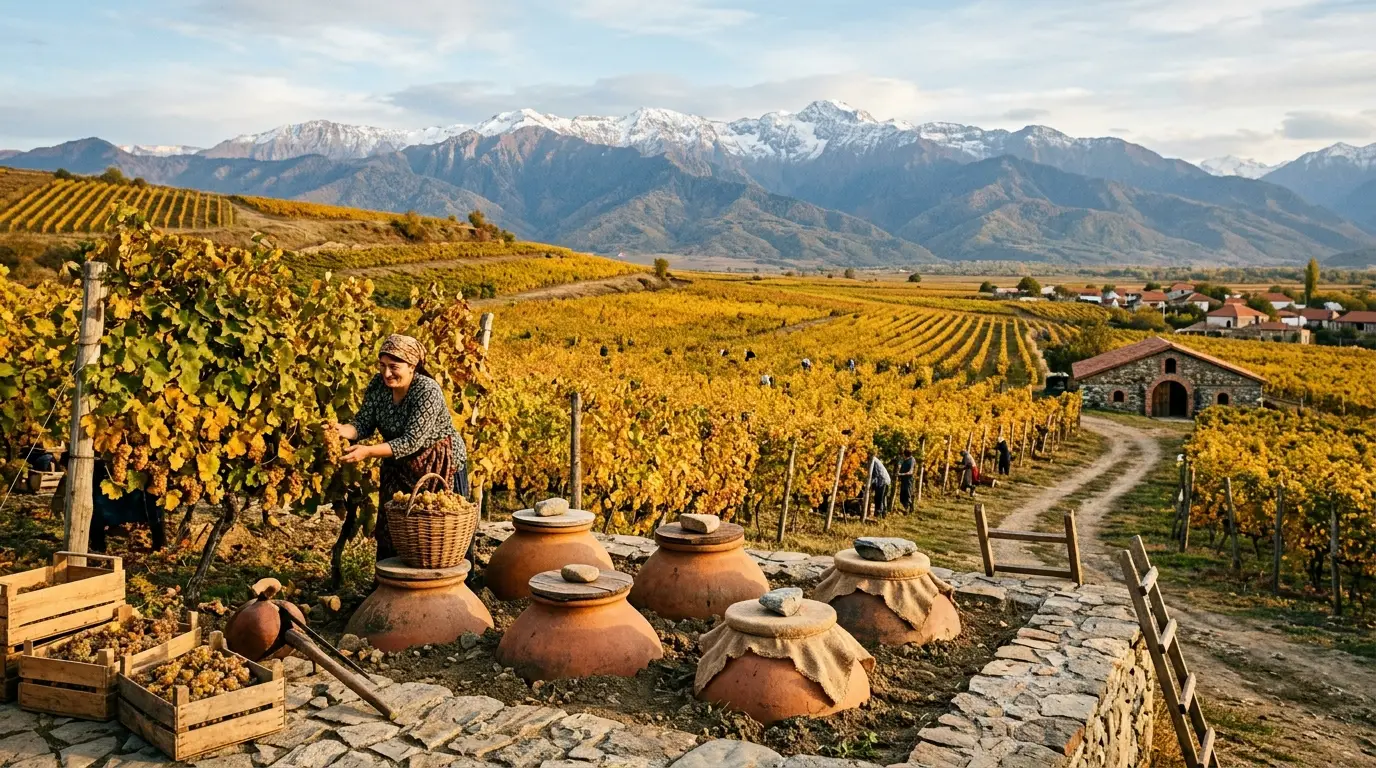
Kakheti is 80–100km from Tbilisi — close enough for a day trip, different enough to feel like another world. Rolling vineyards, medieval fortresses, ancient wine cellars, and family tables that seat fifteen people. One day isn't enough to see everything, but it's enough to understand why Georgians consider this the soul of their country. Since 2026 Georgia requires travel insurance for all visitors, so sort it out before the trip.
I've run this route dozens of times and never tire of it. Every time there's something new: a winemaker who's just opened a special qvevri, a village feast we stumble into by luck, a view I'd forgotten about. Kakheti gives you that. This guide is everything I'd tell a friend before their first trip.
Why Go to Kakheti
Kakheti is Georgia's main wine region — 70% of the country's wine comes from here. But numbers don't capture what makes it worth the drive. It's the combination of scale (the Alazani Valley stretching to the Caucasus), age (wine has been made here for 8,000 years), and the living tradition you can still step into. When you taste Rkatsiteli from a clay vessel buried six feet underground, that's not a tourist attraction — that's how it's always been done.
- Wine tasting at family cellars — not hotel restaurants, actual homes
- Sighnaghi — the most photogenic hilltop town in Georgia
- Bodbe Monastery — active convent with miraculous spring, 4th century
- Georgian food cooked at home: khinkali, mtsadi, pkhali, fresh bread
- 1.5–2 hour drive from Tbilisi through increasingly stunning countryside
Day Route: Step by Step
| Time | Stop | What to Do |
|---|---|---|
| 08:00 | Tbilisi | Depart. Hotel pickup included with guided tour. |
| 10:00 | Sighnaghi | Walk the hilltop town — 23 towers, cobblestones, views of the Alazani Valley. The "city of love" has a 24-hour wedding registry for a reason. |
| 11:00 | Bodbe Monastery | Active Orthodox convent, burial site of Saint Nino. The garden is extraordinary. Walk down to the miraculous spring (20 min round trip). |
| 12:30 | Family marani | Wine tasting: 4–6 varieties including qvevri amber wine. In autumn: join the rtveli grape harvest if timing allows. |
| 14:00 | Lunch | At the host's table: khinkali, mtsadi, fresh herbs, pkhali, homemade bread. Usually more food than you can finish. |
| 16:00 | Return drive | Optional: Telavi market stop for wine and local produce (add 45 min). |
| 18:00 | Tbilisi | Back at hotel. |
Distances & Driving Times
| Leg | Distance | Driving Time |
|---|---|---|
| Tbilisi → Sighnaghi | 112 km | ~2 hours |
| Sighnaghi → Bodbe | 2 km | 5 min |
| Bodbe → Marani (village) | 5–15 km | 10–20 min |
| Marani → Tbilisi | ~115 km | ~2 hours |
| Total | ~240 km | ~4.5 hours driving |
The roads are good — the Georgian Military Highway upgrade reached Kakheti. There are no mountain passes on this route, making it accessible year-round.
Wine Tasting in a Family Marani
A marani is a Georgian wine cellar — usually a separate stone building in the back of the family's property. Inside, qvevri clay vessels sit buried in the earthen floor, keeping wine at a constant 12–14°C without refrigeration. You'll be invited to taste directly from the vessel with a long-handled ladle, the way it's been done for generations.
This is categorically different from tasting at a commercial winery. There's no gift shop, no tasting fee card, no carefully designed ambience. There's a grandfather with rough hands and strong opinions about fermentation, a grandmother who'll appear with bread and cheese ten minutes in, and a dog who'll be underfoot the entire time. It's real.
What you'll typically taste:
- European-style white (light, cold, fresh — good for the uninitiated)
- Qvevri white or amber (skin-contact, tannic, complex — often the revelation)
- Saperavi red (Georgia's best red grape, deep and structured)
- Chacha (grape spirit, Georgian grappa — one glass is enough)
"Rkatsiteli straight from the qvevri — nothing I'd tasted before had prepared me for it. It smelled of apricot and walnuts and something ancient I couldn't name. The host ladled it himself, watched me taste it, and smiled like he already knew the answer."
— Mikhail O., Tel AvivWhat Is Qvevri Wine?
Qvevri (also spelled kvevri) are large clay amphorae, shaped like eggs, buried underground with only the neck visible above the floor. They range from 50 litres to several tonnes. For white wines, whole grape clusters are fermented in the qvevri — skin, seeds, and all. The mixture (called mezga) ferments for 3–6 months, then the liquid is separated and sealed in qvevri for ageing.
The result is orange or amber wine: white grapes with the structure and tannins of a red. If you've only ever drunk European-style whites, the taste will surprise you — it's drier, deeper, more complex, and pairs with food rather than drinking it.
Tasting advice: start with a light European-style white to calibrate, then move to the qvevri amber. Going the other way — amber first — makes the European style taste thin by comparison.
Georgian Food in Kakheti
Lunch in Kakheti is an event. Georgian hospitality doesn't allow for light meals. Expect:
- Khinkali — twisted meat dumplings, eaten by hand. The correct technique: hold by the knot, bite a small hole, drink the broth inside first. Eat as many as possible. The knot is left on the plate to count.
- Mtsadi — grilled pork skewers over vine wood coals. The vine wood gives them a specific smokiness you can't replicate with charcoal.
- Puri (matsnakash) — Georgian bread baked in a clay oven (tone). Tear it by hand and dip everything in it.
- Sulguni — Georgian cheese, a close cousin of mozzarella. Salty, elastic, often served fresh or lightly smoked.
- Badrijani nigvzit — fried aubergine rolled around spiced walnut paste. One of Georgia's great vegetarian dishes.
- Churchkhela — grape juice and walnut "candles", dried and sold everywhere in Kakheti. A sweet to take home.
How to Get There
| Option | Cost | Notes |
|---|---|---|
| Guided tour (Sakhva) | from ₾170/person | Private car, hotel pickup, all stops, wine tasting, lunch. Recommended. |
| Taxi (private) | ₾120–180 return | Driver stays with you. No guide, no marani access by default. Negotiate in advance. |
| Marshrutka (shared minibus) | ₾6–8 one-way | From Ortachala bus station to Sighnaghi. No marani included. Timetable varies. |
The marshrutka option works if you just want to see Sighnaghi and wander independently. For wine tasting at a real family marani, you need either a guide or a local contact — the easiest way is a guided Kakheti wine tour from Tbilisi, since marani visits don't happen by walking up to a farm gate, you need an introduction.
What Wine to Buy and Where
The best place to buy wine in Kakheti is directly from the family you visit. Prices are lower than in Tbilisi shops, the wine is genuine, and you know exactly where it came from. Typical marani prices:
| Variety | Style | Marani Price |
|---|---|---|
| Saperavi | Red, dry | ₾12–25/bottle |
| Rkatsiteli (qvevri) | Amber, tannic | ₾15–35/bottle |
| Mtsvane | White, dry | ₾10–20/bottle |
| Chacha (grape spirit) | 55–70% ABV | ₾5–10/litre |
Family Marani vs Commercial Winery
| Family Marani | Commercial Winery | |
|---|---|---|
| Wine price | ₾10–35 | ₾20–80+ |
| Authenticity | Home production, same family for generations | Scaled, sometimes industrial |
| Tasting experience | Personal — you meet the winemaker | Structured, tasting room |
| Access | Requires guide or introduction | Open to walk-ins |
| Food included | Almost always | Usually sold separately |