
Small group or private trip
- up to 7 people in a minivan — not a 40-seat bus
- scheduled departures with a local guide
- best value for 1–3 people
- just your party
- your start time and stops
- one price for car and guide
From 5 people a private trip isn't needed — the group rate applies per person. A 10% deposit secures the date, free cancellation up to 48 hours before.
Extend your trip
Most guests add to this tour:
The Gori — Uplistsikhe Route
From Tbilisi to Gori it's 88 km on the highway — about 1.5 hours of comfortable driving. We leave early to reach Uplistsikhe before the midday heat sets in. The full day runs around 8–9 hours, covering three millennia of Georgian history in a single loop west of the capital.
The route follows the Kura River valley through the historical region of Shida Kartli — the very heartland of the ancient Georgian kingdom. On the way you pass vineyards, medieval watchtowers on distant ridgelines, and the wide flatlands that make this corridor so strategically important throughout history.
09:00 — Departure from Tbilisi
We meet at your hotel or an agreed central point in Tbilisi. The minivan is air-conditioned and comfortably seats up to 7 people. Along the way, Timur shares the history of Kartli — the province from which Georgian statehood emerged, and the landscape that shaped it. Look out for the ruins of medieval fortresses on the hilltops as you drive west — this valley was contested for centuries between Georgian kings, Mongol invaders, Persian armies, and Russian imperial forces.
10:30 — Uplistsikhe: the Cave City
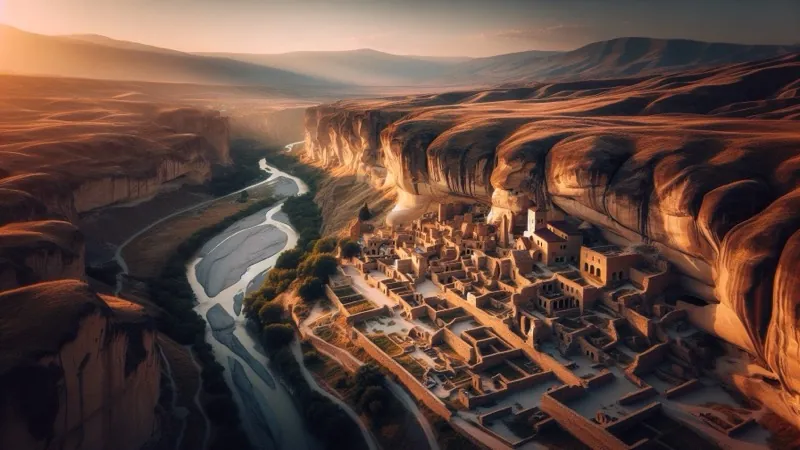
Uplistsikhe ("Lord's Fortress" in Georgian) is a rock-hewn cave city carved directly into a sandstone cliff above the left bank of the Kura River. It was continuously inhabited from the I millennium BC and served as the capital of Kartli between the I and III centuries AD — making it one of the oldest cities in the South Caucasus. At its peak the population reached 20,000 people.
The site covers about 8 hectares with over 700 structures carved into the cliff on three distinct levels: the Lower, Middle, and Upper city. You will walk through pagan temples with carved ceilings that predate Christianity in Georgia by centuries, the great hall believed to be Queen Tamara's throne room, a remarkably preserved ancient pharmacy with stone mortars still in place, a wine cellar with carved vessels cut into the rock floor, and an open-air amphitheater. A narrow secret tunnel leads down through the cliff face to the river — used for escape during sieges.
The Christian basilica built at the top of the site in the IX century stands as a reminder of how the city transitioned from paganism to Christianity and was eventually abandoned after the Mongol invasions of the XIII century. Entrance costs ₾7 for adults (updated 2026), ₾5 for children under 15. Plan 1.5–2 hours. Bring plenty of water — the exposed sandstone plateau offers zero shade and temperatures at the surface can reach 45°C in July and August.
12:30 — Goristsikhe Fortress
Back in Gori, the medieval Goristsikhe fortress sits on an isolated rocky hill directly in the centre of town. The current structure dates to the XIV–XVII centuries, though a fortification has stood on this hill since ancient times. The climb takes about 15 minutes and rewards you with an excellent panoramic view over the city, the Kura River valley, and the Greater Caucasus foothills to the north. Entry is free. Allow 30 minutes.
13:00 — Stalin Museum
Gori is the birthplace of Joseph Dzhugashvili, better known as Stalin (born 1878, died 1953). The Stalin Museum is one of the most unusual museum experiences in the Caucasus — it opened in 1957, just four years after his death, and much of the original Soviet-era narrative is deliberately preserved. The exhibition occupies an elaborate neoclassical building and spans three parts: the main museum building with personal photographs, gifts from world leaders, documents, and death mask; the small wooden childhood cottage where Stalin was born (enclosed within a decorative stone pavilion); and the personal armored railway carriage, a modified 1935 ZIS-110 used for travel to the Yalta Conference in 1945. Entry ₾15–20 per person (cash). Allow 45–60 minutes.
Timur provides balanced historical context throughout the visit. The museum raises real questions about memory, propaganda, and how societies choose to commemorate complex figures — worth experiencing regardless of your political views.
14:30 — Lunch in Gori
Timur takes you to a local restaurant used by Gori residents rather than tourist groups. Expect generous portions of Georgian khinkali (meat dumplings — ₾8–12 per portion of 5), mtsivadi (Georgian-style shashlik on the grill), fresh salads with local herbs, and house wine. Budget ₾25–35 per person for a full meal with drinks. This is usually a relaxed 45-minute break before the drive back.
Option — Mtskheta on the Way Back
Mtskheta lies directly on the road from Gori back to Tbilisi — just a 15 km detour from the main highway, adding around 1.5 hours to the day. This ancient capital of early Georgian kingdoms sits at the confluence of the Kura and Aragvi rivers and contains two UNESCO-listed monuments: Jvari Monastery (V century), perched on a cliff above the rivers with views that inspired some of the most famous lines in Georgian and Russian literature, and Svetitskhoveli Cathedral (XI century), the principal cathedral of the Georgian Orthodox Church built on a site that has been sacred since the IV century. Entrance to Svetitskhoveli costs ₾3. If energy allows, this combination turns the Gori tour into one of the most historically complete single-day itineraries possible in Georgia — three UNESCO sites, three eras of history, one day.
Practical Tips
- Uplistsikhe in summer (June–August): the sandstone plateau heats up to 45°C by midday. We arrive by 10:00–10:30 and leave before 13:00. After noon the heat becomes genuinely dangerous — no exaggeration. Morning timing is essential.
- Uplistsikhe in spring/autumn: perfect conditions. March–May and September–October are the ideal months — mild temperatures, wildflowers on the plateau, and good light for photography.
- Stalin Museum: your political views don't affect the experience — this is a fascinating historical document of an era. An audio guide in English is available at the museum entrance for ₾5 extra. Photography is permitted throughout.
- Children: Uplistsikhe is an excellent adventure for kids aged 6 and up — the caves, tunnels, and carved spaces spark imagination immediately. Some passages have low ceilings requiring adults to duck. Under-6s may struggle with the uneven terrain.
- Photography: the best light at Uplistsikhe is morning (before 11:00) when the sun illuminates the cliff face from the east. The view from the top level over the Kura River bend is the signature shot of the site.
- Mobility considerations: Uplistsikhe involves significant climbing on uneven stone steps and unpaved paths. Not suitable for wheelchairs or guests with serious mobility impairments. The Goristsikhe fortress approach is steep but manageable.
What to Bring
- Water — minimum 2 liters per person; there are no shops, kiosks, or water points inside the Uplistsikhe site
- Sunscreen SPF50+ and UV-blocking sunglasses — open exposed plateau, no natural shade whatsoever
- A wide-brim hat or cap — not optional in summer, essential gear for the rock plateau
- Closed-toe shoes with firm grip — Uplistsikhe has steep, uneven carved stone steps that are slippery when dusty; sandals and flip-flops are genuinely dangerous
- A light layer for the cave interiors — the deep caves maintain a cool temperature even in summer and can feel cold after the heat outside
- ₾200–250 in cash (GEL) — breakdown: Uplistsikhe ₾7–15, Stalin Museum ₾15–20, Goristsikhe fortress free, Svetitskhoveli ₾3 if adding Mtskheta, lunch ₾25–40, plus snacks and souvenirs
Uplistsikhe vs. Other Cave Cities
Visitors familiar with Vardzia (the more famous cave monastery in southern Georgia) often ask how Uplistsikhe compares. The two sites are very different in character. Vardzia is a monastic complex built in the XII century with a clear Christian identity; Uplistsikhe is a secular urban settlement spanning 1,500 years, predating Christianity in Georgia by many centuries. Uplistsikhe is closer to Tbilisi (1.5 hours vs. 4.5 hours) and far less crowded. Scholars sometimes compare it to Petra in Jordan — both are rock-cut cities carved by a civilization that has long since disappeared, leaving only the stone to tell the story. The difference is that Uplistsikhe receives a fraction of the visitors that Petra does, which makes the experience more intimate and the atmosphere genuinely atmospheric.