
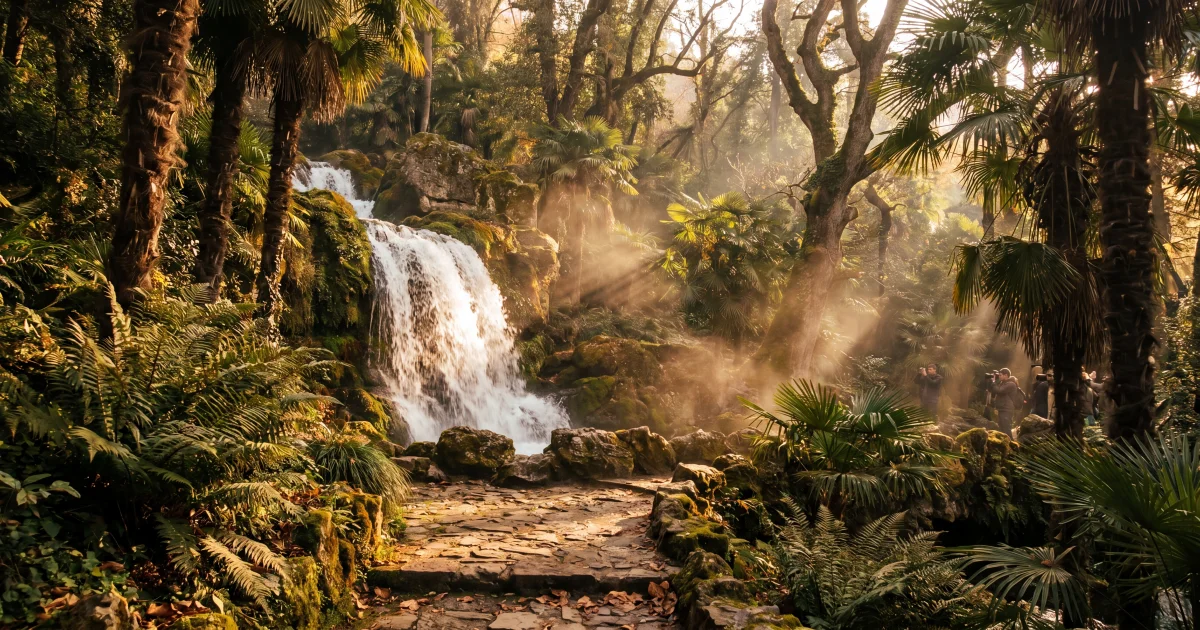
Tbilisi Botanical Garden is a place most tourists skip. That's a mistake. Behind the walls of Narikala Fortress lies one of the oldest botanical gardens in the Caucasus: 128 hectares of forests, alleys, greenhouses, and paths leading to a real waterfall.
The garden doesn't look like European botanical gardens with manicured lawns and labels on every bush. It's different here: wild nature growing into hillsides, ancient trees, bridges over gorges, and silence -- a rare find in noisy Tbilisi.
I bring guests here after Narikala -- and every time I see the same reaction: "We didn't expect a forest like this right in the city center." This guide covers everything: entrances, routes, prices, secret trails, and my personal recommendations.
Brief history: from tsarist times to today
The Tbilisi Botanical Garden was founded in 1845 by decree of the Viceroy of the Caucasus. But gardens existed on this site long before -- Georgian monarchs maintained royal gardens here as far back as the 17th century. Remnants of walls and terraces from that period are still visible in the eastern part of the garden. One more thing: insurance for Georgia has been mandatory at the border since 2026.
During the Soviet era, the garden was a major research center: studying Caucasian flora, acclimatizing plants from other regions, breeding new varieties. After the USSR collapsed, the garden went through hard times -- funding dried up, parts of the grounds fell into disrepair. But since the 2010s, a revival has been underway: paths updated, signs installed, greenhouses restored.
Today the collection includes over 3,500 plant species. The area is 128 hectares, of which about 60 are maintained grounds with paths and zones. The rest is semi-wild forest, making a walk here feel more like a hike than a park visit.
Fun fact: the garden is home to an oak tree over 300 years old. It survived invasions, earthquakes, and the Soviet period. Locals call it "Grandpa" -- it stands on a small hill in the southern part of the garden. Its trunk takes three people to hug.
Three entrances: which to choose and why
Main (lower) entrance -- Botanicheskaya Street
The most convenient entrance for those arriving by taxi or bus. Here you'll find ticket offices, an information board with a map, restrooms, and a small cafe. From the entrance, the main alley begins -- flat, paved, and stroller-friendly. The waterfall is 15-20 minutes on foot from the lower entrance.
How to get there: taxi from the center -- 5-7 GEL (~$2-2.50). Bus #31 from Avlabari metro to "Botanikuri" stop -- 1 GEL. Walking from Meidan Square -- 15 minutes over the bridge and uphill.
Upper entrance -- from Narikala Fortress
My favorite entrance and the one I recommend to everyone. Take the cable car to Narikala (2.5 GEL), explore the fortress (free), then descend into the Botanical Garden through a gate in the fortress's southern wall. The entire route goes downhill -- much easier than climbing up from the lower entrance.
Route logic: cable car from Rike Park to Narikala (30 min) then enter the garden from above, descend through the garden (1.5-2 hours), exit through the lower entrance, then walk to the sulfur baths (5 min) or Meidan Square.
Legvtakhevi entrance (gorge side)
This entrance connects the garden to the Abanotubani sulfur bath district. You walk through Legvtakhevi Gorge (beautiful in its own right), past a waterfall, and enter the garden from the side. But this entrance isn't always open -- check on-site. Most reliable in summer during tourist season.
2026 prices: tickets, tours, extras
| Service | Price (GEL) | Price (USD) |
|---|---|---|
| Adult admission | 4 GEL | ~$1.40 |
| Children under 6 | Free | -- |
| Students (with ID) | 1 GEL | ~$0.35 |
| Seniors | 1 GEL | ~$0.35 |
| Guided tour (group up to 10) | 15-20 GEL | ~$5-7 |
| Cable car to Narikala (one way) | 2.5 GEL | ~$0.90 |
| Taxi from center | 5-7 GEL | ~$2-2.50 |
| Coffee at entrance cafe | 4-6 GEL | ~$1.40-2 |
The Botanical Garden is one of the cheapest attractions in Tbilisi. For 4 GEL you get access to an area the size of a small neighborhood. For context: a coffee downtown costs more than the garden admission.
The waterfall: how to find it and what to know
The waterfall is the main reason tourists visit the Botanical Garden. Its height is about 22 meters, cascading down a rock wall into the Tsavkisis-Tskali gorge. The waterfall runs year-round, but its volume varies greatly by season.
From the lower entrance
From the ticket office, walk straight along the main alley. After 5 minutes, there's a fork -- go left (sign says "Waterfall" / "Chanch'k'eri"). Descend stone steps for 10-15 minutes. Steps can be slippery -- hold the railing. At the bottom, a viewing platform faces the waterfall.
From Narikala (upper entrance)
From the fortress gate, follow the trail down. After 10 minutes, a fork with a sign. Go right toward the waterfall (15 more minutes downhill). The trail is narrower than from the lower entrance, partly unpaved. But the views along the way are significantly better.
When the waterfall is most beautiful
April-May: peak flow. After spring rains, the waterfall roars, spray flies 5-10 meters. Photos come out dramatic.
June-August: the waterfall is quieter, sometimes reduced to a thin stream. But you can get closer without getting soaked.
September-October: moderate flow + fall colors. Perfect combination for photos.
Winter: sometimes partially freezes -- ice formations on the rocks look surreal. But the approach can be slippery.
Three routes: 1, 2, and 3 hours
"Quick" route -- 1 hour
For those short on time. Lower entrance, main alley, waterfall, back the same way. Without rushing -- 50-60 minutes. You'll see the main attraction and walk through the most maintained part. Suitable for people with limited mobility -- the main alley is flat.
"Optimal" route -- 2 hours
My recommended route for a first visit. Enter via Narikala (from above), trail through the upper garden, Japanese garden, rose garden, waterfall, lower exit. Along the way -- 3-4 viewpoints overlooking Tbilisi. Elevation change: about 150 meters (all downhill). Not physically demanding, but comfortable shoes are a must.
Key stops on this route:
- Upper viewpoint -- right after entering from Narikala. View down into the gorge and garden.
- Japanese garden -- small but atmospheric corner with bamboo and stone paths. 10 minutes from the upper entrance.
- Rose garden -- over 100 rose varieties. Best period: May-June when everything blooms. Other times -- just green bushes.
- Waterfall -- final stop before exiting. 15-20 minutes at the waterfall is enough for photos and rest.
"Full" route -- 3-4 hours
For nature lovers who are in no rush. Includes everything from the "Optimal" route plus: the eastern part (wild forest, ancient "Grandpa" oak), subtropical greenhouse, bamboo grove, and trail along the gorge. This route is a semi-adventure: some trails are unmarked, places require pushing through overgrowth. Bring water and snacks.
What blooms and when: seasonal calendar
| Month | What blooms | Notes |
|---|---|---|
| March-April | Magnolias, cherry, almond | Garden wakes up, waterfall at full power |
| May | Roses, irises, peonies | Best month to visit: everything blooms, not too hot |
| June | Lavender, jasmine, oleander | Peak aromas, heat building up |
| July-August | Lotuses (in the pond), hibiscus | Hot -- come in the morning or evening |
| September-October | Chrysanthemums, fall foliage | Golden autumn, best light for photography |
| November-February | Evergreens, conifers | Quiet, empty, unique atmosphere |
My pick: May. The rose garden in full bloom, temperature 22-25C, waterfall still powerful from spring rains, moderate tourist crowds. If you can choose -- come in May.
Hidden trails and viewpoints
"Eagle's Nest" trail. From the upper entrance (Narikala), go right along the fortress wall -- a dirt trail to a rocky outcrop. From there you can see the city, the gorge, and the mountain range on the horizon. Almost nobody comes here -- the trail is unmarked. A spot for those seeking solitude.
Bamboo alley. In the northeastern part of the garden, behind the greenhouse. Bamboo has grown to 8-10 meters here -- creating a green tunnel. Photogenic in any season. Great for portrait photography.
Bridge over the gorge. A wooden bridge between the eastern and western parts of the garden, spanning the Tsavkisis-Tskali gorge. From the bridge -- views down to the river and up to fortress walls. One of the most photographed spots in the garden, but usually empty in the morning.
Lotus pond. Hidden in the southern part, below the rose garden. In summer (July-August), pink and white lotuses bloom. Benches in the shade surround the pond. The perfect picnic spot: quiet, beautiful, nobody around.
Connection to Narikala Fortress
The Botanical Garden and Narikala Fortress form a single route that I always combine. Here's how it works:
Step 1: cable car from Rike Park. Cost: 2.5 GEL, ride takes 3 minutes. Views of Tbilisi from above are stunning. Best to go in the morning (before 10:00 AM) when there are no queues.
Step 2: Narikala Fortress. Free entry. A 4th-century fortress -- one of the oldest in the Caucasus. Climb the walls: 360-degree panorama of the Old Town, the Kura River, and mountains. 20-30 minutes is enough.
Step 3: through a gate in the fortress's southern wall -- enter the Botanical Garden. Descend through the garden to the waterfall and lower exit.
Step 4: from the lower exit -- 5-minute walk to the Abanotubani sulfur baths. Or 10 minutes to Meidan Square.
Total route: 3-4 hours. Physical difficulty: moderate (the only ascent is via cable car, then it's all downhill). One of the best routes in Tbilisi, combining history, nature, and city atmosphere.
Cafes inside and near the garden
Cafe at the lower entrance. Simple but cozy. Coffee: 4-6 GEL, lemonade: 3-4 GEL, sandwich: 6-8 GEL. Terrace overlooking the alley. Good spot to rest after your walk.
Inside the garden -- no permanent cafes. A couple of stands sell ice cream and water (summer only, near the waterfall). So bring water and snacks, especially for routes of 2+ hours.
Near the garden (after exiting):
- Cafe Leila -- 5 minutes from the lower exit, in Abanotubani. Georgian food, coffee, wine. Average bill: 20-30 GEL. Cozy courtyard terrace.
- Machakhela -- Georgian restaurant chain, nearest on Leselidze Street (10 minutes from the garden). Khinkali at 1 GEL each, khachapuri 8-12 GEL. Fast, tasty, affordable.
- Wine Underground -- natural wine bar in a basement on Shavteli Street (15 minutes from the garden). Glass: 8-15 GEL. Ideal ending to a long walk.
Tips for photographers
Best time of day: morning (8:00-10:00 AM) -- soft light, mist in the gorge, nobody around. Or "golden hour" (5:00-7:00 PM in summer) -- slanting rays through trees, warm tones.
Best spots:
- Waterfall -- use a long exposure (0.5-2 sec) for a silky water effect. Tripod or stabilizer needed.
- Bridge over the gorge -- symmetrical composition, forest on both sides. Best in the morning when nobody's there.
- View from Narikala down into the garden -- panoramic shot with fortress in the foreground, greenery below.
- Bamboo alley -- portraits, "tunnel" effect. Works in any light.
- Lotus pond -- macro shots of flowers, reflections in water. July-August.
Equipment: a smartphone is sufficient. If you have a camera -- wide-angle for landscapes and the bridge, telephoto for the waterfall and details. ND filter for long exposures at the waterfall.
Pro tip from Timur: visit the garden right after rain. Wet leaves glisten, mist fills the gorge, trails reflect light. 80% of the best photos my guests take are shot after rain. More about rainy Tbilisi in our guide hidden gems of Tbilisi.
What to wear and when to go
Shoes: the most important thing. Trails are rocky in places, steps are slippery after rain. Sneakers or hiking sandals are essential. Flip-flops and heels -- no.
Clothing: in summer -- light, but cover your shoulders (for sun and branch scratches). Spring and fall -- light jacket; the gorge is cooler than the city. Winter -- warm clothes and non-slip shoes.
What to bring:
- Water (0.5-1 liter per person) -- hard to buy inside the garden except at summer stands.
- Snacks -- for routes of 2+ hours.
- Sunscreen -- the upper part of the garden is exposed.
- Camera or phone with charged battery -- you will want photos.
- Light rain jacket -- weather in Tbilisi can change quickly.