
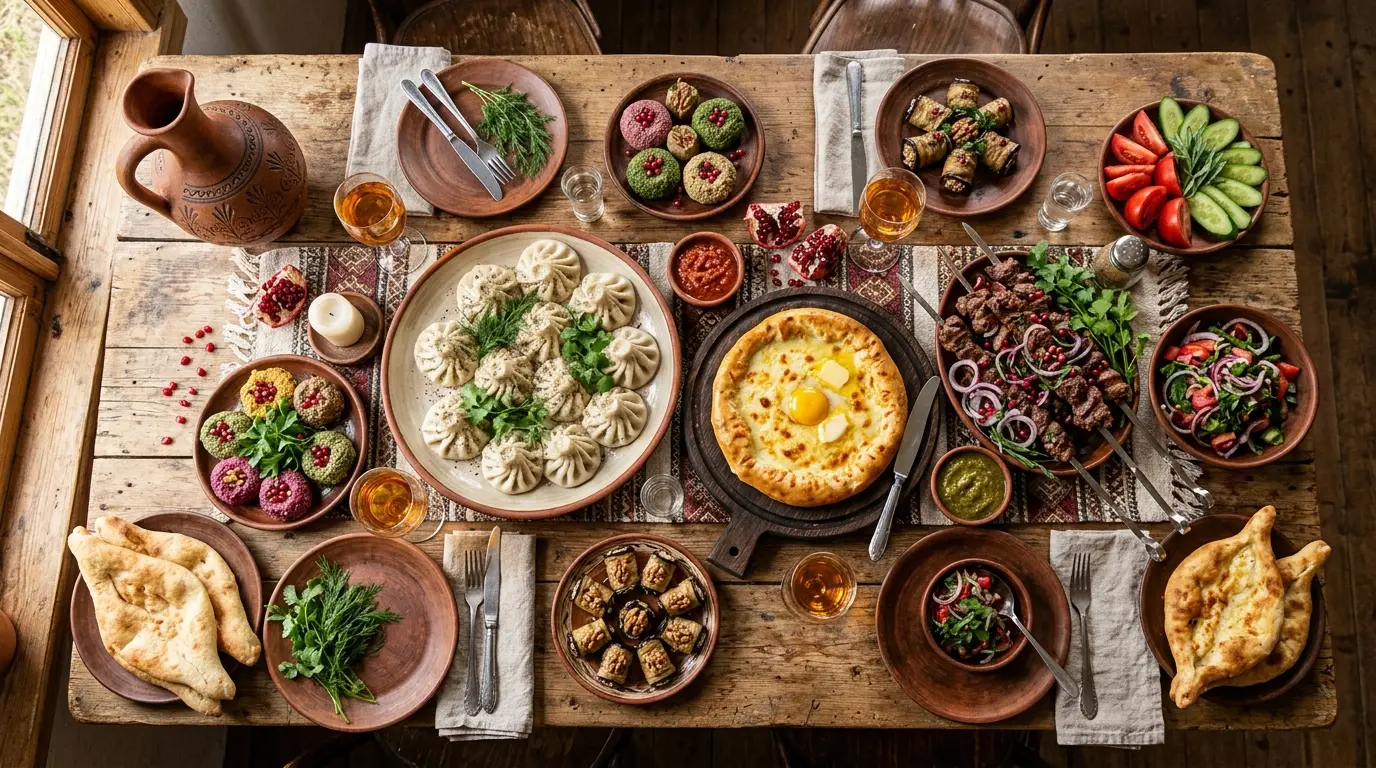
A full Georgian lunch costs ₾15-25 ($5-9) at a local Tbilisi restaurant. The 15 essential dishes: khinkali dumplings (₾0.80-1 each), Adjarian khachapuri (₾9-12), lobio bean stew (₾6-8), mtsvadi grilled meat (₾12-18), shkmeruli chicken in garlic sauce (₾14-18), badrijani walnut-stuffed eggplant (₾5-7), pkhali vegetable pate (₾4-6), churchkhela grape-nut candy (₾2-5), and more. Tourist restaurants on Shardeni Street charge 2-3x more for the same dishes — eat where locals eat instead. One more thing: insurance for Georgia has been mandatory at the border since 2026.
Khinkali — how to eat them properly and where to pay 0.8 GEL
Large dumplings filled with spiced meat and broth. Eaten with your hands. A normal serving is 6–10 pieces. The topknot is not eaten.
Khinkali are Georgian dumplings that look simple but have a technique behind them. Pick one up by the topknot, bite a small hole in the underside, and drink the broth before anything else — that concentrated, herb-spiced liquid is the point of the whole dish. Then eat the meat and dough. Leave the topknot on the plate; the waiter counts how many you have eaten by looking at it. The classic filling is pork and beef, but mushroom and potato versions exist for vegetarians. Mountain-style khinkali (mtiuluri) are smaller, thicker-skinned, and spicier.
The three types of khachapuri — and the key differences
Cheese bread in three regional styles: a closed round flatbread, an open boat with egg, and a double-cheese version. All three are worth ordering.
Imeretian khachapuri is the original: a round, flat bread sealed around a filling of mild brined cheese (imeruli). The classic breakfast in Georgian households — 6–8 GEL. Adjarian khachapuri is the one everyone photographs: a boat-shaped bread filled with melted sulguni cheese, with a raw egg and a knob of butter added on top just before serving. You mix everything together, tear off the bread edges, and dip. Eat it immediately — the texture changes dramatically after ten minutes. Costs 9–12 GEL. Megrelian khachapuri has sulguni both inside and baked into the crust on top, producing a golden cheese crust. The most filling of the three, 8–10 GEL.
Shkmeruli — chicken in garlic-cream sauce
A young chicken flattened, roasted, then simmered in a milk-and-garlic sauce. From the Racha region. Served in a clay keji pan, best shared between two people.
Two spellings, one dish — the variation comes from transliterating the Georgian letter "sh/chk." A young poussin is butterflied, roasted until the skin crisps, then braised in a sauce of whole milk and crushed garlic. The result is extraordinarily tender meat sitting in a thick, fragrant sauce. It arrives in a clay keji pan directly from the oven. The sauce is not optional — you tear pieces of mchadi (Georgian cornbread) and drag them through it.
Lobio — Georgian beans that change how you think about food
Slow-braised red kidney beans with spices, onion, and coriander, served in a clay pot. Comes with mchadi cornbread and pickled cucumber. One of the best vegetarian options in the country.
Lobio is not a side dish. Red beans are cooked for hours with onion, utsho-suneli (blue fenugreek), fresh coriander, garlic, and sometimes crushed walnuts. The result is earthy, complex, and satisfying in a way that beans rarely are. It arrives in a clay keji still bubbling from the fire, accompanied by mchadi and a few pickled vegetables. It is also one of the most affordable dishes in Georgian cuisine — and the best option if you do not eat meat.
Mtsvadi — barbecue grilled over vine wood
Pork or beef skewers grilled over dried grapevine charcoal. Served with raw onion, fresh herbs, and tkemali plum sauce. No mayonnaise in sight.
The secret is the fuel. Dried grapevine wood burns hotter than standard charcoal and imparts a faint sweetness to the smoke. The meat is not marinated — no soy sauce, no vinegar, no overnight brining. It is simply good pork or beef, salt and pepper, fire. Served alongside raw onion and tkemali, a mouth-puckering sauce made from unripe plums. This is Georgian barbecue reduced to its essentials.
Pkhali and Ajapsandali — the best Georgian starters
Pkhali are compressed balls of cooked vegetables bound with walnut paste. Ajapsandali is a summer vegetable stew with aubergine, pepper, and tomato. Both are vegetarian.
Pkhali come in three or four varieties on a single plate — spinach, beetroot, and cabbage are the most common bases. Each is blended with walnuts, coriander, garlic, and a pinch of dried spices, then shaped into a small ball and topped with a pomegranate seed. Order the assortment. Ajapsandali is Georgia's answer to ratatouille: aubergine, sweet pepper, and tomato simmered together with coriander and garlic until the flavours merge. Served warm, ideal for mopping up with bread.
Fried sulguni and kupati — Tbilisi street food
Sulguni is a brined Georgian cheese grilled or pan-fried until golden. Kupati are homemade Georgian sausages of pork with lard and spices. Both are best eaten immediately.
Fried sulguni is what happens when you grill brined cheese until the outside crisps and the inside pulls apart in long, salty strands. It needs to be eaten hot. Kupati are the Georgian equivalent of a farmhouse sausage — coarsely ground pork with utsho-suneli, coriander seeds, and often pomegranate seeds. Fatty, aromatic, and very satisfying. You can buy raw kupati at Deserter's Market (Dezerteris Bazroba) to cook at home.
Chashushuli — the dish every Georgian orders
Braised veal with an enormous amount of onion, ripe tomatoes, hot pepper, and fresh herbs. Served in a clay pot or directly in the pan. One of the great tests of a Georgian kitchen.
Veal is the traditional choice — young, tender, and it cooks down into something approaching a stew but with far more textural interest. The tomatoes and onion reduce into a thick sauce; the herbs go in at the end. In good dukhanis (traditional Georgian taverns), chashushuli is the first thing regulars order when they want to assess the kitchen. If the chashushuli is good, everything else will be too.
Nadugi — the delicate Georgian cheese tourists never discover
A soft, ricotta-like whey cheese wrapped in fresh mint leaves, sometimes served with honey. The gentlest flavour in Georgian cuisine — an ideal way to end a meal.
Most tourists walk past nadugi without knowing it exists, which is a genuine shame. It is a mild, creamy whey cheese — similar to Italian ricotta but slightly tangier — wrapped in fresh mint leaves and often drizzled with local honey. The flavour is delicate and cooling after all the garlic and spice of the main courses. The best version is homemade and sold at Deserter's Market; restaurant versions are more consistent but less interesting. Order it as a final course rather than a starter.
Churchkhela and tklapi — Georgian sweets
Churchkhela are walnuts or hazelnuts threaded on a string and dipped in thickened grape must until coated. Tklapi are dried sheets of sour plum paste. Both have been produced in Georgia for over a thousand years.
Churchkhela is the candy bar of ancient Georgia — dense, nutritious, and shelf-stable for months. The nuts are threaded on a string, dipped repeatedly in thickened grape must (tatara) until a thick coating builds up, then hung to dry. Walnuts are the traditional filling, though hazelnuts and almonds appear too. A good churchkhela should be slightly soft inside, not rock-hard — the ones sold near Narikala fortress tend to be old and dry. Buy from Deserter's Market or directly in Kakheti wine country. Tklapi are thin dried sheets of sour plum or cherry puree — intensely tart and used in cooking as well as eaten as a snack. They dissolve on the tongue like a very sour fruit leather.
Timur organised a food tour for us — three hours, five places, not a single tourist restaurant. We ate khinkali with our hands in an unmarked dukhan, drank young wine straight from a qvevri in a basement on Agmashenebeli, and at the end the owner brought out homemade nadugi unprompted. I live in Barcelona, I travel a lot, but I have never found that level of authenticity anywhere else. A week later I came back and booked another tour, this time for my husband.
Georgian wine — what to drink and how much it costs
Wine in Georgia deserves its own chapter. Eight thousand years of winemaking, a unique method using qvevri (clay amphoras buried underground), and over 500 indigenous grape varieties. Georgia is not a wine region — it is where wine was invented.
For a first encounter, I recommend starting with these four:
- Saperavi — the flagship Georgian red. Dark, tannic, with a concentrated berry character. A good bottle costs 15–30 GEL in a shop.
- Rkatsiteli in qvevri — an amber (orange) wine made from white grapes and aged on the skins in buried clay amphoras. Completely unlike anything from the Western wine world — try it before you judge it.
- Kindzmarauli — a semi-sweet red, soft and approachable, good for those who find dry Georgian reds too austere.
- Mtsvane — a light, herbal white wine. Pairs well with fish and fresh cheese.
How much does eating in Tbilisi actually cost in 2026?
| Dish | Local restaurant | Tourist restaurant |
|---|---|---|
| Khinkali (1 piece) | 0.8–1 GEL | 2–3 GEL |
| Imeretian khachapuri | 6–8 GEL | 10–15 GEL |
| Adjarian khachapuri | 9–12 GEL | 15–22 GEL |
| Lobio in clay pot | 8–12 GEL | 12–18 GEL |
| Shkmeruli | 18–25 GEL | 28–40 GEL |
| Mtsvadi (portion) | 20–30 GEL | 30–50 GEL |
| Wine (bottle) | 15–30 GEL | 30–60 GEL |
| Churchkhela | 5–8 GEL | 10–15 GEL |
| Full lunch per person | 15–25 GEL | 35–60 GEL |
| Dinner with wine per person | 35–55 GEL | 70–120 GEL |
Exchange rate as of April 2026: 1 EUR ≈ 3 GEL. A full Georgian lunch at a local spot costs roughly 5–8 EUR. This is not an exaggeration.
Where to eat in Tbilisi like a local — my tried spots
I give specific addresses on food tours rather than publishing them here — not because I am keeping secrets, but because places open and close constantly in Tbilisi. What does not change are the principles.
- Agmashenebeli Avenue — the main street of Didi Dighomi and Chughureti districts. This is where Tbilisi residents eat. No tourist menus, no QR codes.
- Deserter's Market (Dezerteris Bazroba) — go to buy raw kupati, homemade cheese, spices, and churchkhela. Arrive before noon before the best vendors sell out.
- Chughureti and Avlabari — authentic dukhanis, often without names. Walk toward the smell of cooking.
- Not Shardeni Street — the street is beautiful. The food is priced for tourists, not locals.