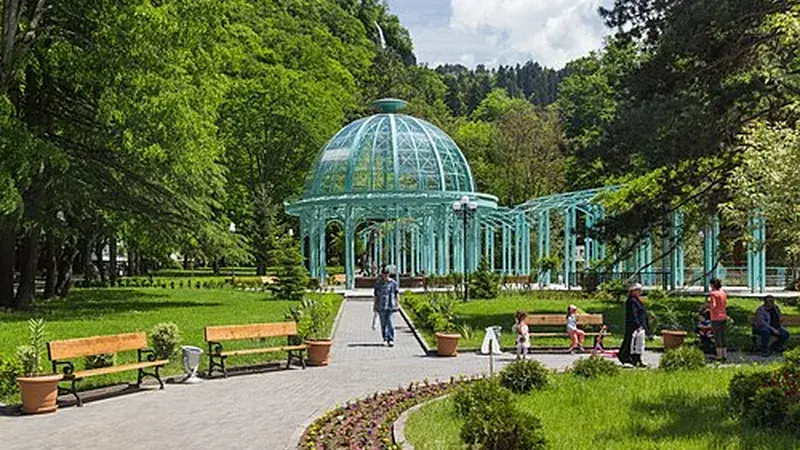
Borjomi Tour from Tbilisi — Mineral Springs, National Park & Rabati Fortress
The resort town of Borjomi sits in a deep Caucasian gorge, famous since the 19th century for its mineral water. Combine the therapeutic springs and forests of Borjomi with the medieval fortress city of Akhaltsikhe — two completely different worlds in one day.
Price
from ₾178
Duration
10–11 hours
Group
up to 7 people
Departure
08:30
Language
English
Format
Private tour
Written by Timur, private tours in Tbilisi since 2015 · 500+ tours · rating 4.9/5
Why choose this tour
Private car — departure from your hotel at 08:30, return to your hotel in the evening
Borjomi is more than mineral water: the Central Park with hot springs (₾15 entry), cable car above the gorge, and quiet streets with wooden balconies
Off-the-beaten-path stops — sulphur springs higher up the trail, away from the tourist crowds
Rabati fortress in Akhaltsikhe: a mosque, an Orthodox church and an Armenian church within one fortified complex — a unique testament to the region's multicultural past
Group up to 7 people — personal attention, flexible pace
Free cancellation 48 hours before; no payment until the day of the tour
In short: Borjomi Tour from Tbilisi — from ₾178 per person. Small group, private guide from Sakhva Travel, direct booking with no agency fees.
From 5 people a private trip isn't needed — the group rate applies per person. A 10% deposit secures the date, free cancellation up to 48 hours before.
Borjomi became famous in the 1820s when Russian officers discovered its mineral springs. By the late 19th century it was the summer residence of the Romanov dynasty, and the waters were being bottled for export across the Russian Empire. Today the iconic Borjomi mineral water is sold in over 40 countries.
The Central Park (est. 1892) covers 17 hectares of riverside forest with century-old sequoias, ponds, pavilions and walking paths from the imperial era. The famous open-air mineral spring at the end of the park lets you drink the water directly — warm (37°C), slightly fizzy, tasting of sulphur and iron. An acquired taste, but worth experiencing at the source.
Borjomi-Kharagauli National Park
One of the largest protected areas in Europe (65,000 hectares), the national park begins at the very edge of town. The cable car (₾5 return) lifts you above the gorge to walking trails through beech and fir forest at altitude. The air — clean, pine-scented — is its own kind of therapy after the city. The trail follows the river for one to two hours through pristine forest before bringing you back to the town.
Rabati Fortress — Akhaltsikhe
Forty minutes from Borjomi, the fortress city of Rabati (Akhaltsikhe) dates from the 9th century and was rebuilt by the Ottomans in the 16th–19th centuries. The complex is extraordinary: a mosque, an Armenian church, a Georgian Orthodox cathedral, a museum of local history, a caravanserai — all within one fortified enclosure. It is a living record of the three religions and cultures that have coexisted in southern Georgia for centuries. Entry ₾7.
The views from the battlements over the Mtkvari River valley and the Javakheti plateau are exceptional. Allow at least 45–60 minutes to explore properly.
Timur's insider tip
The mineral spring at the far end of Borjomi park is free — the water comes out warm, around 37°C, and smells of sulphur. The smell is unusual but it means a high mineral content. Pour it into a bottle and let it cool — it tastes much better cold. The cable car costs only ₾5 and most visitors skip it: it rises 500 metres above the town and from the top you can see the entire gorge. After Borjomi we drive to Akhaltsikhe — Rabati is open until 18:00, entry ₾7. And there is an old Armenian cemetery on the hill above the fortress from the 19th century — officers of the Russian Empire, merchants, local nobility, with inscriptions in Armenian, Russian and Georgian. The view from there over the gorge is better than from the cable car and there is nobody there at all. Tourists never find it — I discovered it by accident three years ago.
Detailed itinerary
The tour begins with an early morning departure from Tbilisi, driving west on the highway through the Likhi Range. The route takes around 2.5 hours and the landscape becomes progressively greener as you descend into the Borjomi gorge.
The first stop is the Borjomi Central Park — time among ancient sequoias, the thermal pool pavilions and the open-air mineral spring. Lunch follows in the park restaurant (average ₾20–30 per person, not included). After lunch, the cable car takes the group up to the national park plateau for a forest walk. The return drive to Tbilisi is approximately 2.5 hours, with a 40-minute stop in Akhaltsikhe for Rabati fortress on the way.
The route can be extended to include Vardzia cave monastery — a 12th-century city carved into a volcanic cliff by Queen Tamar. Ask Timur about the combined Borjomi + Vardzia tour (₾295, 12–14 hours).
08:30Departure from Tbilisi — hotel pickup. 2.5 hours west on the highway.
11:00Borjomi Central Park (est. 1892) — sequoias, ponds, imperial-era pavilions, free mineral spring tasting at 37°C
12:00Cable car to national park viewpoint (₾5 return) — forest trail along the river, 1–2 hours
13:00Lunch in Borjomi — local restaurant in or near the park (₾20–30, not included)
14:30Drive to Akhaltsikhe — 40 minutes south
15:30Rabati Fortress — mosque, Orthodox church, Armenian church, museum (entry ₾7, allow 1 hour)
17:00Departure back to Tbilisi — 2.5 hours return journey
~19:30Return to Tbilisi — drop-off at your hotel. Evening free.
Included
Private transfer from Tbilisi and back
Personal guide (English)
Borjomi Central Park visit
National park forest trail
Rabati fortress, Akhaltsikhe
Bottled water
Not included
Lunch (₾20–30 avg.)
Cable car (₾5 per person)
Rabati entry ticket (₾7)
Personal shopping and souvenirs
Want to extend the route to Vardzia cave monastery — Queen Tamar's 12th-century city carved into volcanic rock?
The tour starts from your hotel anywhere in Tbilisi — Timur picks you up in a comfortable, air-conditioned vehicle. Groups are a maximum of 7 people, and families with children are welcome. Payment is in Georgian Lari (₾) — cash or bank transfer. Booking is through WhatsApp; Timur typically replies within 10–15 minutes and sends a confirmation with all the route details.
When to book
In high season (May–October) book 3–5 days ahead. In winter and shoulder season a day's notice is usually enough. Free cancellation up to 48 hours before departure. If weather is poor the tour is postponed at no extra charge.
What to bring
Comfortable walking shoes — the park paths and Rabati cobblestones require flat soles
Layers — the gorge can be cool even in summer, especially on the cable car plateau
A small refillable bottle — useful for trying and comparing the mineral springs
Sunscreen and sunglasses for the open sections of Rabati fortress
Camera — the gorge, the cedar forest and the fortress battlements are all highly photogenic
Best time to visit
Spring (April–May) and autumn (September–October) are ideal: comfortable temperatures, vibrant colours, and fewer crowds. Summer is warm and popular. Winter brings snow to the gorge, which creates a dramatic atmosphere, but requires waterproof footwear.
Book the Borjomi Tour
Group tour from ₾178 per person, private from ₾585 · Up to 7 people · Timur answers within 1 hour
Spring (April–May) and autumn (September–October) are the most comfortable months — mild temperatures and the landscape at its most vivid. Summer is warm and popular. Winter can bring snow to the gorge, which is beautiful but requires appropriate footwear.
How long is the tour?
The full day runs 10–11 hours. We leave Tbilisi at 08:30 and return in the evening around 19:00–19:30. This gives you enough time to properly explore both Borjomi and Rabati without rushing.
Is a guided tour better than going independently?
You can reach Borjomi by marshrutka from Tbilisi, but a private tour makes a significant difference: you reach the off-tourist spots (the sulphur springs higher up the trail, the Armenian cemetery above Rabati), you have context for what you are seeing, and you don't spend time working out transport between Borjomi and Akhaltsikhe.
Is Borjomi mineral water really good for health?
Borjomi is classified as a sodium bicarbonate mineral water and has been used therapeutically since the 1820s. It is particularly associated with digestive health. The warm spring in the park flows at 37°C — you drink it directly from the tap. The bottled commercial version is the same water, just chilled and carbonated.
Can I combine Borjomi with Vardzia?
Yes — Vardzia cave monastery (12th century, carved into a volcanic cliff) is 1.5 hours south of Borjomi. Timur offers a combined Borjomi + Vardzia day tour for ₾295 (12–14 hours from Tbilisi). It is a long but very rewarding day.
What is the Rabati fortress entry fee?
Entry to the Rabati complex is ₾7 per person (paid directly on site, not included in the tour price). The fortress is open daily until 18:00. Allow 45–60 minutes to walk the full perimeter, visit the mosque, the churches and the museum.
Five stars +! Exceptional service level, clear communication and extreme willingness to go the extra mile all added up to the marvelous experience dealing with Sakhva agency.
Gideon Truter — Google, July 2026
★★★★★
Happy with the trip. I will recommend you! The best in Georgia! (translated from Russian)
Aram Gevorkyan — Google, September 2026
★★★★★
A wonderful, reliable company: detailed information, very friendly and caring staff, always in touch. We booked a three-day route from Batumi to Tbilisi with a 4-month-old baby and sightseeing; they helped with every question and drove us carefully along a route of at least 700 km. (translated from Russian)