History of the Fortress
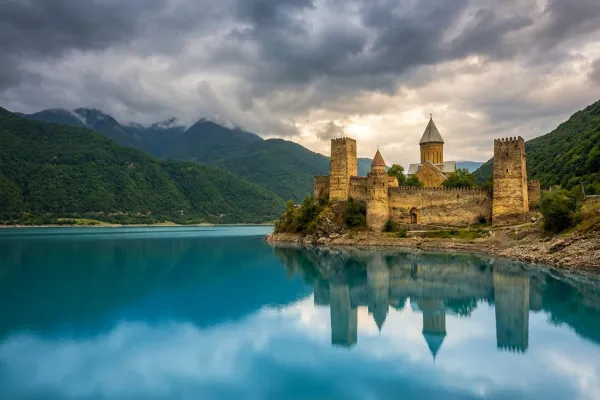
Ananuri was the residence of the Aragvi Eristavi (dukes) — a feudal dynasty that controlled the Georgian Military Highway, the main trade and military route between Georgia and Russia. The Aragvi clan used the fortress to extract tolls from caravans and defend against northern raiders for over a century.
In 1739 the fortress was captured and burned by the rival Ksani clan. The Assumption Church's exterior walls still bear scorch marks visible today. Two churches survived inside the fortress walls — the Assumption Church (XVII c.) with frescoes depicting saints and biblical scenes, and the earlier Salvation Church. The exterior stone carving on the Assumption Church — grapevines, crosses, and geometric patterns — is among the finest medieval Georgian stonework open to visitors.
The outer walls, towers, and gates are remarkably well preserved. Climbing the main watchtower, you see the turquoise reservoir below and the road disappearing into the mountains — the same route travelers walked for centuries on the way to Russia and back.
Zhinvali Reservoir
The reservoir was created in 1985 when the Aragvi River was dammed. Several medieval villages were submerged — in drought years, when water levels drop, the ruins of old buildings emerge from beneath the surface in an eerie and fascinating sight. The water's vivid turquoise color is caused by the glacial minerals carried from the Greater Caucasus mountains.
The reservoir is especially beautiful in early spring and autumn, when the mountains mirror themselves in the still water. On clear days the color shifts from emerald green near the banks to deep blue in the center. If you want a different perspective, local fishermen near the shore offer motorboat rides along the reservoir for about ₾20–30 — the view of the fortress from the water is completely different from the road view.
This tour combines well with a Kazbegi day trip — Ananuri sits directly on the road and makes an ideal stopover in either direction.
What to See Inside the Fortress
The tour of Ananuri Fortress begins from the main gate. Two defensive towers flank the entrance — the round tower on the south is the tallest and offers the best panoramic view. Inside, the courtyard leads to both churches.
The large Assumption Church is the main attraction. The exterior is covered in elaborate relief carvings — look for the grapevine frieze and the large cross carved above the main entrance. Inside, fragments of XVII century frescoes cover the walls. The colors have faded but the composition remains clear: rows of saints, scenes from the Gospels, and a large Christ Pantocrator in the apse.
The smaller Salvation Church beside it is less visited but worth entering. Its interior frescoes are better preserved in places — especially along the north wall. The stonework on the exterior of this church dates to the XVI century and predates the main church by at least a hundred years.
After visiting both churches, climb the south tower for a panoramic view. From the top you can see the full length of the reservoir, the road winding into the mountains toward Gudauri and Kazbegi, and on clear days, snow-capped Caucasian peaks in the distance.
Why Choose This Tour
Ananuri is one of the most photogenic fortresses in Georgia. Standing directly over the turquoise Zhinvali reservoir, on a clear day the water color is extraordinary. Most tourists drive past on the way to Kazbegi — we spend a full hour here, examining the XIII-century frescoes inside the church. The combination of medieval architecture and the reservoir backdrop is unique in the Caucasus.
Timur's Tip
Ananuri sits right above the Zhinvali reservoir — the combination of fortress and turquoise water creates one of the best photographs in Georgia. The best light is in the morning before noon, when the water is calm and reflects the towers. Inside the fortress there are two churches: the large Assumption Church with its stone carvings, and the smaller Salvation Church — visit both. The small one is often skipped by tour groups, but it has better-preserved frescoes from the XVII century. Entry is free, and there are rarely crowds — this is not the tourist conveyor belt that Kazbegi can be on weekends.
Ananuri works perfectly as a stop on the way to or from Kazbegi — it's 70 km from Tbilisi along the Georgian Military Highway, with a well-marked turnoff from the main road. The Zhinvali reservoir was created in 1985, flooding several medieval villages. In dry years when water levels drop, the ruins of old churches and homes emerge from beneath the surface — eerie and fascinating at the same time. Local fishermen at the shore offer motorboat rides for ₾20–30 — the view of the fortress from the water is completely different.
Practical Tips
Before heading to Ananuri, a little preparation makes the trip more comfortable. Wear comfortable shoes — the tour involves walking on uneven cobblestones inside the fortress and climbing stone stairs in the tower. The surfaces can be slippery after rain. Bring a water bottle and a light snack for the drive.
- Dress in layers: Georgia's mountain weather changes quickly. Even in summer, mornings can be cool at 600m elevation where Ananuri sits. A light jacket is recommended year-round.
- Best season: Spring (April–May) and autumn (September–October) are ideal — mild weather, vivid colors, and the reservoir at its most photogenic. Summer is also excellent but can be hot by midday.
- Sunscreen: Even on overcast days the UV index at altitude is higher than in the city. Apply protection regardless of season.
- Book ahead in season: In high season (May–October) book at least 3–5 days in advance. In winter and shoulder season, same-day booking is often possible.
- Photography: Charge your camera or phone — Ananuri and the reservoir are among the most photogenic spots in Georgia. The morning light from the east is best for the fortress exterior.
Frequently Asked Questions
How do I get to Ananuri Fortress from Tbilisi?
By car it's 1 hour on the Georgian Military Highway (approximately 70 km). Public marshrutka (minibus) toward Pasanauri stops at Ananuri — about 1.5 hours, ₾3–5. A private tour is more convenient: pickup from your hotel, flexible timing, and a guide who explains what you're seeing.
Is there a restaurant near Ananuri?
Yes. Several local restaurants line the shore of the Zhinvali reservoir, offering fresh trout caught in the reservoir, khachapuri, khinkali, and Kakhetian wine. Average meal cost: ₾20–30 per person. Lunch is not included in the tour price but we stop here during every tour. Must-try: trout grilled with herbs and walnut sauce.
Is there an entrance fee to Ananuri?
Ananuri fortress is currently free to enter. There may be a small parking fee (₾2–3) if arriving by private car. Verify on-site as fees can change seasonally.
When is the best time to visit Ananuri?
Spring (April–May) and autumn (September–October) offer the most pleasant weather and the most vivid scenery. The turquoise water of the reservoir is most striking on sunny days. Early mornings provide the best light for photography — we depart at 10:00 specifically for this reason.
Practical Information
The tour starts from your hotel in Tbilisi. I pick you up in a comfortable air-conditioned vehicle. Group size: up to 7 people, children welcome. Payment in Georgian lari (₾) — cash or bank transfer. Booking via WhatsApp — I respond within 10–15 minutes and send a confirmation with full tour details.
When to Book
In high season (May–October) I recommend booking 3–5 days in advance. In winter and shoulder season, next-day booking is usually available. Free cancellation up to 48 hours before departure. If rain or bad weather is forecast, we reschedule at no extra charge.
What's Included in the Price
Hotel pickup and return transfer, English-speaking guide service, all entrance fees on the route, bottled water. Not included: lunch (average ₾25–40 at a local restaurant), personal purchases, and souvenirs.
Book This Tour
Timur · Sakhva Travel · licensed guide No. 8247109128 · rating 4.9 · 500+ guests