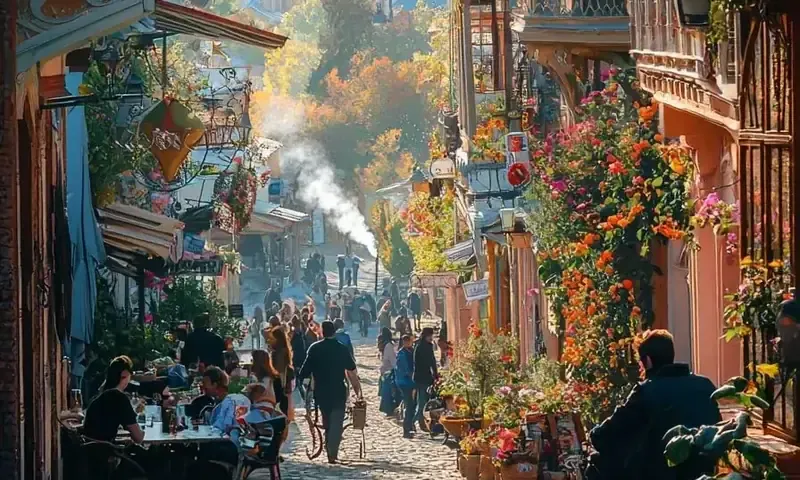
Why Old Tbilisi Is Unlike Any Other City
Tbilisi's old town (Dzveli Tbilisi) is not a museum — it's a living neighbourhood where Georgian families have lived for generations in the same carved wooden balcony houses. The streets layer 1500 years of Persian, Russian, Ottoman, and Georgian history into a dense, walkable space unlike anything in Europe or the Middle East.
The key is knowing where to look. Timur leads you off the tourist track into the courtyards, hidden springs, and neighbourhood churches that define what Tbilisi actually feels like to live in.
The History of the Quarters
Tbilisi was founded in the 5th century by King Vakhtang Gorgasali. According to legend, the king was hunting here when his falcon fell into a hot spring — the bird was healed by the thermal waters. Those warm sulphurous springs gave the city its name: "tbili" in Georgian means "warm."
The old city grew up around those springs. The Abanotubani district with its dome-shaped bathhouses, Metekhi with its 5th-century church perched on a cliff above the river, Narikala — a Persian fortress later expanded by the Arabs. Every conqueror left a trace in the architecture.
Of particular interest are the residential quarters with their carved wooden balconies. These are not stage sets for tourists — people still live here. Timur knows the histories of specific houses and families that help you understand how the city has changed over centuries.
What Makes This Tour Different
Unlike tours sold through aggregators, this route has no obligatory stops at souvenir shops and no paid promotional breaks. Only history, architecture, and the real Tbilisi.
The route adapts to your interests: for history lovers — more time at Metekhi and Narikala; for architecture enthusiasts — we go deeper into the courtyards and balcony streets. Read also: Tbilisi in One Day: a walking itinerary.
Freedom Square — Where History Happened
We begin at Freedom Square, the central plaza where Tbilisi's most dramatic historical events unfolded — from Soviet-era demonstrations to the Rose Revolution of 2003. The golden statue of St. George slaying the dragon (2006) replaced a Soviet Lenin statue — a transformation that tells the entire story of Georgia's 20th century in a single image.
Sioni Cathedral — 500 Years of Continuity
Sioni Cathedral (6th century, rebuilt multiple times) holds the Cross of St. Nino — the grapevine cross bound with the saint's own hair, which she used to perform miracles when bringing Christianity to Georgia in 337 AD. The original cross has been here since the 5th century. The dimly lit interior, with its ancient frescoes and flickering candles, is genuinely moving even for non-religious visitors.
Abanotubani — Three Faiths in 100 Metres
In the sulfur bath district of Abanotubani you will find a Sunni mosque, a Jewish synagogue, and an Armenian Orthodox church within 100 metres of each other — all active, all open to visitors. This proximity is not coincidental; it reflects centuries of deliberate coexistence that is one of Georgia's greatest cultural achievements.
The Leghvtakhevi waterfall hides in a gorge just behind the bath domes — a 25-metre cascade that most tourists walk past without realising it exists. The Abanotubani synagogue on Askharmova Street is one of the oldest active synagogues in the Caucasus, built in 1895. The Juma mosque and Armenian Norasheni church stand nearby: three religious buildings within 100 metres of each other. They are not museums — they are all functioning places of worship. On Fridays, several hundred worshippers gather at the mosque. This is the real Tbilisi — not for postcards, but for understanding.
Narikala — the Fortress Above the City
The 4th-century Persian fortress of Narikala was expanded by Arabs, Byzantines, Mongols, and Russians — its walls represent 1600 years of overlapping empires. From the upper ramparts you have a 360° panorama: the Kura river winding below, the old town rooftops, Metekhi Church on its cliff, and the Mother Georgia statue above the Vake hills. You can reach the fortress on foot via a steep path or take the cable car (₾5 each way) — both options are excellent and Timur will advise based on the group.
Metekhi & Anchiskhati — the Oldest Churches
Metekhi Church (13th century) stands on a cliff above the Kura — the site where, according to tradition, St. Nino was imprisoned before converting the king. The bronze equestrian statue of Vakhtang Gorgasali below the church is one of the iconic images of Tbilisi. Across the city, Anchiskhati Basilica (5th–6th century) is the oldest standing church in Tbilisi — a quiet, brick-vaulted space with an intimacy that the larger cathedrals cannot match.
Detailed Route and What to Look For
During the Old Tbilisi walking tour you will see a wealth of significant landmarks. Starting from Freedom Square, where the statue of St. George stands on its golden column, we move along Shardani Street — known for its antique shops, gallery courtyards, and 19th-century wrought-iron balconies. Passing through the narrow alleys, you enter the Abanotubani district, famous for its sulfur baths, where you can not only learn about the bathing tradition but also catch the scent of the mineral springs that gave Tbilisi its name.
The next landmark is Narikala fortress, from which you get a breathtaking view of the city and the Mtkvari (Kura) river. The ascent can be made by cable car, which adds a touch of adventure to the route. After visiting the fortress, we head to the beautiful Metekhi Church built on a cliff, and see the statue of King Vakhtang Gorgasali, the city's founder. Each of these stops is filled with history and atmosphere that make Old Tbilisi unique.
Don't miss the architecture of the old houses with their carved balconies and beautiful courtyards — ideal for photography. Towards the end of the tour we pass through Leselidze Street (now Kote Abkhazi Street), where you can try local dishes at one of the restaurants and enjoy live music. This route not only introduces you to the history but gives you a sense of what Tbilisi actually feels like.