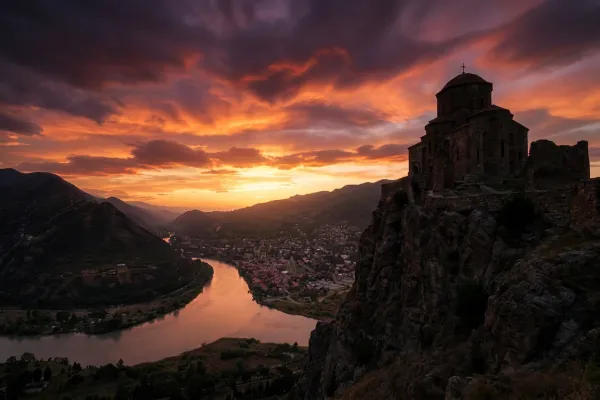
Route of the Jvari Excursion
We leave Tbilisi at 09:00. The drive to the monastery is 25 km, about 40 minutes, running along the Kura river toward Mtskheta. Our first stop is the viewing platform above the meeting of the Kura and Aragvi — the exact place Lermontov opened "Mtsyri" with: "There, where, merging, the streams of Aragvi and Kura embrace and roar like two sisters."
The final climb up to the monastery takes five minutes along a short serpentine road. Jvari sits on the summit of a hill (870 m) overlooking Mtskheta and the valley. On the grounds you'll find the 6th-century church itself, the ruins of a fortress wall, and a viewing terrace with a full 360-degree panorama.
Inside the church stands a copy of St. Nino's cross, considered one of Georgia's holiest relics (the original is kept at Sioni Cathedral in Tbilisi). Timur explains the story of Georgia's conversion to Christianity and points out the architectural details that most tourists walk straight past.
History of Jvari Monastery
Jvari (Georgian for "cross") was built between 586 and 605 on the spot where St. Nino raised a wooden cross after Georgia's conversion in 337. It is one of the first cross-domed churches in the world — its design shaped all of Georgian architecture that followed.
In 1994 the monastery was inscribed on the UNESCO World Heritage List together with the historical monuments of Mtskheta. Restoration work in the 2000s reinforced the walls and roof, but inside the church has kept its austere 6th-century look — no frescoes, just stone and light through narrow windows.
An interesting detail: the reliefs on the facade of Jvari are among the earliest examples of Georgian stone carving. The east facade shows the "Exaltation of the Cross" — angels lifting the cross, with the donors who commissioned the church standing below.
Jvari + Mtskheta in One Day
Most guests combine Jvari with a visit to Mtskheta, the ancient capital of Georgia (20 minutes from the monastery). In Mtskheta: Svetitskhoveli Cathedral (11th century, the country's main church), Samtavro Monastery, and the old town with souvenirs and churchkhela.
The "Jvari + Mtskheta" route takes 4–5 hours with lunch. Lunch in Mtskheta is at a restaurant on the bank of the Aragvi: khinkali, mtsvadi (grilled skewers), lobiani — from ₾25–30 per person. You're back in Tbilisi by 14:00, with the rest of the day free.
Practical Tips
- Dress code: Jvari is an active monastery. Women need to cover their head and shoulders, men should wear long trousers. Free wraps are available at the entrance.
- Footwear: comfortable, with non-slip soles — there are stone slabs inside and around the church.
- Photos: unlimited outside, no flash inside. The best light is in the morning before 11:00, when the sun lights up the facade.
- Weather: it's windy on the hill year-round, even in summer — bring a light jacket.
Frequently Asked Questions
Can I combine Jvari and Mtskheta?
Yes, the two sites are close together. A combined Mtskheta + Jvari tour takes 5–6 hours.
How do I get to Jvari?
By car only. There is no public transport to the monastery. Timur picks you up from your hotel.
Do I need a ticket for Jvari Monastery?
Entry to Jvari Monastery is free — it is an active 6th-century church. Please dress modestly: covered shoulders and knees; women may want a headscarf.
What can you see from the Jvari viewpoint?
Jvari stands on a hill above the confluence of the Kura and Aragvi rivers, with a panorama over ancient Mtskheta. This is the very place from Lermontov's poem "Mtsyri".
Do I need my own transport?
No, the tour includes transport from Tbilisi to Jvari and back. Your guide handles all logistics.
Can I bring children?
Yes, the tour is family-friendly. Just let us know in advance so we can accommodate everyone comfortably.
Practical Information
The tour starts from your hotel in Tbilisi. I pick you up in a comfortable air-conditioned car. Group: up to 7 people, children welcome. Payment in lari (₾) in cash or bank transfer. Booking via WhatsApp — I reply within 10–15 minutes and send a confirmation with route details.
When to Book
In high season (May–October) book 3–5 days ahead. In winter and off-season — 1 day is fine. Free cancellation 48 hours before the tour. If weather is bad, we reschedule at no extra cost.
What Is Included in the Price
Transfer from the hotel and back, English-speaking guide services, all entrance tickets on the route, bottled water. Not included: lunch (average restaurant bill ₾25–40), personal purchases and souvenirs.
Book This Tour
Timur · Sakhva Travel · licensed guide No. 8247109128 · rating 4.9 · 500+ guests