
The Georgian Military Highway is 212 km from Tbilisi to the Russian border, crossing the Jvari Pass at 2,379 m. Key stops: Zhinvali Reservoir (70 km), Ananuri Fortress (72 km), Pasanauri — birthplace of khinkali (105 km), Kazbegi (157 km). Marshrutka from Tbilisi ₾15; with a private tour from ₾175 per car. Don't forget to get travel insurance — mandatory for entering Georgia since 2026. Sort out your mobile internet before flying — a local SIM or eSIM is 10x cheaper than roaming in Georgia.
212 kilometres from Tbilisi to the Russian border. One of the most beautiful roads in the world. Most tourists ride through it in a marshrutka staring at their phones. The mountains are beautiful, sure. But the road itself is the destination — each stop has its own story. Everything waiting for you in Kazbegi at the end of the journey is covered in the Kazbegi Day Trip guide.
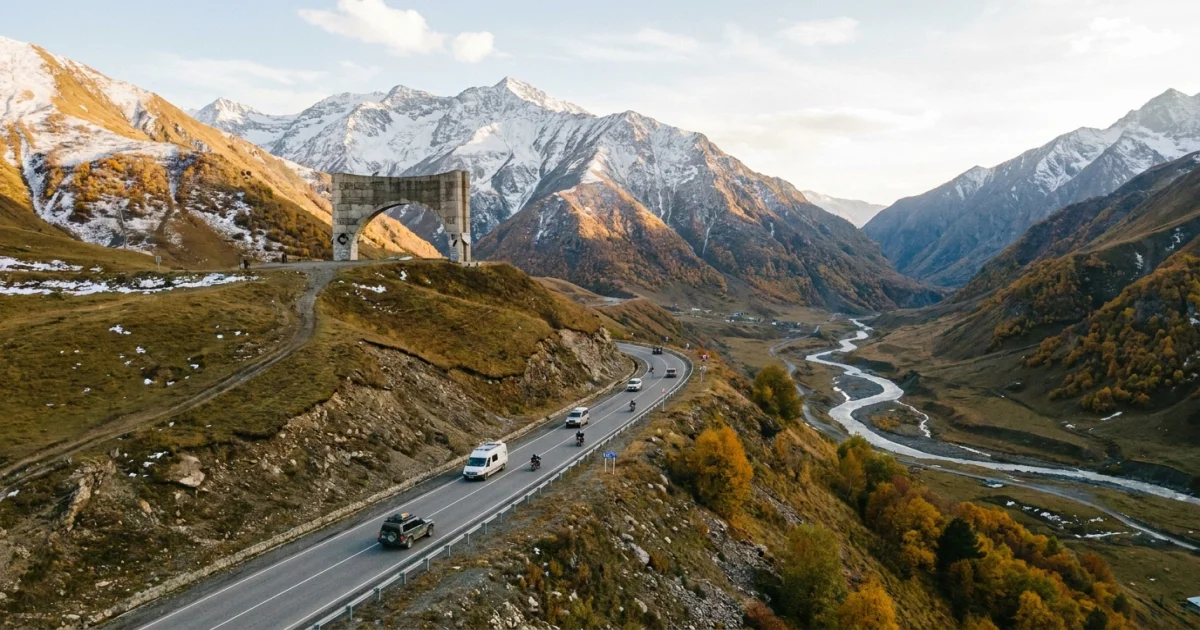
Where to stop on the Georgian Military Highway?
Seven points worth stepping out of the car for:
| Stop | km from Tbilisi | Why stop |
|---|---|---|
| Zhinvali Reservoir | 70 | Turquoise water no camera can do justice to |
| Ananuri Fortress | 72 | Medieval drama without special effects |
| Pasanauri | 105 | Birthplace of khinkali. Seriously. |
| Jvari Pass | 140 | 2,379 m. Bring a jacket. |
| Friendship of Nations Monument | 145 | Soviet mosaic + 900 m drop |
| Stepantsminda | 160 | Base for the final push |
| Gergeti Trinity Church | 166 | The reason for the whole journey |
Why stop at Zhinvali Reservoir?
The reservoir looks photoshopped: turquoise water, green mountains, silence. The catch is you can't really see it from the main road. The marshrutka drives straight past. The best viewpoint is a spot I found by missing a turn once — from there the entire reservoir is visible, and on a calm day the mountains reflect in the water like a mirror.
This is the drinking water supply for all of Tbilisi. Two million people drink this beauty from their taps.
Time: 10 minutes. Long enough to take a photo and fall completely silent.
What to see at Ananuri Fortress?
Two kilometres past the reservoir stands a 13th-century fortress. In the 18th century the Aragvi Eristavis and the Ksani Eristavis were bitter rivals. One invited the other to a feast and had him killed. The resulting war lasted fifty years. The fortress was besieged, burned, and rebuilt. Inside the church, scorch marks from the fires are still visible. On the outer walls, relief carvings of grapevines and dragons survive almost perfectly.
Climb to the watchtower. At the top, the view makes it immediately clear why anyone would build a fortress precisely here. A strategic chokepoint. Complete control of the road.
I stop at Ananuri on every single Kazbegi tour — always for 30 to 40 minutes, never less. Marshrutkas rush straight past, which is a shame: free entry to a 13th-century fortress with these views is a gift you shouldn't skip. Best time to arrive: before 10 AM, when the tour buses haven't appeared yet.
Where to eat the best khinkali on the way to Kazbegi?
A small village at the confluence of the White and Black Aragvi rivers. Two rivers — one murky, one clear — merge and for a stretch flow side by side without actually mixing.
We stop here for the khinkali. Ask any serious Georgian cook and they'll tell you: the best khinkali in the country come from Pasanauri. Because this is where they were invented. The dough is thinner — almost translucent. More meat. The broth inside is rich, aromatic, perfumed with herbs.
I stop in Pasanauri on every tour — and I have a trusted place where they roll the dough in front of you and khinkali are ready in fifteen minutes. My guests invariably compare them to the Tbilisi version afterwards and say: "Pasanauri is on another level." I recommend ordering 7 to 8 per person, minimum. After a morning in the mountains, mountain-sized appetites follow.
What is the Jvari Pass and is it worth stopping?
Tbilisi: +35°C. The pass: +10°C. Sometimes +5°C. About half of all tourists step out in shorts, snap a photo, turn blue, and climb back in. Bring a jacket.
The Jvari Pass is a continental watershed. Rivers on one side drain to the Black Sea; rivers on the other drain to the Caspian. You are standing on the divide between two drainage basins. In winter the pass closes. When it reopens after snowfall, the walls of snow on either side of the road can reach three or four metres high. If you're heading to Kazbegi for the first time, check road status at georoad.ge — the pass can be closed or fogbound depending on the season.
Should you stop at the Friendship of Nations Monument?
Built in 1983. Soviet monumentalism at its most ambitious. Designed by Zurab Tsereteli. A vast mosaic depicting Georgian and Russian historical scenes. Erected to mark the 200th anniversary of the Treaty of Georgievsk. Georgians have complicated feelings about it.
Walk to the edge of the viewing platform. Be careful — the railing is low. Below is the Devil's Valley. A canyon 900 metres deep. No photograph captures the moment when the ground simply ends beneath your feet.
Why visit Gergeti Trinity Church and how to get up there?
A 14th-century church. 2,170 metres above sea level. Below: Stepantsminda. Above: Mount Kazbek at 5,047 metres. "Weather permitting" are the key words. Kazbek doesn't reveal its summit every day.
That's precisely why I leave Tbilisi at 8:00 AM. By 11:00–12:00 we're at the church. In the morning, the odds of seeing Kazbek clearly are around 70%. After 2:00 PM they drop to about 30%. The marshrutka departs at 10:00 and arrives at 2:00 PM. Draw your own conclusions.
Getting up: by 4WD jeep — 15 to 20 minutes (₾50–80 per vehicle round-trip). On foot — 1.5 to 2 hours. A standard passenger car cannot make it. If you want to spend a second day exploring the gorge with its almost Martian landscapes, read about Truso Gorge, just 10 km from Stepantsminda.
How to travel the Georgian Military Highway?
| Option | Price | What you'll see |
|---|---|---|
| Marshrutka + Gergeti | ~₾95/person | Stepantsminda and the church. No stops along the way. |
| Taxi (for 4) + Gergeti | ~₾79/person | Whatever you ask for. No guide, no history. |
| With a guide (Sakhva Travel) | from ₾175/car | All seven stops. Departure 8:00 AM → Kazbek visible. |
"We were going to Kazbegi for the first time and didn't realise the Military Highway is a destination in itself. Timur explained that it's not just about the church at the end — it's Ananuri, Gudauri, the Jvari Pass. Every stop had its own story."
Where to eat along the Georgian Military Highway
This is a practical question that most travel guides ignore. Between Tbilisi and Kazbegi there are 157 km of mountain road, and food options are genuinely uneven. Here's what works and what doesn't.
Pasanauri — the main food stop
Don't skip it. This is where khinkali were invented, and they're the best on the route. The standard budget is ₾5–7 for a portion of five dumplings. Locals order seven or eight per person — mountain air does things to your appetite.
Stepantsminda — where to eat in Kazbegi
Four or five cafes on the central square. Prices are reasonable, quality varies. Lobio (bean stew) in a clay pot (₾5–7) is the best thing you can order. Khinkali here are larger and cheaper than in Tbilisi — ₾1.20–1.50 each.
| Stop on route | What's available | Average spend |
|---|---|---|
| Mtskheta (on the way) | Khachapuri, coffee, souvenirs | ₾8–15 |
| Pasanauri (105 km) | Khinkali — best on the route | ₾5–12 |
| Gudauri (130 km) | Ski resort cafes | ₾15–30 |
| Stepantsminda (157 km) | Full menu, lobiani, lobio | ₾10–20 |
The road in different seasons
- Spring (April–May): road open, green hillsides, fewer tourists. Excellent. The pass can be foggy
- Summer (June–August): peak season, everything open, hot in the valleys, cool at the pass. Most crowded at the church between 12:00 and 16:00
- Autumn (September–October): golden trees, thinner crowds, perfect light for photography. Best season for weather-to-traffic ratio
- Winter (November–March): Jvari Pass closes during snowfall for 3–8 hours, sometimes overnight. Check status at georoad.ge the day before your trip
What to bring on the Georgian Military Highway?
- A warm jacket — even in summer, the pass can be +5–10°C
- Comfortable shoes — if you're walking up to Gergeti Trinity Church
- Cash in GEL — cards aren't accepted everywhere in the mountains
- Sunscreen — mountain UV is deceptively strong
- An empty stomach — for the khinkali in Pasanauri