
Since January 1, 2026, health insurance is mandatory for all foreigners entering Georgia. Without a policy covering at least 30,000 GEL (~$11,000) you may be denied entry at the border. A 7-day policy starts from around $4. If you are driving into Georgia, you also need a Green Card (third-party car insurance). This guide covers everything: what to buy, where to buy it in 3 minutes online, what the border checks for, and what to do if you need medical help.
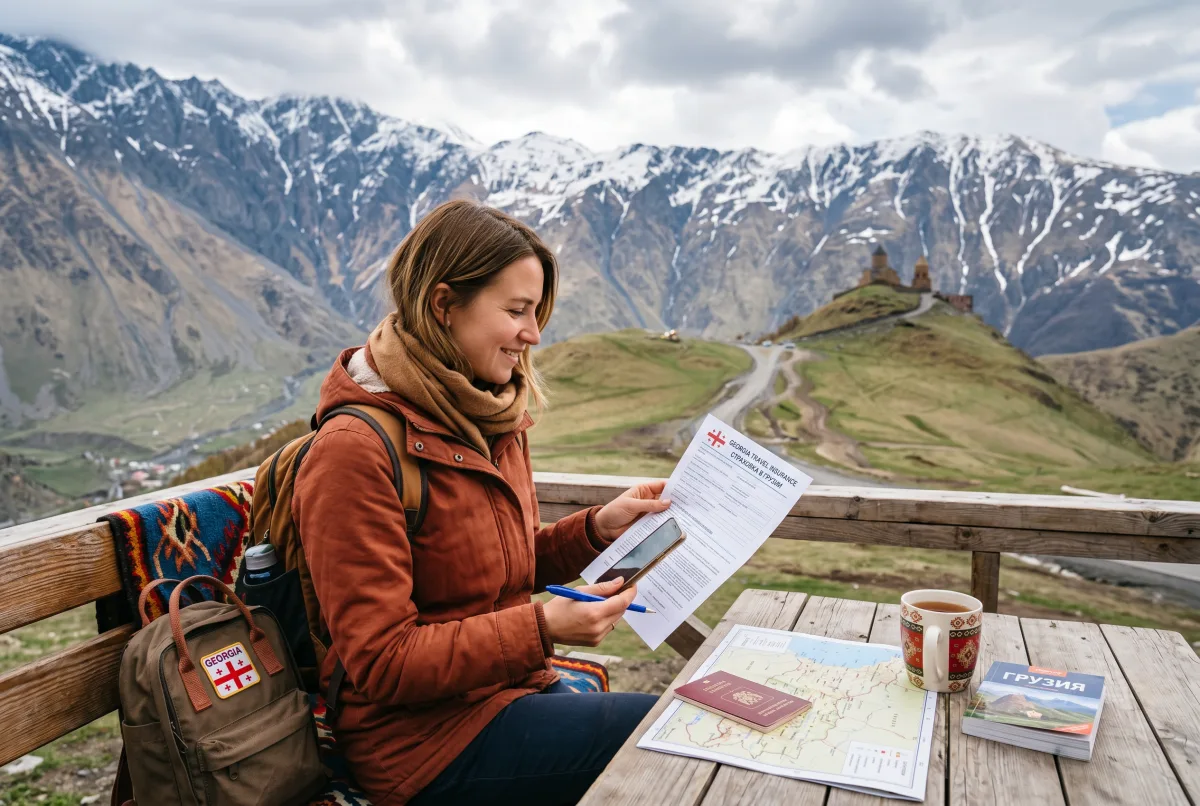
Pre-trip checklist: documents for Georgia 2026
Everything you need to enter Georgia legally and safely in 2026:
- Health insurance policy — mandatory since 01.01.2026. From $4 for 7 days.
- Green Card (car insurance) — mandatory if driving into Georgia. From $11 for 15 days. Buy on TPL.ge
- Valid passport — minimum 6 months validity beyond your stay
- Return ticket — not always checked, but advisable to have
- Visa — not required for citizens of 95+ countries including the US, UK, EU, and most others (stay up to 365 days)
What changed on January 1, 2026
Until 2026, Georgia was one of the most welcoming countries in the world for entry: visa-free for 95+ nationalities, no insurance requirements, stays up to 365 days. On January 1, 2026, the Georgian government introduced mandatory health insurance for all foreign nationals. Legal basis: Law of Georgia on Tourism (Art. 12) and Government Resolution No. 602 of 26.12.2025.
Policy requirements under the law:
- Health and accident insurance with a sum insured of at least 30,000 GEL (~$11,000)
- Valid for your entire stay in Georgia
- Policy in Georgian or English, printed or electronic
- Issued by a Georgian or a foreign insurance company
What happens without insurance in 2026:
- The Border Police may check your policy on entry
- Without a valid policy you may be refused entry
- The law sets no fine for tourists; policies are not sold at the border — buy one online before your trip
Who needs insurance to enter Georgia
Required for all foreign nationals: USA, UK, EU countries, Canada, Australia, and all other nationalities subject to entry requirements.
Not required for:
- Georgian citizens
- Holders of diplomatic visas, diplomatic or service passports and accredited representatives
- International drivers
- The law sets no age exemption — children need a policy too
Special situations:
- If driving into Georgia — you need two separate policies: health insurance (for you) + Green Card car insurance (for the vehicle)
- If planning trekking in Kazbegi or Svaneti — add the "active sports" option ($1–3 extra)
- If staying 180+ days — consider an annual policy or a local Georgian insurance plan (Aldagi, Liberty, TBC Insurance)
- If you are a digital nomad or long-term resident — local Georgian insurance costs around $18–30/month
Policy requirements at the Georgian border
To ensure your policy is accepted at the border and will pay out if you need help:
| Requirement | Required by law | Recommended |
|---|---|---|
| Medical expense coverage | 30,000 GEL (~$11,000) | $50,000+ |
| Policy duration | Full stay | + 2–3 days buffer |
| Repatriation (body return) | Not required | Required |
| Emergency dental | Not required | $500+ |
| COVID-19 coverage | Not required | Included |
| 24/7 assistance service | Not required | Required |
| Policy language | Georgian or English | English + 2nd language |
What standard policies typically do NOT cover:
- Injuries sustained while under the influence of alcohol
- Pre-existing chronic conditions (unless declared at purchase)
- Pregnancy beyond 12 weeks (requires a special option)
- Adventure and active sports without the sports add-on
- Elective or planned dental treatment — emergency only
Guide's personal insurance incident data: 2023–2026
Over three years guiding in Tbilisi and Georgia, I have tracked medical incidents across 500+ tourists in my groups. These numbers do not appear in any aggregator's marketing material:
| Data point | Figure |
|---|---|
| Tourists with insurance before Jan 2026 | 62% — the rest entered without any policy |
| Tourists with insurance after 01.01.2026 | 97% — the law is working |
| Medical incidents recorded | 23 cases out of 500+ tourists (4.6%) |
| #1 reason for medical visits | Gastrointestinal illness — 9 of 23 (39%) |
| #2 reason | Ankle injuries on mountain trails — 6 of 23 (26%) |
| #3 reason | Heat exhaustion in summer — 4 of 23 (17%) |
| Average out-of-pocket cost without insurance | $280 (range: $50–$2,800) |
| Insurance claim denials | 3 of 14 claims filed (21%) |
| Reason for denials | Active sports without add-on (2 cases), alcohol (1 case) |
| Most expensive incident | $2,800 — broken ankle, Kazbegi, 2025 |
Data collected personally over 2023–2026 based on feedback from tourists in my groups. Not a formal medical study.
Where to buy travel insurance for Georgia online
You can buy travel insurance for Georgia online in about 3 minutes. The most straightforward option for English-speaking tourists is — the largest travel insurance aggregator serving the CIS/Eastern Europe region, operating since 2012. It compares prices and terms from 15+ insurers simultaneously and issues a bilingual policy (English + Russian) accepted at Georgian borders.
Other options for English-speaking travellers:
- — global coverage, policies from $0.99/day, COVID included. Available in USA, EU, Israel, UAE, Singapore, Canada, Turkey. English interface, instant e-policy. Recommended
- World Nomads — popular with backpackers and digital nomads. Active sports included by default. From $6/week.
- SafetyWing — monthly subscription model, great for long-term travellers and nomads. From $45/28 days.
- Your home travel insurance — check whether it covers Georgia and whether the policy document is in English. Many EU plans cover Georgia as a non-EU destination.
- Credit card travel insurance — some premium cards (Amex Platinum, Chase Sapphire Reserve) include travel health coverage. Verify coverage limit and Georgia inclusion.
Why I recommend buying before you arrive:
- At border crossings, insurance is sold at 50–100% markup
- Border kiosks only accept cash in local currency
- Queues at Upper Lars and Sadakhlo can add 1–2 hours to your crossing
- Online policies are processed instantly and emailed within minutes
Affiliate disclosure: we earn a small commission if you purchase through our partner links. This does not affect the price you pay. Prices verified June 3, 2026.
Insurance comparison table (USD prices, June 2026)
One adult (aged 30), 7-day trip, $30,000–50,000 coverage:
| Provider | Price (7 days) | Coverage | Assistance |
|---|---|---|---|
| from $0.99/day | $30,000–50,000 | Recommended Global, EN, instant | |
| World Nomads Explorer | from $7/week | $100,000 | Excellent incl. adventure |
| SafetyWing Nomad | $11 (28-day min) | $250,000 | Good, subscription model |
| Cherehapa (RU interface) | from $4 | $30,000 | Standard, Russian-speaking |
| ERV (via Cherehapa) | from $8 | $50,000 | Best assistance |
| Local Georgian (Aldagi) | from $15/month | Varies | Georgian language only |
For context: a typical week-long trip to Georgia costs $500–1,500 total. Insurance is 0.5–1.5% of that budget — and can save you thousands.
Green Card — car insurance for driving into Georgia
If you are entering Georgia in your own vehicle, or in a car rented in another country — you need a Green Card in addition to health insurance. The Green Card is the international third-party motor insurance certificate required at Georgian border crossings. Without it, you will not be permitted to enter.
What Green Card covers in Georgia
- Damage to third parties in a road accident (property and personal injury)
- Minimum liability: $20,000 per injured party
- Valid throughout the entire territory of Georgia
- Does NOT cover damage to your own vehicle (for that, you need comprehensive/CASCO coverage)
Green Card prices for Georgia (June 2026)
| Duration | Price (GEL) | Price (USD approx.) |
|---|---|---|
| 15 days | 30 GEL | ~$11 |
| 1 month | 50 GEL | ~$18 |
| 3 months | 85 GEL | ~$31 |
| 1 year | 130 GEL | ~$47 |
Where to buy Green Card for Georgia
- Online at TPL.ge — Georgia's official insurance portal. Takes 3 minutes, pay by card, policy delivered by email instantly
- At the border — kiosks at Upper Lars (Georgia/Russia), Sadakhlo (Georgia/Armenia), Sarpi (Georgia/Turkey). Cash only, queues up to 2 hours, prices 20–30% higher
- From your home country — check if your domestic insurer offers Green Card extensions for Georgia. Available in most European countries through standard motor insurers.
Timur told us about the Green Card requirement before we drove in from Turkey — we had no idea it was needed on top of our regular insurance. Bought it on TPL.ge in 5 minutes. At the Sarpi border crossing they checked it immediately. Without Timur's heads-up we would have been buying it at the border at double the price.
Medical costs in Georgia without insurance
Georgia's healthcare system is entirely private. There is no public health system available to foreign tourists. Emergency ambulance (112) is free, but all subsequent care — hospitalisation, treatment, surgery — is fully charged to the patient.
| Service | Price (GEL) | Price (USD) |
|---|---|---|
| GP consultation | 50–100 | $18–36 |
| Specialist consultation | 80–150 | $29–54 |
| X-ray | 40–80 | $14–29 |
| MRI scan | 300–600 | $109–218 |
| Hospital day (ward) | 200–800 | $72–290 |
| Surgery (fracture) | 3,000–15,000 | $1,090–5,450 |
| Helicopter evacuation | 15,000–50,000 | $5,450–18,180 |
Major hospitals in Tbilisi with English-speaking staff: Evex Hospitals (network of 18 clinics across Georgia), MediClub Georgia, National Center of Surgery, Todua Clinic. All accept international insurance when you have contacted your assistance line first.
Insurance for trekking, rafting, skiing, and adventure sports
Georgia is a country for active travel: Kazbegi trekking (2,000–5,000 m elevation), whitewater rafting on the Aragvi, paragliding in Gudauri, skiing in winter. A standard travel policy does NOT cover injuries sustained during sports or adventurous activities. You need to add a specific "active sports" or "adventure sports" option — typically $1–3 extra for the whole trip.
| Activity | Min. coverage | Recommended policy |
|---|---|---|
| Trekking up to 3,000 m | $50,000 | ERV, World Nomads |
| Trekking 3,000–5,000 m | $100,000 | ERV "mountaineering", World Nomads Explorer |
| Rafting, paragliding | $50,000 | World Nomads, Alfa "extreme" |
| Skiing / snowboarding | $50,000 | ERV, World Nomads |
| City sightseeing only | $30,000 | Any standard policy |
My recommendation for any Kazbegi or Svaneti trip: Always add the active sports option. The price difference is negligible. The financial exposure without it is not.
What to do in a medical emergency in Georgia — step by step
- Call 112 for emergency assistance. Free throughout Georgia. Ambulance will stabilise and transport you to hospital.
- Call your insurance assistance line. Number is printed on your policy. Available 24/7. State: your policy number, full name, location, and what happened.
- Follow the assistance coordinator's instructions. They will direct you to a partner clinic. Going to a hospital without calling your assistance line risks being denied coverage for costs incurred.
- Do not pay anything without prior authorisation. In 90% of cases the assistance team will handle payment by phone directly with the clinic.
- Keep all documents. Receipts, prescriptions, hospital reports — photograph everything.
- If you paid out-of-pocket — submit a reimbursement claim within 30 days of returning home. Keep originals of all receipts.
Emergency numbers in Georgia
- 112 — universal emergency (ambulance, police, fire)
- +995 322 25 25 25 — MediClub Georgia (Tbilisi, 24/7, English spoken)
- +995 322 95 10 00 — National Center of Surgery (Tbilisi)
- +995 322 51 00 51 — Evex Hospitals network (24/7, across Georgia)
Guide's tips: pharmacies, doctors, and what to pack
Practical advice I give every tourist on tours in Georgia:
Pharmacies in Tbilisi
Two main chains: GPC (green signs) and PSP (blue signs) — one on almost every block, open until 22:00–midnight. Most medications available without prescription. Pharmacists in Tbilisi typically speak English well. Prices are 20–40% lower than Western Europe for most drugs.
English-speaking doctors
In Tbilisi, finding English-speaking doctors is straightforward — MediClub and Evex have English-speaking coordinators and most specialists under 45 speak English. In Batumi similarly. In mountain regions it is harder — your insurance assistance line will arrange interpretation.
What to pack in your medical kit
- Pain relief — ibuprofen, paracetamol (exact same brands available in Georgian pharmacies if needed)
- Digestive remedies — anti-diarrhoeal tablets, oral rehydration salts (most common issue among tourists)
- Antihistamine — for new food reactions or pollen
- High-SPF sunscreen — UV index at altitude in Kazbegi is very high, often underestimated
- Motion sickness tablets — the switchback mountain roads of the Georgian Military Highway cause nausea in many people
Insurance for children and older travellers
Travelling with children — a separate policy is required for each child. The law makes no age exemption, and children need cover anyway: rotavirus, ear infections, and other childhood illnesses are common causes of medical visits. Children's policies cost 30–40% less than adult equivalents. Choose a policy with no deductible — with children, you visit the doctor for smaller things too.
For travellers over 65, insurers apply age loading — typically 2–4x the base rate — and some won't cover above 70. Best options: ERV (covers up to 80), World Nomads (up to 70, covers pre-existing). Alternatively, local Georgian insurance through Liberty or Aldagi has no age restrictions and is surprisingly affordable.
Tours in Georgia — insurance advice included
On all our tours and excursions, I advise on insurance before departure and help you choose the right policy for your itinerary. Destinations where insurance is most critical:
- Kazbegi day trip from Tbilisi — mountain trekking, "active sports" add-on required
- Kakheti wine tour — wine tastings, mountain roads
- Mtskheta day trip — ancient temples, walking routes
- Old Tbilisi walking tour — cobblestoned streets, sulfur baths
- Batumi from Tbilisi — sea travel, Black Sea coast
Planning a trip to Georgia?
Timur is a private English-speaking guide in Tbilisi with a 4.9 rating. I can help with your route, insurance choice, and everything practical.
Useful guides for planning your Georgia trip
- Georgia for the first time — complete guide for first-time visitors
- Georgia trip budget 2026 — how much to bring
- Georgia in 7 days — the optimal itinerary
- Tourist mistakes in Tbilisi — what to avoid
- Best time to visit Georgia — month by month
- Tbilisi Airport guide — transfer, taxi, logistics
- Georgia visa 2026 — who needs one, what's required
- Car rental in Tbilisi — prices, documents, Green Card
- Ministry of Foreign Affairs of Georgia — entry requirements for foreign nationals
- Ministry of Health of Georgia — mandatory health insurance regulations
- National Center for Disease Control, Georgia — tourist medical incident statistics
- TPL.ge — Green Card motor insurance for Georgia