
I have been guiding in Georgia since 2023 — over 500 tours across 40+ destinations. This is not a list of the places that appear on Google's first page. It is 50 places I take people to because I know what leaves a lasting impression, and what is a tourist checkbox that wastes half a day. Entry rule since 2026: every visitor needs health cover — see our Georgia travel insurance guide.
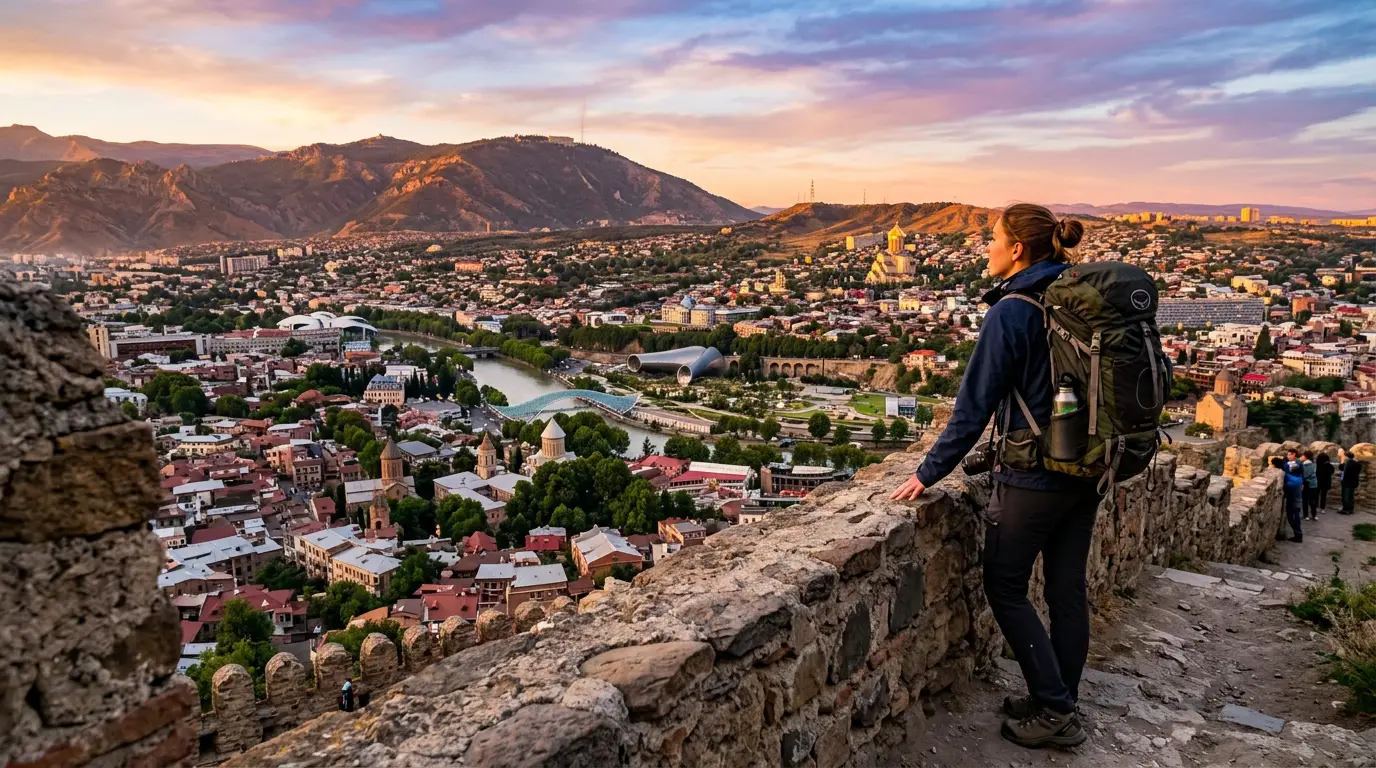
Tbilisi: 10 places you cannot miss
Tbilisi rewards slowing down. The city is not large enough to feel overwhelming, but it has layers — Ottoman, Persian, Russian, Soviet, and post-Soviet — that you only start reading after the second or third day. Plan two full days minimum. With a guide, you can cover the essential ten in one long day.
1. Abanotubani — the sulphur bath district
The domed bathhouses of Abanotubani have been here since the 5th century, which is when Tbilisi was founded — according to legend, by King Vakhtang Gorgasali whose falcon fell into a hot spring. The water comes out of the ground at 37–42°C, smells faintly of sulphur, and is genuinely therapeutic. Private bathing rooms cost 5–10 GEL per hour for the basic option. Go to Chreli-Abano for the historic experience or Orbeliani (the one with the Moorish facade) for the visual.
2. Narikala — the fortress above the city
The fortress dates to the 4th century and was expanded by the Persians, Arabs, Mongols, and Ottomans over the following 1,400 years. Most of it is ruins now — which is why it looks so good. Take the cable car from Rike Park (3 GEL each way) and walk down through the Metekhi neighbourhood rather than going back the same way.
3. Sololaki — hidden courtyards
The old residential quarter below Narikala. Georgian architecture is famous for its carved wooden balconies (each one hand-made, no two alike) and the interior courtyard culture. In Sololaki many of these courtyards are still accessible — push open the wooden gate, walk in, and you find laundry lines, potted plants, cats, and sometimes a grandmother who has lived there for 50 years. This is the part of Tbilisi that does not photograph well but feels like the real thing.
4. Peace Bridge
The glass and steel pedestrian bridge over the Mtkvari River, built in 2010, is a useful landmark and pleasant at night when it illuminates blue. Not a historical site, but good for orientation and photographs of the old town from the water.
5. Mtatsminda Park and cable car
The funicular up to Mtatsminda runs every 15 minutes (4 GEL each way). At the top: a Soviet-era amusement park with a Ferris wheel (functional), a television tower, and views of the entire city and the mountains beyond. Best at sunset. The restaurant at the top is overpriced, but the view from its terrace is free if you walk up to the observation deck.
6. Fabrika
A Soviet-era textile factory converted into a creative hub with a hostel, coffee shops, vintage stores, studios, and outdoor seating. Not a tourist attraction in the traditional sense, but a good place to understand what Tbilisi in its 30s looks like in 2026. Arrive in the evening when it is full.
7. Botanical Garden
The garden sits in the gorge directly below Narikala — 128 hectares of forest, a waterfall, and old stone paths. Entry is 2 GEL. It is one of the coolest places in the city on a hot summer afternoon, and almost nobody goes there.
8. Dry Bridge Market
Every weekend, Tbilisi's antique and flea market takes over the area around the Dry Bridge. Soviet-era badges, old Georgian jewellery, vintage cameras, lace, icons, and general junk. The icons are not for sale (customs law), but the Soviet era items are. Worth two hours and the price of a cup of coffee.
9. Deserter's Market (Dezerteris Bazroba)
The real Tbilisi market, not a tourist attraction. Suluguni and imeruli cheese, spices, homemade wine, churchkhela, matzoni. Morning (7–10am) has the best selection and lowest prices. Buy Svan salt and adjika here — the best souvenirs in the city at 5–8 GEL.
10. Rustaveli Avenue and the National Museum
The main boulevard with theatres, galleries, and cinemas. The Georgian National Museum contains the Colchian Treasure Hall (5,000-year-old gold objects) and the Soviet Occupation Hall — the most honest account of the Soviet period you will find in any post-Soviet museum. Entry: 15 GEL. Worth every lari.
Private Tour of Old Tbilisi
Timur takes you through hidden courtyards, tells the history of each district, and stops for khinkali at a local canteen. From ₾98 per person.
Kakheti: 8 places — wine, history, vineyards
Kakheti is the cradle of Georgian winemaking — 60% of all Georgian wine comes from here, the first qvevri were buried 8,000 years ago, and in autumn the vineyards turn gold and copper. From Tbilisi: 1.5 hours by car.
11. Sighnaghi — the city of love
A small hilltop town with fortress walls and views over the Alazani Valley. Famous for two things: pink houses with wooden balconies, and a registry office that operates 24 hours a day (you can get married at 3am). Population: 2,000 people. Atmosphere: Tuscany.
12. Bodbe Monastery
9th–11th century monastery where Saint Nino — the woman who converted Georgia to Christianity in 337 AD — is buried. A cypress avenue leads to a spring whose waters are considered miraculous by locals. Spectacular views over the valley. 15 minutes on foot from Sighnaghi.
13. Alaverdi Cathedral
An enormous 11th-century cathedral — one of the tallest medieval churches in the world at 50 metres. The monks produce wine on the grounds using a method unchanged for a thousand years. During the Alaverdoba festival (September–October), all of Kakheti gathers here.
14. Gremi Fortress
The 16th-century capital of the Kakhetian Kingdom — a tower with frescoes and panoramic views over the valley. Almost no tourists, unlike Sighnaghi, which creates a completely different atmosphere. The viewpoint nearby is one of the best in Kakheti.
15. Tsinandali Estate
The estate of poet and aristocrat Alexander Chavchavadze — one of the first European-style gardens in the Caucasus (19th century) and the first private winery in Georgia. Tastings from cellars containing 16,000 bottles, the oldest dating to 1814.
16. Family marani (wine cellars)
The main Kakheti experience is not a restaurant tasting — it is a visit to a family marani. The owner unearths a qvevri, pours amber tkinuli or Alazani wine, and tells you about his grandfather. Tasting cost: 10–20 GEL including several dishes. I arrange these visits as part of the Kakheti tour.
17. David Gareja Monastery
A 6th-century cave monastery complex on the Azerbaijan border — 80 km of caves carved into pink tuff. Frescoes from the 12th–13th centuries. Semi-desert landscape unlike anything else in Georgia. The last 20 km of road is unpaved — a 4WD is needed.
18. Vardzia
A 12th-century cave city in southern Georgia — 600 rooms carved into the cliff face, tunnels, and frescoes from the reign of Queen Tamar. One of the most impressive monuments in the country, but far away (260 km from Tbilisi). Worth combining with Borjomi and Akhaltsikhe on a two-day trip.
Kazbegi: 6 places on the Georgian Military Highway
The Georgian Military Highway — 212 km from Tbilisi to the Russian border — is one of the most beautiful mountain routes in the world. Kazbegi (officially Stepantsminda) at the end of the road has become a major destination: people arrive and do not want to leave.
19. Gergeti Trinity Church (Tsminda Sameba)
A 14th-century church on a rock at 2,170 metres — the symbol of Georgia. The view from the road below is already impressive; the drive up (20 minutes) or hike (1.5 hours, 500m elevation gain) opens the view to the Kazbek glacier. Entry is free, but cover your shoulders and knees. Bring a warm layer — even in summer it is cold at the church.
20. Mount Kazbek (5,047m)
Kazbek is an extinct stratovolcano and one of the highest peaks in the Caucasus. The trek to the Betlemi Meteorological Station (3,650m) takes two days and requires no special equipment — thousands of tourists do it every summer. The summit ascent is a Grade 2A mountaineering route.
21. Ananuri — fortress on the Zhinvali Reservoir
16th–17th century. Two towers, two churches, and a turquoise reservoir as a backdrop. Just 45 minutes from Tbilisi. One of the best stopping points en route to Kazbegi — 20–30 minutes of walking and excellent photographs.
22. Cross Pass (2,379m)
The highest point on the Georgian Military Highway. There is always snow somewhere nearby at any time of year. A viewing platform looks across the Greater Caucasus mountain range. In winter the pass sometimes closes due to snowfall — check conditions the day before.
23. Friendship of Peoples Arch (Gudauri)
A Soviet mosaic from 1983 on a mountain ledge above the Gudauri ski resort, commemorating the Georgian-Russian Treaty of 1783. Soviet-era grandeur against a backdrop of wild mountains. The view from there is one of the best on the entire route.
24. Truso Valley
A hidden valley 10 km from Stepantsminda with mineral springs, ruined ancient towers, and landscapes that resemble Iceland. Almost no tourists. The road is unpaved — 4WD required.
Mtskheta: 4 places in Georgia's ancient capital
Mtskheta was Georgia's first capital (5th century BC to 5th century AD) and sits 20 minutes from Tbilisi. UNESCO has listed it as a World Heritage Site. King Mirian and all of Georgia were baptised here in 337 AD.
25. Svetitskhoveli Cathedral
The 11th-century cathedral — the main church of Georgia. According to tradition, Christ's robe is buried here. Frescoes from the 13th–17th centuries, a complete church-within-a-church structure, and the tombs of Georgian kings. Entry: 5 GEL.
26. Jvari Monastery
6th century, on the mountain above the confluence of the Aragvi and Mtkvari rivers. Lermontov described this view in his poem "Mtsyri" — and it has not changed in 200 years. The church is small but monumental. A taxi from Mtskheta takes 10 minutes (10–15 GEL return).
27. Samtavro Monastery
11th century, a working convent in the centre of Mtskheta. The first Christian monarchs of Georgia — Mirian and Nana — are buried here. The nuns hold services in traditional Georgian polyphonic chant. If you arrive during a service, it is one of the most acoustically powerful experiences in Georgia.
28. The confluence of the Aragvi and Mtkvari rivers
A viewing platform by the water where two rivers meet — the Aragvi (blue, mountain water) and the Mtkvari (brown, lowland water). The boundary between the two streams is visible to the naked eye. Local vendors often sell homemade wine here.
Western Georgia: 8 places — Kutaisi, Batumi, Borjomi
Western Georgia is a different country altogether. Subtropical climate, a different accent, different food (more maize and dairy), and the Black Sea coast. From Tbilisi: 4–5 hours by car or 2.5 hours by train to Kutaisi.
29. Gelati Monastery (Kutaisi)
12th century, founded by King David the Builder during Georgia's golden age. UNESCO World Heritage. Frescoes from the 11th–12th centuries — the finest in the country. David IV is buried here. Kutaisi is Georgia's second city, 3 hours from Tbilisi.
30. Prometheus Cave
One of the largest caves in Europe, 20 minutes from Kutaisi. 11 chambers, an underground lake, and stalactites lit in multiple colours. You can take a boat along the underground river. Entry: 33 GEL, boat: 20 GEL extra.
31. Okros Chardakhi — the golden balcony
A viewpoint above Kutaisi with views of the mountains and Gelati on the horizon. Fiery sunsets over Imereti. Known to locals, unknown to tourists.
32. Batumi
The Black Sea resort and architectural experiment of the 2010s — skyscrapers, an alphabet tower, a seaside promenade with an Ali and Nino sculpture, casinos, and palm trees. Batumi divides opinion: some love it, others find it tasteless. Pebbly beaches. The sea is warm from June to October. From Tbilisi: 5–6 hours — better to fly or take the overnight train.
33. Adjarian mountains
Behind Batumi begin the Adjarian highlands — beech forests, pastures at 2,000m, villages with wooden houses. Khuloghorji, Gonio, the Machakhela canyon — few tourists, clean air, and Georgian hospitality unchanged by mass tourism.
34. Borjomi
A 19th-century spa town in a river gorge, famous for its mineral water. Borjomi-Kharagauli National Park (one of the largest in Europe), thermal springs open for free bathing at 48°C, and grandiose Soviet-era sanatoriums. From Tbilisi: 2.5 hours.
35. Vardzia (Southern Georgia)
A 12th-century cave city — 600 rooms carved into the cliff, tunnels, and frescoes from the era of Queen Tamar. A monk still lives in one of the caves. Nearby: Rabati Castle in Akhaltsikhe, a Georgian-Turkish cultural mosaic. Best as a 2-day route combined with Borjomi.
36. Ubisi Monastery
9th–14th century, on the road between Tbilisi and Kutaisi. Unique 14th-century frescoes with astronomical motifs, painted by the monk-astronomer Damiane. Almost no tourists, though the monument rivals Gelati in historical significance.
Svaneti: 4 places for those who want more
Svaneti is the highest permanently inhabited region in Europe (villages at 1,500–2,000m). Medieval towers from the 11th–13th centuries, a dialect that other Georgians cannot understand, and trails to glaciers. Plan a minimum of 3–4 days. From Tbilisi: 6–8 hours by minibus or 1 hour by plane (Tbilisi–Mestia flight).
37. Mestia
The main town in Svaneti — 3,000 residents, 30+ towers, a Svaneti Museum with gold icons from the 11th–13th centuries. Starting point for all treks. Good tourist infrastructure (guesthouses, restaurants, equipment rental). Summer temperatures around +18°C when Tbilisi hits +36°C.
38. Ushguli
The highest permanently inhabited village in Europe (2,200m) — four hamlets, 70 towers, and the Shkhara glacier 4 km away. UNESCO listed. The road from Mestia takes 45–60 minutes by 4WD in summer. In winter, Ushguli is cut off from the world for several months.
39. Chalaadi Glacier
An easily accessible glacier 7 km from Mestia — a 3–4 hour return hike requiring no special equipment. The final view of the ice tongue descending from the mountain is one of the most spectacular in Georgia. The trail is well marked.
40. Svan towers
175 towers from the 10th–13th centuries are scattered across Svaneti. They were built for protection against enemies and blood feuds (a custom that persisted until the 20th century). Height: 20–25 metres, built without cement, using lime and eggs. Many are open to visitors for a small fee.
Routes for 3, 5 and 7 days
| Day | 3 days (minimum) | 5 days (recommended) | 7 days (ideal) |
|---|---|---|---|
| 1 | Tbilisi: Old Town | Tbilisi: Old Town | Tbilisi: Old Town |
| 2 | Kazbegi | Tbilisi: Sololaki, Fabrika | Tbilisi: deeper exploration |
| 3 | Mtskheta (half-day) + fly home | Kazbegi | Kazbegi |
| 4 | — | Mtskheta + rest | Rest / sulphur baths |
| 5 | — | Kakheti | Kakheti |
| 6 | — | — | Mtskheta |
| 7 | — | — | Farewell day |
When to visit Georgia
Georgia is rewarding at any time of year, but each season offers a different experience.
| Season | Tbilisi | Mountains (Kazbegi) | Kakheti | Batumi |
|---|---|---|---|---|
| Spring (Apr–May) | +18–24°C, flowers | +8–14°C, snow melting | Green hills | +16–20°C |
| Summer (Jun–Aug) | +30–38°C, very hot | +12–18°C, ideal | +30–35°C, dry | +25–30°C, beach |
| Autumn (Sep–Oct) | +18–26°C, best | +8–14°C, autumn colours | Grape harvest! | +20–26°C |
| Winter (Nov–Mar) | +2–8°C, few tourists | Skiing at Gudauri | Quiet, low prices | +8–12°C, empty |
Winter in Tbilisi is underrated. Three to four times fewer tourists, cheaper hotels, restaurants not overcrowded. The Gudauri ski resort is two hours away — one of the best in the Caucasus with runs at 2,000–3,307m. And in January Tbilisi sometimes has days of +12°C and full sun.