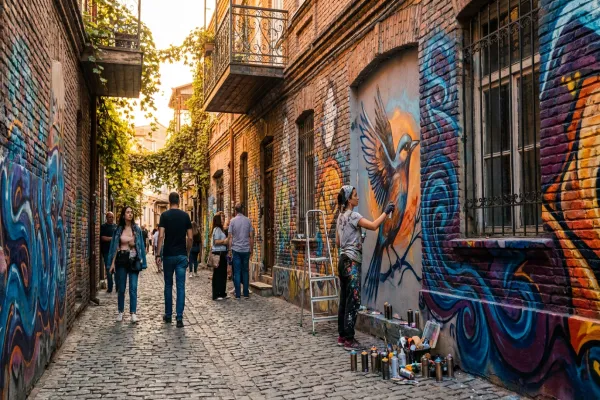
Tbilisi has one of the most vibrant and underrated street art scenes in Europe. Murals on building facades, galleries hidden in basements, studios inside former Soviet factories — this is all part of the city's living cultural landscape. This tour takes you through it all, layer by layer, over four hours on foot.
Who This Tour Is For
This tour is for people who have already seen Narikala fortress and want to discover a different Tbilisi — creative, informal, alive. If you're curious about contemporary art, street culture, or the stories behind the city's walls, this is the right tour.
Route: Fabrika → Chughureti → Sololaki
Detailed Route: Tbilisi Art Tour
Tbilisi is one of the great post-Soviet art cities. Classical galleries from the Soviet era, independent contemporary spaces, world-class street art, and working artist studios that open their doors to small groups — all within walking distance of each other. In 3–4 hours we move through several layers of this world.
11:00 — Fabrika: post-industrial creative hub
We start at Fabrika on Agmashenebeli Avenue — a Soviet-era textile factory transformed into an art cluster. Today it houses galleries, studios, conceptual cafes, the Idiot bookshop, and designer showrooms. On Saturdays there's a flea market with Georgian Soviet-era artifacts: badges ₾1–5, old postcards ₾2–3, Soviet porcelain ₾15–50. I'll introduce you to resident artists — some of them work right here in the courtyard.
12:00 — Street Art: Markarashvili and Eliava Streets
Tbilisi's street art scene has a particular character. Since 2012, artists from 20+ countries have worked here: from Berlin, New York, and across the local scene. The largest murals are on Markarashvili and Eliava Streets. I'll show you works by Nika, Tika Kvaratskhelia, and international guests. More than just pointing at walls — I explain the context: what each image means, who commissioned it, what happened to the artist. This is a conversation about art, not a walk between Instagram spots.
13:00 — Georgian National Gallery
The National Gallery on Rustaveli Avenue holds Soviet avant-garde from the 1920s–50s, Georgian primitive painters, and a collection of Pirosmani originals — 12 works in the permanent collection. Admission: ₾15 adult, ₾5 student. I'll show you how to tell an original Pirosmani from a copy, and explain why his work commands the prices it does on the international art market. We spend 45–60 minutes here.
14:00 — Artist Studios
I have several artist contacts whose studios are open for small groups. This isn't a commercial gallery visit — it's a genuine conversation about what it means to work as an artist in Tbilisi today. They show unfinished work, explain technique, and sometimes sell directly — without gallery markup. Small works start from ₾50–150. I arrange the studio visit in advance when you book.
Included
- Private English-speaking guide (Timur)
- Fabrika creative hub
- Chugureti and Marjanishvili street art walk
- Georgian National Gallery (Pirosmani originals)
- Artist studio visit
- Coffee at Fabrika
- Photos at the best street art locations
Not Included
- Gallery entrance tickets (₾15 adult)
- Food and drinks beyond coffee
- Art purchases
- Transfer (this is a walking tour)
Why Choose This Tour
- This is not a standard sightseeing tour. We walk through Sololaki courtyards, look at street art on abandoned building walls, and step inside working artist studios.
- The route changes slightly each time — I follow new murals and installations as they appear across the city.
- Maximum 7 people — small enough to enter narrow courtyards and have real conversations with artists.
- I explain context: who made it, why, what it means in Georgian culture. You leave knowing things, not just having seen things.
- Studio visits are arranged in advance — these aren't random drops-in, but genuine connections with working artists.
Timur's Tip
The best time for an art tour is morning, when the light falls directly onto the Sololaki facades. After midday, many courtyards fall into shadow and the murals lose their three-dimensional quality. Bring a camera — some works disappear within a few weeks as new pieces go up over them.
Practical Tips
- Buying art: if you plan to purchase anything, bring cash — most artists and independent galleries don't accept cards. Prints start from ₾50, paintings from several hundred lari.
- Photography in galleries: state museums allow photography without flash. Private galleries — ask individually.
- Fabrika flea market: Saturdays only, 11:00–18:00. If your tour falls on another day, I'll show you similar spots nearby.
- Weather: check the forecast before you go — Tbilisi weather can shift quickly. The tour runs rain or shine, but comfortable shoes matter.
- Note-taking: bring a phone or small notebook — you'll want to remember artist names and gallery details for later research.
What to Bring
- Cash ₾100–200 — for possible purchases in galleries and at the market
- Small bag or backpack — if you plan to buy something bulky
- Camera or phone — for street art documentation
- Comfortable walking shoes — we cover about 3–4 km on foot
Frequently Asked Questions
Is physical preparation needed for the art tour?
The art tour suits people of all fitness levels. The walk covers about 3–4 km on mostly flat streets. Comfortable shoes and curiosity are the main requirements — no special preparation needed.
Is the art tour suitable for children?
Yes, the tour works well for families with children. Street art is universally engaging, and the Fabrika hub has great food options. Pirosmani's primitive paintings are especially accessible for younger visitors. Note that some narrow courtyards may be difficult for strollers — older children are ideal.
Can I book a private art tour?
Yes — all tours with Timur are private by default. No strangers added. Just your group, up to 7 people. Contact Timur in advance and he'll adapt the route to your specific interests.
What should I bring on the art tour?
Comfortable walking shoes, a camera or smartphone, and cash in GEL (₾100–200) if you plan to buy artwork. In summer, bring a bottle of water and wear light clothing — you'll spend most of the time outdoors.
When is the best time for the art tour?
Morning is ideal — morning light hits the Sololaki and Chugureti facades at the best angle, and the shadows bring out the depth and texture of the murals. After midday, many courtyards fall into shade and the colors lose their impact. We depart at 10:00 for exactly this reason.