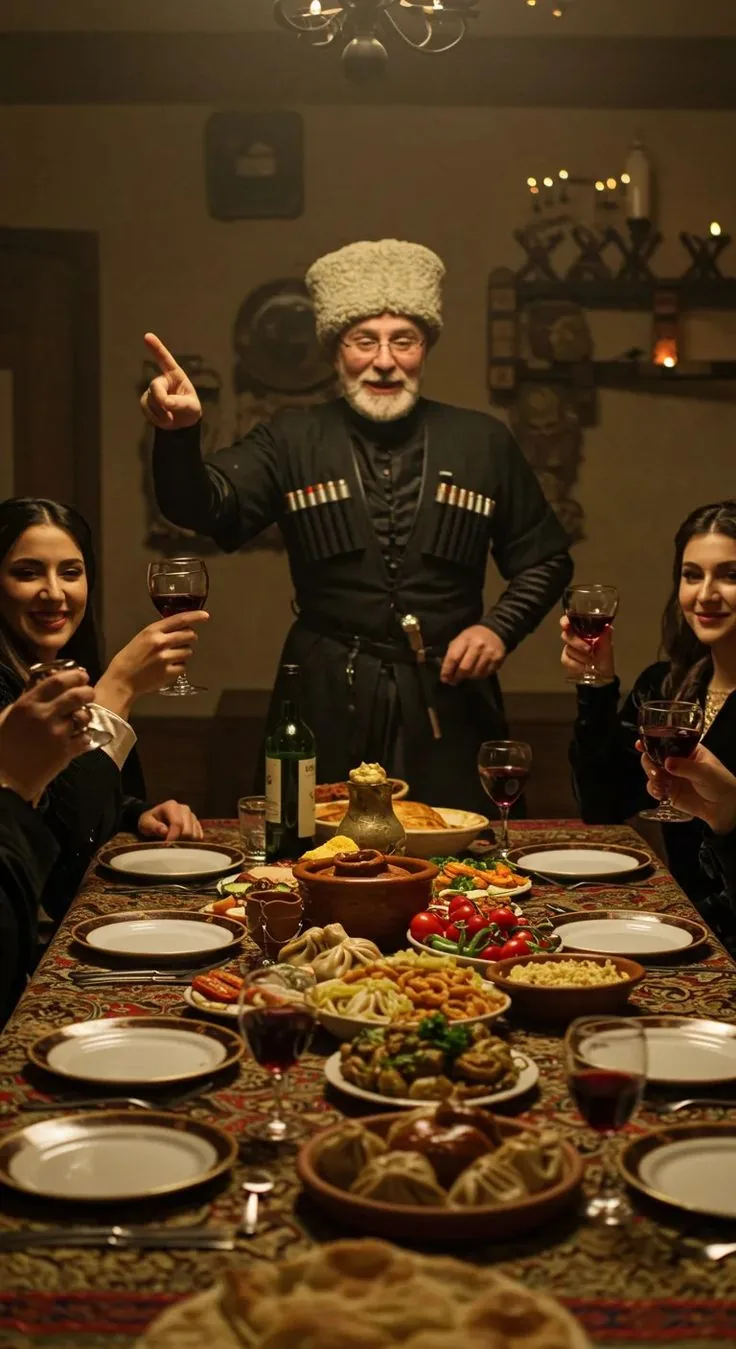
Georgian cuisine is one of the reasons tourists keep coming back to Tbilisi. A 4000-year culinary tradition shaped by the Silk Road, Persian influence, and extraordinary regional diversity — khachapuri with egg, khinkali with hot broth, tkemali and churchkhela — each dish carries a history and a tradition behind it.
In short: Tbilisi Food Tour 2026 — 4 hours, from ₾165 per person, up to 7 people, departure 11:00. Private guide from Sakhva Travel, direct booking with no agency fees.
What You Will Taste
The gastro tour starts at Dezertirka Market — Tbilisi's largest wholesale food market. Here Timur shows you how to choose Georgian spices and how to tell a proper home-made wine from an industrial one. The first dish: Imeretian khachapuri at a bakery where the dough has been rolled by hand for 40 years.
The next stop is pkhali and lobiani at a traditional dukhan. Pkhali — a cold appetizer made from spinach or beetroot with ground walnuts — is a dish that rarely appears on tourist restaurant menus, but is found easily in neighbourhood cafes favoured by locals.
We eat khinkali standing up, the way Tbilisi residents do. Timur explains the technique: how to hold the dumpling without spilling the broth, and why the knot is never eaten. The tour ends with a tasting of natural wine — amber and red — in a cellar wine bar in the Old Town.
Why This Tour Is Special
Every place we visit is non-touristy. These are spots where Tbilisi residents eat themselves — no laminated photo menus, no background music arranged for visitors.
The tour is suitable for any level of culinary interest, from the casually curious to a genuine food lover. Timur explains the history of each dish and answers questions about Georgian culinary culture. Further reading: Georgian cuisine — the dishes you must try.
Why Guests Choose This Gastro Tour
In 4 hours you taste 12+ dishes at 5 stops that no guidebook mentions. Not tourist restaurants — places where locals actually eat: the khinkali house near Dezertirka market (₾1 per khinkali), a bakery where shotis puri comes straight out of the tone oven, a home churchkhela maker. I explain the difference between Imeretian and Adjarian khachapuri, show you how to eat khinkali correctly (hold the knot!), and take you for a tasting of chacha and Saperavi wine.
Timur's Tip
Skip breakfast on the day of the tour — the first stop at Dezertirka Market involves tasting 5–6 dishes. By midday we move to a bakery where tonis puri is baked fresh in front of you. The finale is a khinkali restaurant (I always order lamb, not beef — the broth is richer and less greasy).
Detailed Tour Route
Georgian cuisine is one of the most complex and diverse in the world. In Tbilisi alone, five regional traditions coexist: Kakhetian, Imeretian, Adjarian, Megrelian, and Gurian. In 4 hours I guide you through the country's defining flavours — from the market to a family restaurant.
10:00 — Dezertirka Market
The city's main wholesale market — Navtlughi, nicknamed Dezertirka — is our starting point. I know the right vendors: I show you how to choose Georgian spices (utskho-suneli, fenugreek, coriander), how to tell real suluguni from industrial cheese (we buy samples for ₾1–2 right at the counter), and where to find the best churchkhela — walnuts dipped in grape must at ₾4–8 each. We try tklapi — dried fruit leather sold in sheets. The market visit takes 40–50 minutes.
11:00 — Khachapuri: the Art of the Dough
We walk to a bakery where khachapuri is made in front of you. I show the differences: Imeretian (round, closed, fresh cheese filling, ₾5–7), Adjarian (open boat shape with egg and butter melted on top, ₾8–12), Megrelian (cheese both inside and layered on top of the dough, ₾9–14). At one of the best bakeries in the centre — Retro Bakery on Aghmashenebeli — the dough is stretched by hand in full view of guests. Hot khachapuri with coffee is the best breakfast in Tbilisi.
12:00 — Khinkali House: the Science of the Dumpling
Khinkali are not simply dumplings. They are a ritual. In a proper khinkali house they are eaten by hand — you hold the knot (which is never eaten, it is considered bad manners), bite a small hole, drink the broth first, then eat the filling. We go to the Khinkali House on Gudiasvili 14, open since 1964. A portion of 5 khinkali costs ₾8–10. Options: meat (beef and pork), mushroom, or cheese. I explain the technique and the right portion size — tourists usually order 5 and then immediately order 5 more.
13:00 — Spice Market and Pkhali
Next stop: spice sellers in the covered arcade near the market. Adjika (₾5–10 per jar), Svan salt (₾4–8), black Thursday salt, khmeli-suneli blends. I help you choose for home cooking — what is actually used in Georgian dishes, what makes a good gift. Then a small pkhali tasting: cold appetizer balls of spinach, beetroot, or bean blended with spices and ground walnuts (₾2–3 per portion).
14:00 — Final Lunch
We finish with lunch at the family restaurant Barbarestan (or an equivalent depending on the day). The menu here is built from a 19th-century Georgian cookbook. Must-try dishes: satsivi (chicken braised in a walnut and spice sauce, ₾18), lobiani (flatbread stuffed with spiced beans, ₾8), chaqapuli in spring (lamb with tarragon and young wine). Average bill with a glass of wine: ₾50–70 per person.
Included
Private tour Timur in English
Dezertirka market tasting
Khachapuri at Retro Bakery (3 types)
Khinkali house visit
Pkhali and spice tasting
Natural wine tasting
Recipes and recommendations
Not Included
Restaurant bills (food and drinks at lunch)
Souvenir and market purchases
Transport (walking program)
Ready to book?
Timur — private English-speaking guide with rating 4.9. Groups up to 7 people, hotel pick-up, 10% deposit to confirm.
Adjarian and Imeretian khachapuri, khinkali dumplings, pkhali vegetable bites, Georgian cheeses, churchkhela, and local wines — your guide leads you to trusted spots where food is made from traditional recipes handed down over generations.
Is food included in the price of the gastro tour?
Market tastings and bakery samples are included in the program. Restaurant meals are paid separately by guests — the guide helps you order well and avoid overpaying. Budget roughly ₾60–80 per person for meals during the tour.
Is the Tbilisi food tour suitable for vegetarians?
Yes, Georgian cuisine is exceptionally rich in vegetable dishes: pkhali, lobiani, adjapsandali, mushroom and potato khinkali are all meat-free. The guide factors in your dietary preferences when planning the route — just let Timur know in advance.
Where does the tour start and finish?
The tour starts from your hotel in Tbilisi — Timur picks you up at 11:00. It finishes in the Old Town, where you can continue exploring on your own or get a return transfer. Departure time can be adjusted for groups.
Practical Tips
Come hungry: the first two hours are tastings. Arrive on an empty stomach — otherwise by the time we reach the khinkali house you will have no appetite.
Vegetarians: pkhali, lobiani, khachapuri, mushroom and cheese khinkali are all meat-free. Let Timur know in advance and the route adapts.
What to buy to take home: Svan salt, churchkhela (keeps for 6 months), adjika in a jar, and walnuts are the best market souvenirs.
What to Bring
An empty stomach — skip breakfast or have only a light coffee
₾80–120 in cash — for tastings, lunch, and spice purchases
A small bag or tote — for market buys
Comfortable walking shoes — we cover around 3–4 km on foot
Openness to new flavours — some textures and tastes in Georgian cooking are unfamiliar to Western palates, and that is part of the adventure
Practical Information
The tour starts from your hotel anywhere in Tbilisi. Timur arrives in a comfortable air-conditioned vehicle. Group size: up to 7 people, children are welcome. Payment in GEL (₾) cash or bank transfer. Booking via WhatsApp — response within 10–15 minutes, confirmation sent with full route details.
When to Book
In high season (May–October) book 3–5 days in advance. In winter and off-season, the day before is usually fine. Free cancellation up to 48 hours before the start. If rain or bad weather affects the outdoor market section, we reschedule at no extra charge.
What Is Included in the Price
Hotel pick-up and drop-off, private tour in English, all included tastings listed above, bottled water throughout. Not included: lunch bills (average ₾25–40 per person at the restaurant), personal purchases and souvenirs at the market.
I don’t like group tours, so I was very glad to find out that SakhvaTravel can put together an individual trip. They picked a route to our wishes, suggested beautiful spots and organised everything without any fuss. Georgia is in our hearts now, we will definitely come back. (translated from Russian)
Regina — Google, September 2026
★★★★★
Saba, our guide and driver, was wonderful. He was on time, knowledgeable, and provided a memorable day for us.
Ralph Grunewald — Google, September 2026
★★★★★
I want to single out the organisation. Everything was explained in detail before the trip, questions were answered quickly, and they stayed in touch during the journey too. That matters a lot to me, because I don’t like holidays where I have to sort out a hundred organisational issues myself. With SakhvaTravel everything went smoothly. (translated from Russian)