
Tbilisi is a city that has died dozens of times and risen from the ashes each one. Over 1,500 years it was burned by Persians, plundered by Arabs, massacred by Mongols, levelled by Tamerlane — and it rebuilt itself every time on the same warm springs it was founded for. You can't understand Tbilisi without its history: every crooked Old Town lane, every carved balcony, every church on a hill is the trace of a specific era. Here they are, in order.
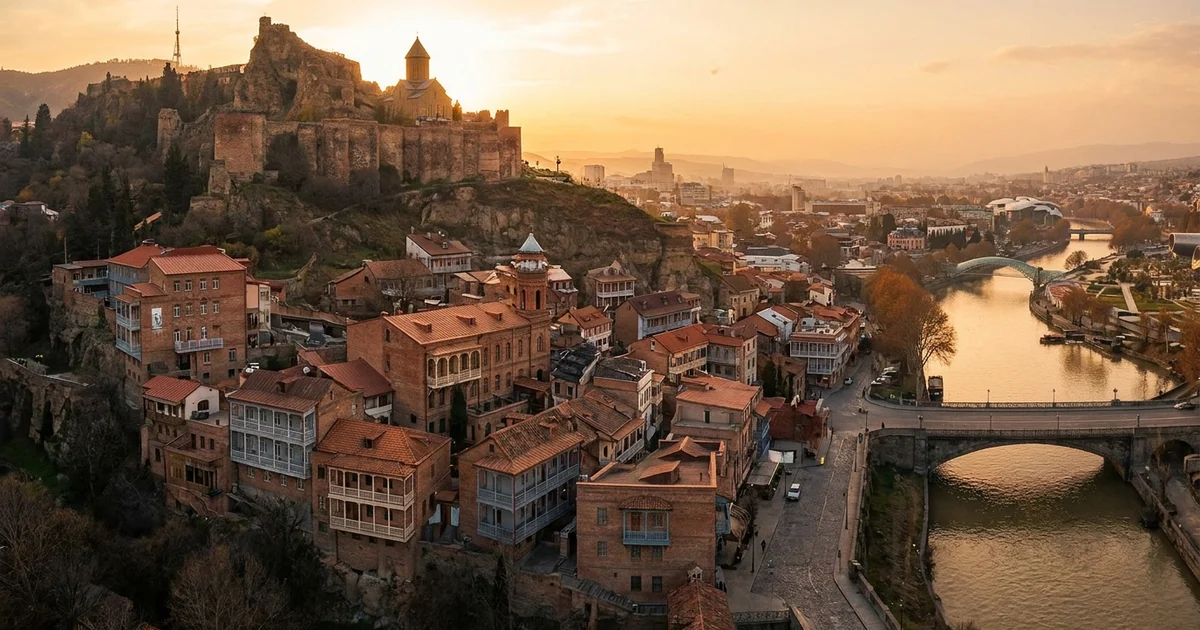
I guide visitors through the Old Town, and I always say: you're not looking at "pretty little houses," you're looking at a thousand years of survival. This is the story I usually fit into the first walk, so that everything afterwards falls into place. For the visual side of the city, pair it with what to see in Tbilisi.
The Founding Legend: a Falcon and Hot Springs
Georgia's most famous legend goes like this. In the 5th century, King Vakhtang I Gorgasali of Iberia was hunting in the forests where Tbilisi now stands. His falcon caught a pheasant, but both birds fell into a spring and were boiled — the water was hot and sulfuric. Amazed, the king ordered a city founded on the spot and named it "Tbilisi," from the Georgian tbili, "warm."
It's a beautiful legend, though archaeology clarifies that a settlement existed by the springs before Vakhtang. But it was he who turned the place into a city and laid the foundation of a capital. Those same sulfur springs still run — the famous sulfur baths of Tbilisi in the Abanotubani district, which you can visit today. In a sense, the city began with the baths — and they're still here 1,500 years later.
How Tbilisi Became Georgia's Capital
Before Tbilisi, the capital of the Georgian kingdom was Mtskheta — the ancient spiritual centre 20 km away, where Christianity was adopted back in the 4th century. In the 6th century, Vakhtang's son King Dachi fulfilled his father's wish and moved the capital to Tbilisi. The choice was strategic: the city sat at a crossroads of roads, in the gorge of the Mtkvari (Kura) river, which was easy to defend.
Mtskheta remained the country's religious heart — the Svetitskhoveli Cathedral still stands there, and a trip is essential for understanding Georgia's origins (see the Mtskheta tour). Tbilisi, meanwhile, has been the political and commercial centre ever since — a role it hasn't surrendered in fifteen centuries.
The Silk Road and the Golden Age
Its position at the crossroads between Europe and Asia made Tbilisi rich. Caravans of the Great Silk Road passed through it: silk, spices, silver. Georgians, Armenians, Persians, Jews and Greeks lived side by side — a polyphony you can still hear in the architecture and cuisine.
The peak came in the 12th–13th centuries, Georgia's golden age under King David the Builder and Queen Tamar. The country was a strong regional power, and art and architecture flourished. Many of the churches and fortresses you see across Georgia are a legacy of that era.
Invasions: Persians, Arabs, Mongols
A wealthy city at a crossroads is also a curse. Tbilisi constantly became the prey of conquerors. In the 7th century the Arabs arrived and founded the Emirate of Tbilisi, which lasted for centuries. In the 13th century the Mongols sacked the city. At the end of the 14th century came Tamerlane's armies — several times over.
Every invasion meant fires, massacre, and enslavement. But Tbilisi rebuilt again and again, partly because its position was too valuable to abandon. The Narikala fortress, looming over the Old Town, remembers almost all these sieges — its walls were begun by the Arabs. The climb up is worth it for both the views and the history: more in the Narikala fortress guide.
1795: Destruction and Rebirth
The most tragic date in the city's history is 1795. The Persian ruler Agha Mohammad Khan invaded Georgia, defeated the army of King Erekle II, and burned Tbilisi to the ground. The city was virtually erased, with tens of thousands killed or enslaved. This destruction was one of the reasons Georgia sought protection from the Russian Empire.
Almost everything you see in the Old Town today was built after 1795 — which is why "old" Tbilisi is mostly 19th-century. The carved wooden balconies everyone admires are the architecture of recovery after catastrophe.
The Russian Empire: a New City
In 1801, eastern Georgia became part of the Russian Empire, and Tbilisi (then Tiflis) became the administrative centre of the Caucasus. In the 19th century the city changed sharply: a new European centre appeared with wide avenues — today's Rustaveli Avenue — an opera house, mansions and gymnasiums.
So Tbilisi acquired the two faces you still see: the labyrinth of the old eastern town at the foot of Narikala, and the grand imperial avenue above. Walking between them is the best way to feel the shift of eras; that's exactly how the Old Tbilisi tour is built.
The Soviet Period
In 1921 the Red Army entered the short-lived independent Georgian Democratic Republic, and the Soviet era began, lasting 70 years. Tbilisi was built up with blocks of standard housing, a metro, and grandiose Stalin-era buildings; Stalin himself was born nearby and began his revolutionary career here.
This contradictory legacy — from modernist masterpieces to dormitory districts — is a big topic of its own. There's detail in the Soviet Tbilisi guide and the Soviet Tbilisi tour, while the era's darkest side is shown by the Museum of Soviet Occupation (see Tbilisi museums).
Independence and Modern Tbilisi
In 1991 Georgia became independent again. The 1990s were hard: civil conflict in the city centre, economic collapse, power cuts. There was fighting on Rustaveli Avenue and buildings burned — scars the city took a long time to heal.
The turning point came with the Rose Revolution of 2003 and the reforms that followed: the city was transformed, with new symbols — the glass Bridge of Peace, the illumination of the Old Town, restored facades. Today Tbilisi is a fast-changing capital that Tripadvisor named one of the world's most trending destinations in 2026. Old and new argue at every step here — and that's the city's main charm.
What Survives From Each Era
Tbilisi's history isn't an abstraction — you can touch it. Here's what to see, era by era:
| Era | What survives | Where |
|---|---|---|
| Founding (5th c.) | Abanotubani sulfur baths | foot of Narikala |
| Arabs / medieval | Narikala fortress, Metekhi church | Old Town |
| Pre-Russian Tiflis | Carved balconies, winding lanes | Sololaki, Kala |
| Russian Empire | Rustaveli Avenue, opera house | centre |
| USSR | Metro, Museum of Occupation | across the city |
| Modern | Bridge of Peace, illumination | Mtkvari riverside |
All these layers sit literally on top of one another within a couple of kilometres, and the best way through them — from 5th-century baths to a glass bridge — is with a guide who connects the legend, the stone and the present day. That's what a walking tour of Tbilisi does: you don't just look at buildings, you read fifteen centuries in a single day.
After years of guiding I've learned this: a tourist who knows the city's history falls for it in a completely different way. They look at the avenue that once burned, the baths where it all began, the glass bridge — and see not postcards but a living organism that survived everything and never gave up. That feeling is exactly why it's worth learning Tbilisi's history before you walk it.