
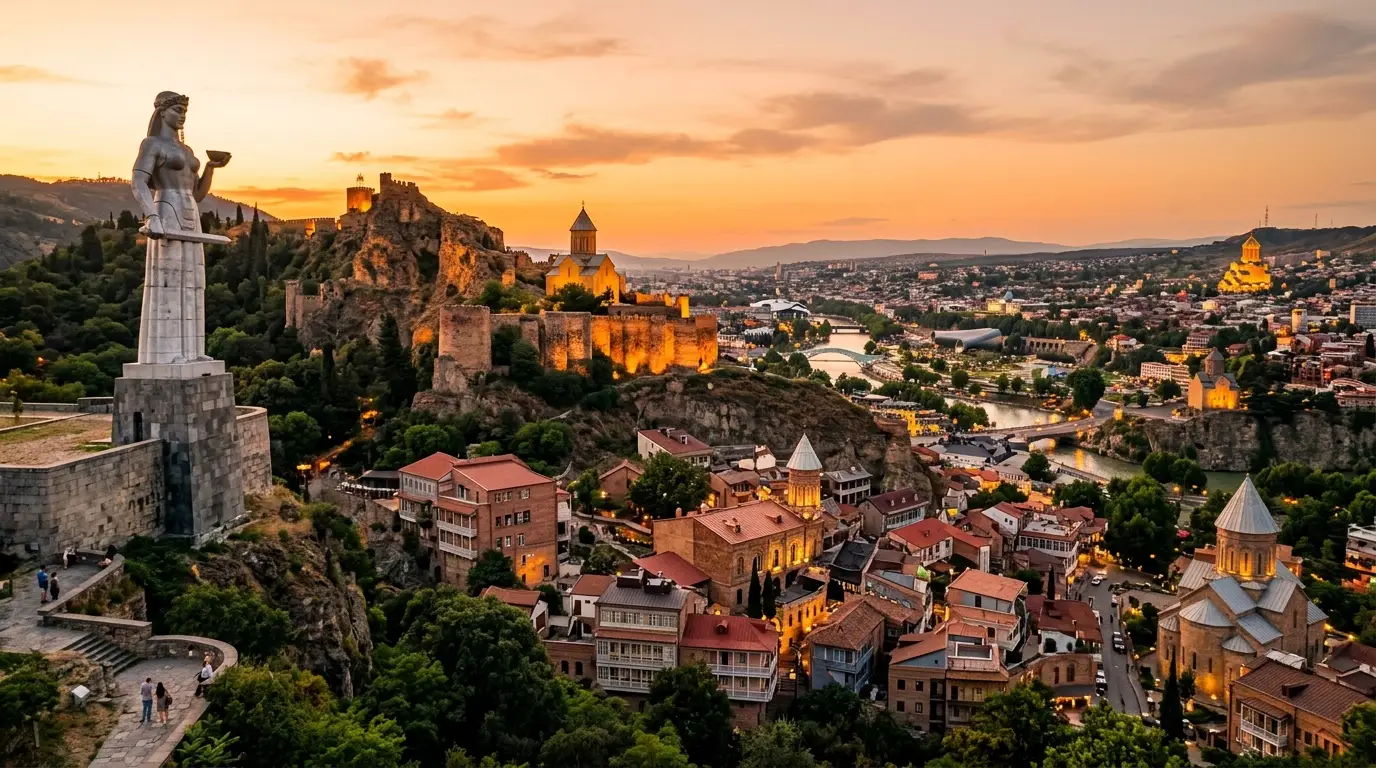
Narikala is an ancient fortress on a cliff above Old Tbilisi, founded in the 4th century. Entry is free. Walk up through Abanotubani — 20 minutes. Cable car from Rike Park — 5 minutes (₾5). Best time: before 10:00 or one hour before sunset. From the upper walls: a panorama of all Tbilisi, the Kura river, and the Great Caucasus Range. Don't forget to get travel insurance — mandatory for entering Georgia since 2026.
History of Narikala fortress
Narikala is one of the oldest fortresses in the Caucasus. The first fortifications on this cliff were built in the 4th century AD during the reign of King Vakhtang Gorgasali. The fortress was then known as "Shuris-Tsikhe" — "the Enviable Fortress." Later, in the 11th–12th centuries, under Kings David the Builder and Queen Tamar, the fortress was significantly expanded and became the city's primary defensive stronghold.
The name "Narikala" appeared later — from the Persian "narin-kala" (meaning "small fortress") or the Mongol "narin-kala" (meaning "small city fortress"). Over fifteen centuries the fortress passed from hand to hand: Persians, Arabs, Mongols, Seljuk Turks, Safavids — each left their trace here.
In 1827 the fortress was partially destroyed by an explosion in the gunpowder stores that were kept here during the Russian Empire period. This is why much of the walls remain in their ruined state — and it is precisely this that gives Narikala the atmospheric quality that photographers prize so highly.
How to reach Narikala fortress
Option 1: Walk via Abanotubani (recommended)
This is the most atmospheric route. From central Tbilisi, head towards the Abanotubani sulphur baths — the characteristic Persian domes are easy to spot. From Abanotubani, climb up the staircase through the rocky park. The ascent takes 15–20 minutes, with a height gain of around 80 metres. Along the way you get views over the bath domes and the Old Town.
I always lead tourists this way. The route through Abanotubani is not just a climb — it is the history of Tbilisi in cross-section: from 4th-century sulphur springs to a medieval fortress. When you emerge onto the walls and see the whole city at once — that is worth every step.
Option 2: Cable car from Rike Park
The cable car runs from Rike Park on the Kura riverbank. The station is clearly visible from the Bridge of Peace — a glass tower. Price: ₾5 one way, ₾10 return. Journey time: approximately 5 minutes. The cable car operates daily from 09:00 to 23:00. For visitors with limited mobility, this is the only comfortable way to reach the fortress. See the full guide to the Tbilisi cable car for prices, hours and the route.
Option 3: Taxi
You can take a taxi to the car park at the base of the fortress. Price from the centre: ₾8–15. However, the final climb is still on foot — the car park is at the lower gate, the walls are higher still.
| Route | Cost | Time |
|---|---|---|
| Walk via Abanotubani | Free | 20–25 min |
| Cable car (one way) | ₾5 | 5 min |
| Cable car (return) | ₾10 | 5 + 5 min |
| Taxi to car park | ₾8–15 | 10 min by car |
Best viewpoints at Narikala
Narikala is not a single viewpoint — it is a system of walls and towers, each offering its own perspective.
- The upper tower (citadel) — the highest point. You can see all of Tbilisi: the bend in the Kura, the Bridge of Peace, the Abanotubani domes, Rustaveli Avenue, and Mount Mtatsminda. On a clear day the Greater Caucasus Range is visible.
- The north wall above Abanotubani — the best view of the sulphur bath domes and the Tsavkisis-Tskhali river gorge. This is where the classic postcard photograph of Tbilisi is taken.
- The east tower — view over Metekhi church and the cliff above the river. Particularly beautiful at sunset, when the western sun illuminates the cliff face.
- The platform at the cable car station — a view of the Kura, Rike Park, and the Bridge of Peace from above. An unusual angle that few people photograph.
We visited Narikala once on our own and once with Timur — the difference was enormous. On our own, we just looked at beautiful old stones. With the guide, we learned about Arab caliphs, Persian shahs, and the 1827 explosion. We climbed through Abanotubani, Timur narrating the history of every building along the way. At the top he showed us exactly where to stand for the best shot — we would never have found it ourselves.
St. Nicholas Church inside the fortress
Inside the fortress, against the north wall, stands a small Church of St. Nicholas. The original church was built in the 12th–13th centuries, destroyed in the 18th century, and restored in 1996. From the outside, the church looks authentically medieval — the restoration was done with great care, using traditional materials and methods.
Entry is free. It is an active church: liturgies are held, candles burn. Women should bring a headscarf. Photography inside is not recommended during a service.
Guide's tips: timing, photography, route
- Best time to visit — 09:00–10:30 or 1–1.5 hours before sunset. Mornings have almost no tourists and soft light for photography. At sunset the views are at their most dramatic, but more visitors are present.
- What to wear — comfortable shoes with non-slip soles. Parts of the walls are uneven; stones can be slippery after rain. Heels are not recommended.
- Water — bring your own. There are no cafes or kiosks on Narikala itself. Below, in Abanotubani, there are several places to buy drinks.
- Duration — 40–60 minutes for the fortress alone. Including the walk up through Abanotubani and back down: 1.5–2 hours.
- Best combined route — Freedom Square → Abanotubani → Narikala → Metekhi Church → dinner in the Old Town. This covers the essential history of Tbilisi in one afternoon.
Narikala with guide Timur
Narikala is included in the Old Tbilisi walking tour — or book the dedicated Narikala Fortress tour from Tbilisi. In 3–4 hours, guide Timur takes you through Abanotubani, explains the history of the sulphur springs and every conqueror who ever held Tbilisi, climbs with you to the fortress, and shows you the best photography spots. Then — the hidden courtyards of the Old Town and Metekhi Church above the river.
Price: from ₾100 per person, groups up to 7, free cancellation 48 hours in advance.
Explore Narikala with a guide
Timur shows the best viewpoints and tells the history you will not find in any guidebook
Sources