
Few people travel to Tbilisi "for the museums" — and that's a mistake. Here the museums aren't a backdrop like the Louvre in Paris; they're the key to a country you can't read at a glance: 8,000 years of winemaking, the gold Jason sailed for, Soviet occupation, the naive genius of Pirosmani, and a puppet theatre famous worldwide. Half a day in the right museums and Georgia clicks into focus — and you see the city differently afterwards.
I've guided visitors around Tbilisi for years, and there's a pattern: those who go to a museum on day one ask completely different questions on the streets afterwards — because they start to see the layers. This guide is my personal pick of what's genuinely worth your time and what you can skip. For the broader "what to see" picture, pair it with what to see in Tbilisi.
Are Tbilisi's Museums Worth It?
The honest answer: if you have one day and good weather, walking the Old Town beats any museum. But if you have several days, it's raining (see the Tbilisi rainy day guide), or you want context, Tbilisi's museums give you what no walk can. You don't need to be a "museum person" — the collections are compact, with no multi-hour labyrinths, and the stories are dramatic and alive.
The bonus: Tbilisi isn't overloaded with museums, which is a good thing. You don't choose from a hundred options — there are five or six that genuinely earn the ticket, and they sit close together. In a day you see plenty without exhausting yourself.
Georgian National Museum (Simon Janashia)
The country's main museum stands right on Rustaveli Avenue in a monumental building you can't miss. It's not one museum but a complex under one roof, which is exactly why you start here: one ticket (plus a separate one for the Treasury) gives you archaeology, nature, and the heaviest page of the 20th century.
The permanent exhibition covers Caucasian archaeology: the ancient hominid skulls from Dmanisi (some of the oldest human remains outside Africa — a global sensation), Bronze Age artefacts, medieval finds. A separate floor covers Georgia's nature. But the two magnets are the Treasury and the Museum of Soviet Occupation, covered separately below.
The Treasury: Colchis Gold
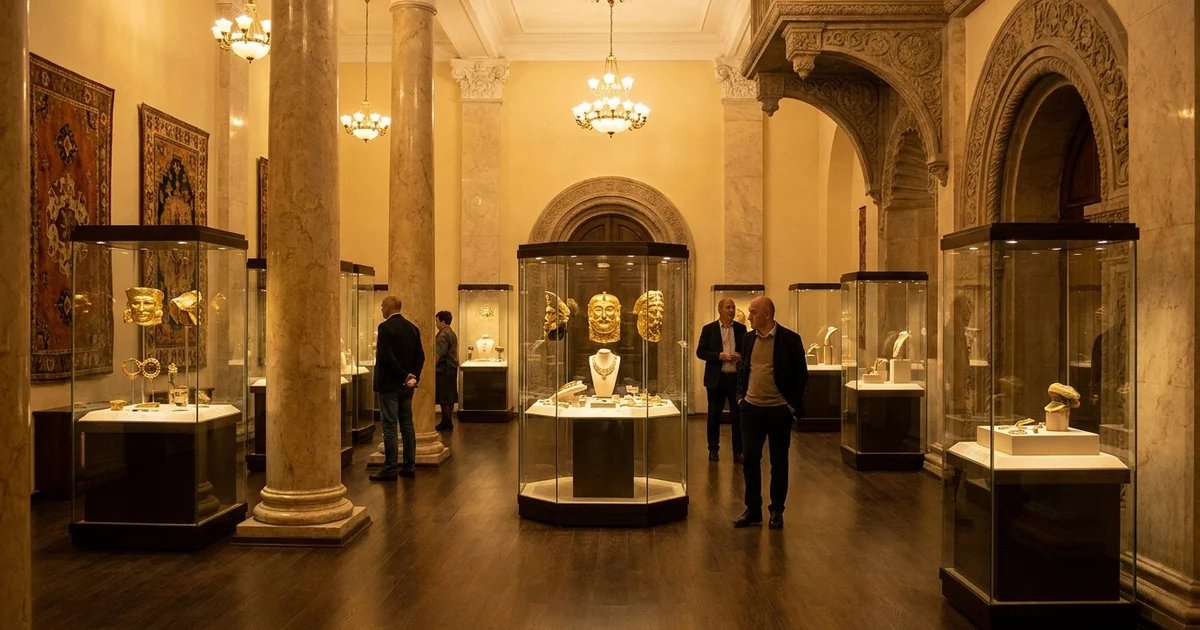
If you pick one thing in Tbilisi worth buying a ticket for, it's the Treasury (Golden Fund) of the National Museum. It holds archaeological gold from Georgian territory: jewellery, bowls, animal figures of astonishing craftsmanship, up to 5,000 years old.
This is Colchis — the ancient kingdom in western Georgia where, in myth, Jason and the Argonauts sailed for the Golden Fleece. Looking at the cases of golden lions and diadems, you understand the myth didn't come from nowhere: the goldsmiths here were brilliant long before classical Greece. Photography is usually not allowed, which is right — better to just stand and look.
The Treasury ticket is separate and pricier than general admission (around 30 GEL), but it's probably the most justified money you'll spend in museum Tbilisi.
Museum of Soviet Occupation
On the top floor of the same National Museum is the Museum of Soviet Occupation. A small but powerful exhibition on the period from 1921, when the Red Army entered independent Georgia, to the collapse of the USSR: repression, deportations, an execution railcar, documents, photographs.
It's emotionally heavy but important for understanding modern Georgia and its relationship with Russia. A lot of what you see on the streets — monuments, renamed avenues, the political mood — makes more sense here. If the theme resonates, continue with a walk through the city's Soviet legacy: see the Soviet Tbilisi guide and the Soviet Tbilisi tour.
Pirosmani and Georgian Art
Niko Pirosmani is Georgia's defining painter and one of the world's most famous naive artists. A poor self-taught man who painted tavern signs for food, he created images that became the country's visual code: black backgrounds, deer, feasts, the actress Margarita. The song "A Million Scarlet Roses" is about him.
The best Pirosmani collection is at the National Gallery (often called the "Blue Gallery") on Rustaveli Avenue, a few steps from the National Museum. It also holds Lado Gudiashvili, David Kakabadze and other classics of early-20th-century Georgian modernism. The exhibition is compact, bright, and doesn't tire you out.
Art lovers should also dip into contemporary Tbilisi galleries — the scene is lively. The easiest way to cover it is an art tour of Tbilisi, where a guide takes you from the classics to current galleries and street art.
Gabriadze Puppet Theatre and Clock Tower
Even if you're indifferent to puppets, go. Rezo Gabriadze — artist, director and screenwriter — built a magical corner in the heart of the Old Town: the famous leaning clock tower with a mechanical angel, a puppet theatre, and a cafe. The tower is one of Tbilisi's most photographed spots.
Every hour an angel emerges from a little door in the tower and strikes a bell, and twice a day a tiny puppet show, "The Cycle of Life," plays out. Tickets for the theatre's full performances (in Georgian with subtitles) sell out in advance — book ahead if you want to get in. The square at the tower, the cafe and the shop are free and open to all.
Open Air Ethnographic Museum
On the slope by Turtle Lake (Kus Tba), just above the city, sprawls an open-air museum: dozens of traditional houses from across Georgia — Svaneti, Kakheti, Adjara — moved here whole. Inside are tools, carpets, and qvevri wine vessels buried in the ground.
It's the best place to "tour" all of Georgia in a couple of hours without leaving Tbilisi, and to understand how people lived in the mountains and valleys. A nice bonus: shade, forest and cool air in summer, plus Turtle Lake nearby for a rest. It pairs with the walk described in the Tbilisi lakes guide.
Niche Museums: Wine, Silk, Money
Once you've seen the essentials, Tbilisi has unusual small museums for every taste:
- Wine museum (qvevri and winemaking) — on the UNESCO-listed qvevri method, with a tasting. A logical follow-up is the Georgian wine guide.
- Silk Museum — an elegant 19th-century building and the story of the Silk Road that ran through Tbilisi. One of the oldest silk museums in the world.
- Money Museum (at the National Bank) — coins and banknotes from ancient Colchis to the lari. Small and free.
- Stalin Museum in Gori — not in Tbilisi itself, but 1.5 hours away. A controversial, powerful place; included in the Gori day trip.
Tickets, Hours and Free Days
A 2026 reference for prices (tickets change periodically):
| Museum | Ticket | Hours | Closed |
|---|---|---|---|
| National Museum | ~15 ₾ | 10:00–18:00 | Monday |
| Treasury (gold) | ~30 ₾ (separate) | 10:00–18:00 | Monday |
| Museum of Occupation | in general ticket | 10:00–18:00 | Monday |
| National Gallery | ~10–12 ₾ | 10:00–18:00 | Monday |
| Ethnographic | ~5 ₾ | 10:00–17:00 | Monday |
| Gabriadze Tower | square free | shows on schedule | — |
Useful: students and children get discounts (bring ID). Many museums have occasional free days or promotions — ask on site. Almost everything is closed on Mondays, so plan your route for any other day.
One-Day Museum Route in Tbilisi
- 10:00 — National Museum + Treasury. Start with the Colchis gold while you're fresh, then archaeology and the Occupation museum. 2 hours.
- 12:30 — National Gallery (Pirosmani). 200 metres along Rustaveli. 45 minutes is enough.
- 13:30 — lunch on Rustaveli or in Sololaki. A break.
- 15:00 — Gabriadze tower and theatre. Down into the Old Town, photograph the tower, coffee at the cafe beneath it.
- 16:30 — optional: Ethnographic Museum (if you have energy and a car) or the sulfur baths nearby.
The central block — National Museum, gallery, Gabriadze tower — sits on one axis of the Old Town, and the most rewarding way through it is with a guide who connects the exhibits to the streets around them. That's exactly what a walking tour of Tbilisi does: the museums stop being a set of glass cases and become part of the city's living history.
After years of guiding I've learned a simple thing: a museum in Tbilisi isn't a box to tick — it's a fast way to fall deeper for the country. A guest who stood by the Colchis gold in the morning and learned about the occupation looks at the same Sololaki balcony in a completely different way by evening. That's why it's worth going in.