Imereti — Canyons, Caves and Ancient Kutaisi
About Imereti
Imereti stretches across the heart of western Georgia — between the Likhi Range to the east and the Colchis Lowland to the west. It is the country's second most populated region: nearly seven hundred thousand people live in the valleys of the Rioni and Kvirila rivers, among hills covered with beech and chestnut forests. The capital is Kutaisi, Georgia's parliamentary city and one of the oldest continuously inhabited cities in Europe.
Kutaisi appears in the myth of the Golden Fleece — this is the legendary Colchis where Jason and the Argonauts arrived. Archaeological finds confirm that a settlement on the banks of the Rioni existed as early as the 6th century BC. In the 11th-12th centuries Kutaisi became the capital of the united Georgian Kingdom, and it was then that Gelati and Bagrati were built — two monuments that defined the face of Georgian architecture.
Imereti's landscape features deep limestone canyons, underground rivers and caves carved by water over millions of years. Okatse Canyon, Martvili Canyon, Prometheus Cave, Sataplia with dinosaur footprints — all within an hour's drive of Kutaisi. That's why Imereti is called "Georgia for nature lovers": in a single day you can walk on a suspended bridge over a gorge, boat along an underground river and climb to a monastery where Georgia's greatest king is buried.
Imeretian cuisine is considered the most refined in Georgia. They don't like spicy food here — preferring mild sauces made from walnuts and herbs. Imeretian khachapuri is round, filled with Imeretian cheese (mild, brined). Pkhali, kupati, chakhokhbili with veal and tarragon — all originate from Imereti. And the dessert churchkhela here is made not from grape juice as in Kakheti, but from pomegranate or tangerine juice.
What to See in Imereti
Gelati Monastery
A 12th-century academy and monastery founded by King David the Builder — Imereti's main attraction and a UNESCO World Heritage Site. David wanted to create not just a temple but an intellectual center for the entire Caucasus. The Gelati Academy taught philosophy, mathematics and astronomy, attracting scholars from Byzantium and Persia. The 12th-century mosaic of the Virgin in the apse is among the finest in the world. David the Builder is buried at the entrance: his tombstone lies in the passageway so that everyone entering steps on it — the king's way of remaining part of the monastery's life forever.
Bagrati Cathedral
An 11th-century cathedral on Ukimerioni Hill — visible from anywhere in Kutaisi. Built under Bagrat III, the first king of united Georgia. The temple was destroyed by the Turks in 1691 and restored only in 2012 (which caused UNESCO to delist it). Despite restoration controversies, Bagrati remains Kutaisi's symbol. The viewing platform offers a panorama of the city and the Rioni valley.
Okatse Canyon
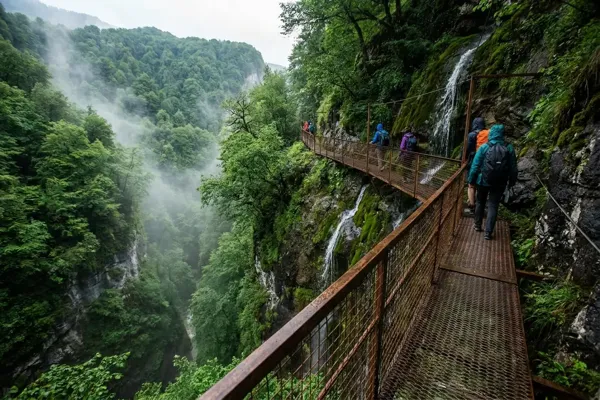
A suspended metal walkway 780 meters long, set at heights of 20 to 140 meters above the canyon floor. Beneath your feet — the abyss; around you — sheer moss-covered cliffs and waterfalls. The trail ends at a viewing platform hanging over the edge. The feeling is like something from the movie Avatar. Entry 15 lari, open year-round (except Monday). Walk from parking to the trail start takes 20 minutes through the forest.
Martvili Canyon
A narrow gorge carved by the Abasha River through limestone cliffs over twelve million years. Visitors ride rubber boats — slowly, on emerald water, between walls 30-40 meters high. Light filters from above, turning the water an unreal turquoise. The ride lasts fifteen minutes but the impressions last much longer. Entry 17 lari. Summers can be crowded — arrive at opening (10:00).
Prometheus Cave
Georgia's largest open-access cave — the route is 1,400 meters long. Inside: stalactites, stalagmites, underground waterfalls and a river. Professional lighting makes the cave shimmer in red, blue and green. You can boat along the underground river (extra 12 lari). Temperature inside is 14°C year-round — bring a jacket. Entry 40 lari for foreigners.
Sataplia
A nature reserve 12 km from Kutaisi with real dinosaur footprints — paw prints preserved in 120-million-year-old limestone. Also here: a small cave with stalactites and a glass viewing platform over the cliff edge (heart-stopping). Perfect for families: dinosaurs + cave + adrenaline in one visit.
Motsameta and Gelati in One Route
Motsameta Monastery sits on a cliff above the Tskaltsitela river gorge, three kilometers from Gelati. Small and intimate, with the legend of two martyred brothers David and Constantine, whose relics are kept inside. Crawl under the reliquary three times and your wish will come true (locals say). Motsameta and Gelati are connected by a forest path — the 40-minute walk reveals views found in no guidebook.
When to Visit and What to Bring
Best time: April-June and September-October. Canyons are most beautiful in spring (full water) and fall (golden leaves). Summer is hot (+32-35°C in Kutaisi) but canyons are always cooler. Winter is mild (+5-10°C), few tourists, all sites are open.
What to bring: comfortable sneakers (slippery canyon trails), jacket for caves (+14°C inside), raincoat (more rain than Tbilisi). Swimsuit for Martvili Canyon — swimming allowed in summer.
Getting there: Tbilisi to Kutaisi 230 km, 3h30m on the highway. Minibuses from Didube 20 lari. Kutaisi Airport has Wizz Air flights. With guide — hotel pickup, everything in 1-2 days.
Our Tours to Imereti
Want a custom itinerary in Imereti?
Message Timur — we'll plan a route for you. Reply within 15 minutes.