Adjara — Subtropics, Sea and Mountain Villages
About Adjara
Adjara is the only region in Georgia where subtropical climate, palm trees and the Black Sea combine with mountains nearly three thousand meters high. This autonomous republic occupies the southwestern corner of the country, borders Turkey and stretches from the coast deep into the Lesser Caucasus. About three hundred fifty thousand people live here, most of them connected to the sea, tourism or growing tea and citrus fruits.
Batumi is the capital of Adjara and Georgia's second largest city. Over the past fifteen years it has transformed from a sleepy port town into an architectural showcase with skyscrapers, casinos and a seven-kilometer boulevard. Yet old Batumi remains: narrow streets with wooden balconies, a mosque and synagogue sharing a wall, the fish market and courtyards where laundry dries on ropes strung between buildings.
Mountain Adjara is a completely different world. Thirty kilometers from the coast, mountain passes begin, along with alpine meadows and villages where life has barely changed in a century. Khulo, the main settlement of the highland part, sits at a thousand meters. The road from Batumi to Khulo runs through the Acharistskali river gorge, past Makhuntseti waterfalls and a 12th-century arched bridge from Queen Tamar's era. Along the way you encounter fortress ruins and old mosques — reminders that Adjara was part of the Ottoman Empire for three hundred years.
Adjarian cuisine differs from the rest of Georgia. Adjarian khachapuri — a boat-shaped bread with cheese, butter and egg — is famous worldwide, but only here is it made properly: thin, crispy dough with filling mixed by hand right in front of you. Boraki, sinori, achma — Adjarian cheese pastries prepared quite differently from their Tbilisi versions. Fish is grilled with walnuts, and baklava is served for dessert — the influence of Turkey, just twenty minutes away by car.
What to See in Adjara
Batumi Boulevard
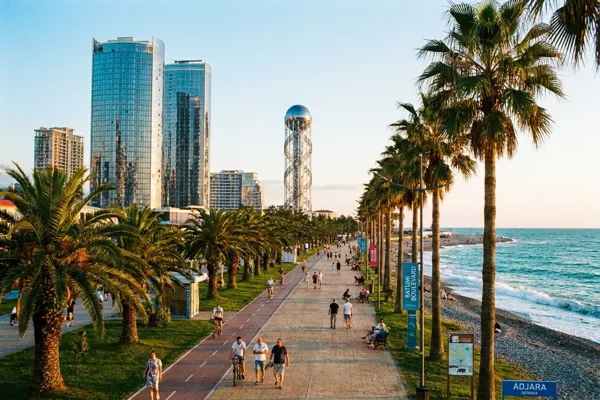
Seven kilometers of seafront promenade — the main walking area that never gets old. The boulevard was laid out in 1884 by French gardeners and has only grown since. Here you'll find the 130-meter Alphabetic Tower, the moving sculpture "Ali and Nino" (a man and woman pass through each other every ten minutes), dancing fountains and dozens of cafes. In the evening the promenade is illuminated, live music plays, and people cycle and ride e-scooters along the boulevard.
Gonio-Apsaros Fortress
A 1st-century Roman fortress fifteen kilometers south of Batumi — one of the oldest fortifications in Georgia. Walls five meters high and twenty-two towers are almost completely preserved. Archaeologists found gold jewelry, Trajan's coins and mosaic floors here. Legend says the Apostle Matthias is buried inside. Nearby is the best pebble beach on the coast with clear water and mountain views.
Makhuntseti Waterfall and Bridge
Twenty kilometers from Batumi, in the Acharistskali river gorge, stands a 12th-century arched stone bridge — one of the symbols of mountain Adjara. The bridge spans the river at twenty meters high and is still used by locals today. Nearby is the twenty-meter Makhuntseti waterfall with a natural pool beneath it. In summer the water is warm enough for swimming. The best time to visit is spring, when the flow is most powerful.
Batumi Botanical Garden
One of the world's largest botanical gardens — one hundred thirteen hectares on hills above the sea. Founded in 1912 by botanist Andrey Krasnov. Nine climate zones: a Japanese garden, Mexican desert, Mediterranean olives, Himalayan rhododendrons. Paths wind between giant bamboo, sequoias and eucalyptus trees. From the viewing platforms, the coastline panorama stretches out — on clear days you can see the Turkish shore.
Piazza Square
A small square in old Batumi styled after Venice. Mosaic walls, stained glass, a clock tower with astronomical clock — built in 2009-2011 but looking a century old. In the evening Piazza comes alive: live jazz, wine, outdoor dining. One of Batumi's most photogenic spots.
Argo Cable Car
A two-and-a-half-kilometer cable car ride from the seafront to Mount Feria (260 meters). The cabin takes ten minutes — the entire way you see Batumi's panorama, the port, sea and mountains. Best to go before sunset — the city below begins to glow. Cost: fifteen lari round trip.
Mountain Adjara and Khulo
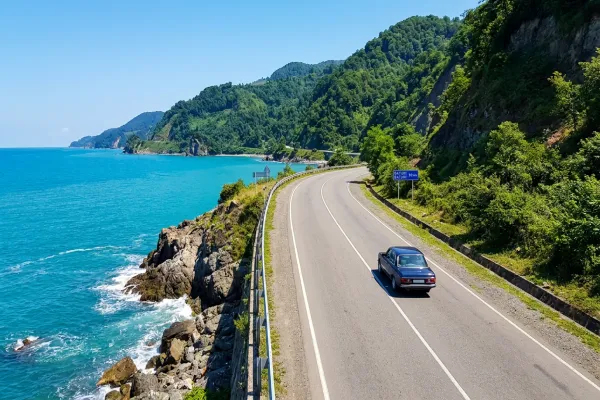
The serpentine road from Batumi to Khulo is one of Georgia's most beautiful drives. Gorges, cliffs, terraced villages, old mosques with wooden minarets. In Khulo there's a cable car crossing the gorge, featured in every guidebook. Further on is Goderdzi Pass (2,025 m) with a ski resort in winter and alpine meadows in summer. The circular route Batumi-Khulo-Goderdzi-Akhaltsikhe-Tbilisi makes an excellent two-day trip.
When to Visit and What to Bring
Best time for beach: June-September, water +24-26°C, air +28-32°C. July and August are peak season, crowded. September is ideal: warm sea, fewer people, cheaper accommodation.
Mountain Adjara: May-June and September-October. Summer in the mountains +18-22°C. In winter Goderdzi Pass is snowed in — 4WD required.
What to bring: swimsuit, beach shoes (pebble beaches), umbrella or raincoat (subtropical — rain even in summer), warm layer for evenings on the promenade and mountain areas.
Getting there: from Tbilisi by car 5 hours 30 minutes, by plane 40 minutes, by train 5 hours (overnight sleeper — convenient option). Minibuses from Didube — 35 lari.
Our Tours to Adjara
Want a custom itinerary in Adjara?
Message Timur — we'll plan a route for you. Reply within 15 minutes.