Shida Kartli — Cave Cities and the Silk Road
About Shida Kartli
Shida Kartli — "Inner Kartli" — occupies central Georgia in the Kura River valley between the Likhi Range and Tbilisi. This fertile plain surrounded by mountains has been continuously inhabited since the Bronze Age. The regional capital is Gori, a city of fifty thousand at the confluence of the Kura and Greater Liakhvi rivers.
Gori is known worldwide as Joseph Stalin's birthplace. The house where he was born in 1878 stands under a glass canopy in the city center, alongside a museum with personal belongings, documents and the armored train car Stalin used for the Tehran and Yalta conferences. Views on the museum are mixed, but as a historical artifact it's unique — no such Soviet exhibition exists anywhere else.
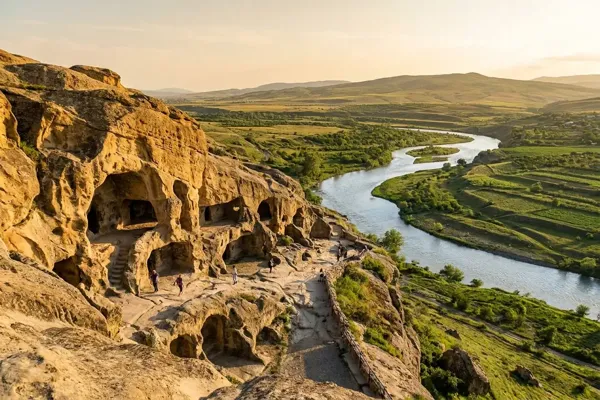
But Shida Kartli's greatest treasure is not the 20th century but deep antiquity. The cave city of Uplistsikhe, carved from sandstone three thousand years ago, was the largest pagan center in the South Caucasus. The Silk Road passed through here; there were sun god temples, pharmacies and a theater — all carved directly into stone. After Christianity's adoption the city declined but remained a fortress until the 13th century. Today Uplistsikhe is one of Georgia's most impressive archaeological monuments.
Shida Kartli's landscape features endless apple orchards (the region produces over half of Georgia's apples), wheat fields and poplar-lined avenues along the Kura. In autumn, during harvest, the air smells of apples and fresh-cut grass. Winter whitens the ridges around the valley with snow while the plain stays warm and sunny.
What to See in Shida Kartli
Uplistsikhe — Cave City
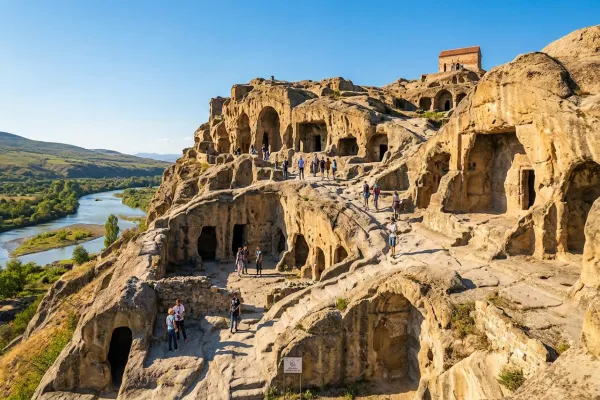
Georgia's oldest cave city, carved from sandstone cliff on the Kura riverbank about three thousand years ago. At its peak up to twenty thousand people lived here: streets, temples, living quarters, wine storage and even a pharmacy were carved out. The throne hall of the pagan temple survives with stone columns imitating wooden beams — a unique example of pre-Christian Georgian architecture. At the top — a 9th-century basilica. Entry 7 lari, audio guide 10 lari. Allow 1.5-2 hours. Wear non-slip shoes — stones polished by millennia.
Goristsikhe Fortress
A medieval fortress on a rocky hill in central Gori — from which the city gets its name (gori means "hill"). Fortifications existed here since the 1st century BC, but current walls date to the 13th century. The fortress offers panoramic views of the entire city, the Kura valley and snowy ridges. Free entry. Especially beautiful at sunset when the sun gilds the walls.
Stalin Museum
The largest museum dedicated to Stalin occupies an entire block in central Gori. The exhibition includes three objects: the house where Stalin was born (a wooden shack under a glass sarcophagus), a two-story museum with personal belongings and documents, and his personal armored railway car weighing 83 tons. The museum neither promotes nor condemns — it simply shows. Entry 15 lari, with guide 25. Photography allowed everywhere.
Ateni Sioni
A 7th-century temple in the picturesque Ateni Gorge, 12 km from Gori. Built on the Jvari model but unique for its 11th-century frescoes preserved almost completely. Scenes from Christ's life, portraits of Georgian kings — all painted directly on stone, colors unfaded after a thousand years. The road to the temple winds through the narrow Tana River gorge — worth the drive alone. Free entry.
Surami Fortress
A medieval fortress on a hill near Surami town, on the border of Shida Kartli and Imereti. Famous for the Georgian legend of a youth walled inside so the fortress would stand forever (Parajanov's film "The Legend of the Suram Fortress" is based on this story). The fortress is restored; you can climb the walls. Nearby — hot sulfur springs and a town park.
Kvatakhevi
A 12th-century monastery in the mountains above the Tana valley, 25 km from Gori. Remote and rarely visited — a real find for those tired of crowds. The cross-dome church stands in a forest surrounded by silence and the scent of pines. Monks are friendly and offer their own honey. Dirt road but passable by regular car.
Ksani Valley and Fortresses
The Ksani River valley north of Gori features a chain of medieval fortresses and towers: Ksani, Largvisi, Itria. Many sit atop cliffs, visible from the road. Local villages preserve the old way of life, where you can see traditional Georgian agriculture without tourist packaging. This route suits those wanting to see the real, unpolished Georgia.
When to Visit and What to Bring
Best time: April-June and September-October. Autumn is especially lovely — apple harvest, golden trees, +18-24°C. Summer is hot (+33-37°C) but Uplistsikhe and Ateni Gorge offer shade. Winter is mild (+2-8°C), all museums open.
What to bring: comfortable shoes with non-slip soles (Uplistsikhe has polished stone), hat in summer, scarf for church visits. Cash lari — cards not accepted everywhere in villages.
Getting there: Tbilisi to Gori is 86 km, 1 hour 20 minutes on the highway. Minibuses from Didube — 5 lari, train — 2 lari. With a guide — hotel pickup, Gori + Uplistsikhe + Ateni Sioni in half a day.
Our Tours in Shida Kartli
Want a custom itinerary in Shida Kartli?
Message Timur — we'll plan a route for you. Reply within 15 minutes.