Culture · 8 min read
Georgian Dance: Types, History and Where to See It Live in Tbilisi
Tour on this topic: Tbilisi Night Tour — from ₾100

In short: Georgian dance is not one dance but dozens of regional ones: the wedding dance Kartuli, the war dance Khorumi, the sword dance Khevsuruli and the playful Acharuli. Men dance on the tips of their toes in soft boots with no pointe shoes, while women seem to glide. The country's leading company, Sukhishvili, was founded in 1945. In Tbilisi you can see Georgian dance at ensemble concerts and every evening at restaurants with folk shows.
Anyone who has seen Georgian dance remembers it: men in chokhas leap, drop to their knees and rise onto the tips of their toes, while women cross the stage so smoothly that you cannot see their steps. For Georgians it is not a stage attraction but part of life. People dance at weddings, at Tbilisoba and at village feast days. Here is what the dances are, what they tell, and where to see them in Tbilisi without settling for a tourist imitation.
What is Georgian dance?
Georgian folk dance is a family of several dozen regional dances, each with its own story. Highlanders dance about duels and rivalry, the coast about war and flirting, the valleys about love and weddings. Most dances are accompanied by the doli drum, the accordion or polyphonic singing, and Georgian polyphony itself was proclaimed by UNESCO in 2001 a masterpiece of the intangible heritage of humanity.
Modern stage dance took shape in the 20th century, when choreographers built ensemble programmes out of folk movements. What you see on stage is folklore pushed to athletic difficulty.
Types of Georgian dance
These eight dances appear in almost every programme:
| Dance | Region | What happens |
|---|---|---|
| Kartuli | All Georgia | A couple's wedding dance. The man never touches his partner or looks at her directly; the woman seems to glide |
| Khorumi | Adjara, Guria | A war dance of scouting, battle and victory performed by dozens of men |
| Khevsuruli | Khevsureti | A duel with swords and shields, often striking sparks |
| Mtiuluri | Highlands | A contest of who jumps higher and stays longer on their toes |
| Acharuli | Adjara | Playful flirting between couples with handkerchiefs, the sunniest dance |
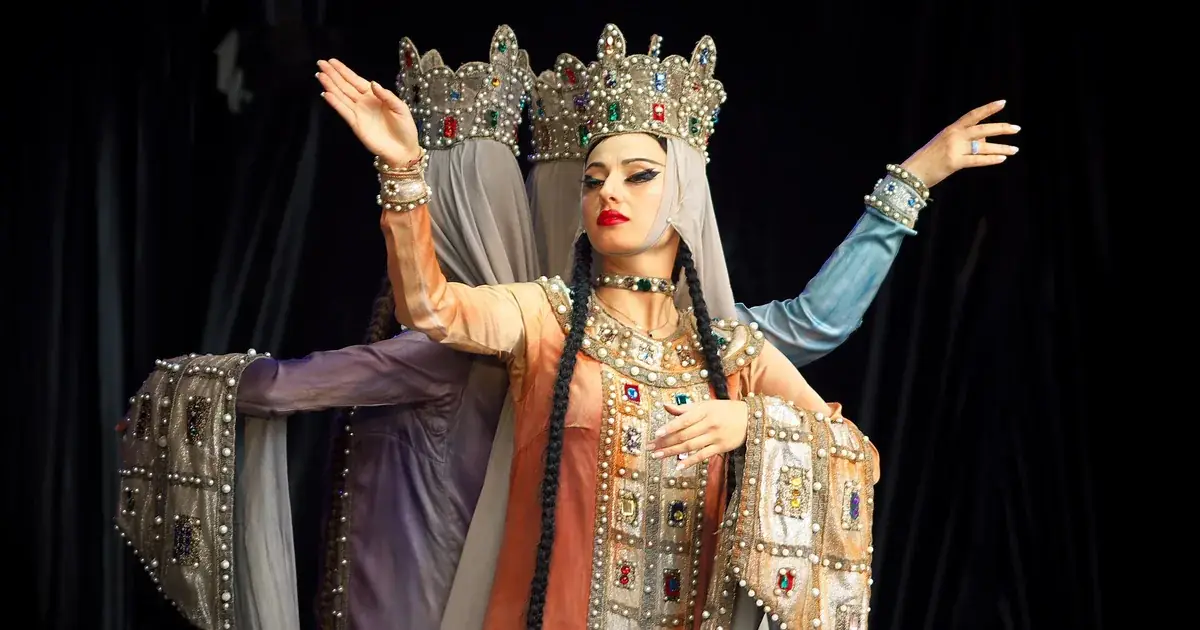
| Samaia | East | A dance of three women, linked by legend to Queen Tamar |
| Perkhuli | Svaneti, Kartli | A round dance to song, sometimes two or three tiers high on shoulders |
| Lekuri | Caucasus | The Georgian take on the lezginka: fast, with drops to the knee |
Khevsuruli deserves a special mention. Dancers fence with real blades and shields, and sparks really do fly. It echoes the time when the Khevsurs, highlanders from the north, still wore chain mail in the early 20th century.
Kartuli: the dance without touching
Kartuli is the central dance and the hardest to understand. It tells a courtship: the man circles the woman, protects her and shows strength and agility, yet never touches her and keeps his eyes lowered. There is always a distance between them. She answers with restraint and dignity: smooth arms, tiny steps, a long dress hiding her feet, so she seems to glide across the floor.
Kartuli is often called a "chivalrous" dance. It reflects the ideal of Rustaveli's poem The Knight in the Panther's Skin: respect, not possession. At weddings the newlyweds dance Kartuli while the guests form a circle.
Why do Georgian men dance on their toes?
The most recognisable element is men dancing on the tips of their toes. They do it in soft leather boots with no hard inserts, unlike ballet pointe shoes. Body weight rests on bent toes, and it takes years of training. There are also jumps that land on the knees, practised so the knee meets the floor without impact. The technique comes from highland contests where the most agile and enduring man won.
Costume: chokha and kaba
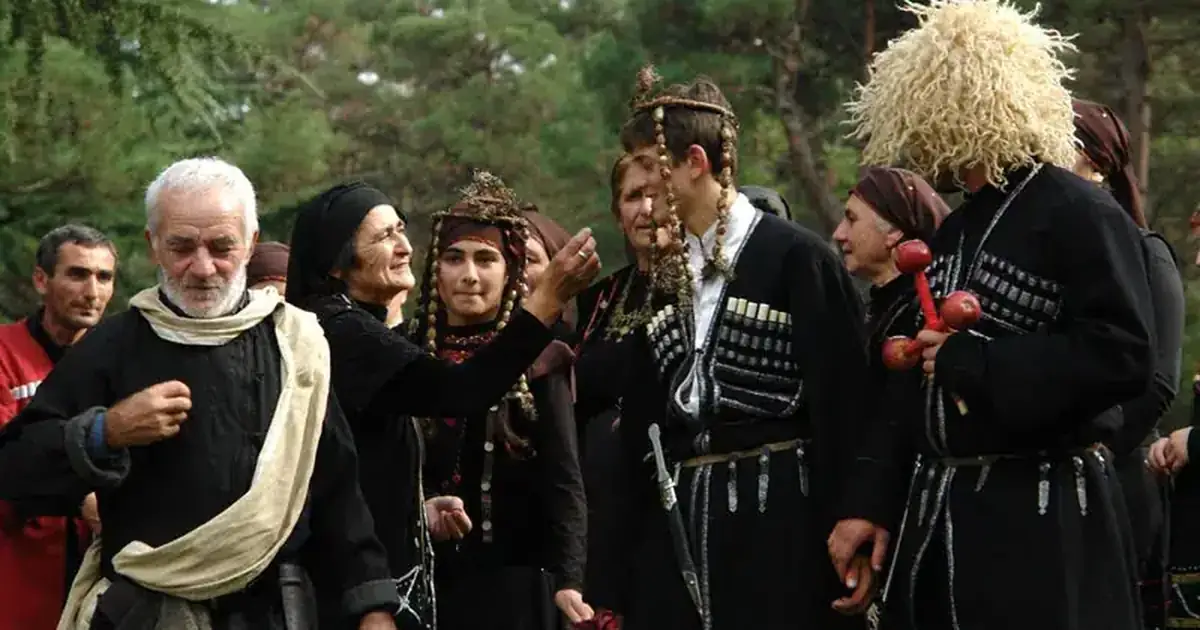
The men's costume is the chokha, a fitted coat with cartridge pockets (gazyri) across the chest that once held gunpowder charges. It is worn with a khanjali dagger and soft boots. Ensembles match the chokha's colour to the dance: white and black for Kartuli, bright for Acharuli, chain mail for Khevsuruli.
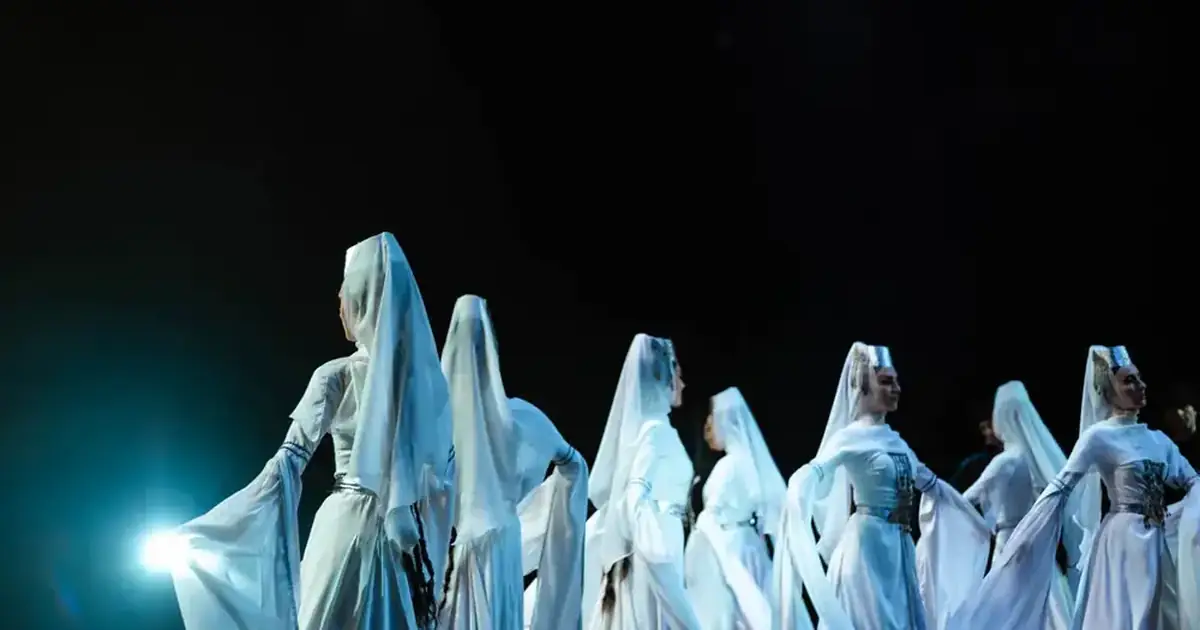
The women's costume is the kartuli kaba: a floor-length dress with long split sleeves, a belt and a veiled headdress, the lechaki. The floor-length dress creates the gliding effect. Today the chokha is worn off stage too, at weddings and national holidays, and Tbilisi has workshops that tailor them to order.
Sukhishvili and other ensembles
The Georgian National Ballet "Sukhishvili" was founded in 1945 by dancers Iliko Sukhishvili and Nino Ramishvili. It is still run by the Sukhishvili family. The company has performed in more than 90 countries and made Georgian dance famous worldwide.
Also worth knowing:
- Erisioni, one of the oldest song and dance ensembles, which tours widely;
- Rustavi, famous for polyphonic singing, whose programmes also include dance;
- children's and youth ensembles that perform at Tbilisoba and city festivals.
Music: doli, garmoni and panduri
Georgian dance is inseparable from its music. The rhythm comes from the doli, a double-headed drum played with palms and fingers. The melody is carried by the garmoni (Georgian accordion), the stringed panduri and chonguri, the wooden salamuri flute, and the bagpipe, called chiboni in Adjara and gudastviri in Racha. Mountain dances often use only drum and clapping, while in the perkhuli round dances the dancers sing themselves, in polyphony.
In ensembles the musicians usually sit on stage. At a dinner show, check whether the music is live: good restaurants keep their own band instead of playing a recording, and the difference in atmosphere is huge.
How to choose a dinner with a folk show
- Live music. Ask when booking whether there will be live musicians and a full dance programme or only songs.
- Timing. Check when the show starts and book 30–40 minutes earlier so you have time to order.
- Table. Ask for a view of the stage: in big halls, far tables see the dancing only on screens.
- Food. The best show venues cook as well as ordinary restaurants. Khinkali, mtsvadi and khachapuri should be fresh, not reheated for tourists.
- Service charge. Many Tbilisi restaurants already add 10–18% for service, so check the bill before tipping.
Where to see Georgian dance in Tbilisi
| Format | Where | When |
|---|---|---|
| Ensemble concert | Tbilisi Concert Hall, theatres. Tickets on tkt.ge and biletebi.ge | A few times a year between tours, more often in autumn and winter |
| Dinner with folk show | Ethno Tsiskvili, In the Shadow of Metekhi, Ethnographer (Dighomi, 30–40 min by taxi from the centre, with Erisioni dancers) | Most evenings, usually from 8–9 pm |
| Street performances | Old Town, Rustaveli Avenue | Tbilisoba in October, city festivals |
| Weddings and feasts | Wherever you are invited | Wedding season is autumn |
A Sukhishvili concert is the best option, but dates do not always line up, so check the schedule early. A dinner show is easier: book a table a day or two ahead, especially at weekends. The music and dancing usually start after the main courses, with Georgian toasts in between. For places with live music and good food, see our guide to the best restaurants in Tbilisi.
A folk-show dinner pairs well with an evening walk through the Old Town: after dinner you step out right below the illuminated Narikala fortress and Metekhi church.
If you are invited to dance at a supra
At a Georgian wedding or big feast, guests are almost always called into the circle. A few simple rules:
- Women: keep your arms soft and slightly raised, take small steps and stay calm. Nobody expects complex moves; smoothness is what counts.
- Men: do not touch your partner, move around her, and spread your arms if you like. Clapping and shouts of "tash-tash" from the guests are encouragement, not mockery.
- Do not cut in on someone else's dance uninvited. Usually one couple or one dancer takes the circle while everyone else claps.
- You can decline, politely and with a smile; the tamada will surely invite you again later.
Where dance lives beyond the stage
To see dance in its natural setting, head to the regions. In Adjara, Acharuli is danced at summer festivals by the sea, and folk groups often perform on the Batumi seafront. In Kakheti, dancing is part of every feast during rtveli, the grape harvest in September and October. In the mountains of Tusheti and Khevsureti, summer festivals such as Atengenoba gather people from every village, and you can see real men's contests. In Tbilisi the big occasion is Tbilisoba in October, when ensembles perform in the streets.
Can you learn Georgian dance?
Yes. Tbilisi has plenty of dance schools and ensemble studios, and some run one-off masterclasses for visitors: in an hour or so you learn basic Kartuli or Acharuli steps and arm positions. You will not get to toe dancing in one lesson, of course. Georgian children start dance classes at five or six, and many Georgians can at least dance at a wedding.
Georgian dance on screen
The world rediscovered Georgian dance in 2019 through Levan Akin's film And Then We Danced, the story of a young dancer preparing to audition for the national ensemble. It was shot in Tbilisi with plenty of rehearsals in real studios. For this and other films worth watching before your trip, see our list of the best Georgian films.
★★★★★
«Excellent guide. Showed and told us everything about sunny Georgia. Speaks excellent Russian.»
Georgian dance FAQ
What is the traditional Georgian dance called?
There is no single name: it is dozens of dances. The best known are Kartuli (wedding), Khorumi (war), Khevsuruli (swords), Acharuli (Adjarian) and Lekuri (the Georgian lezginka).
Why do Georgian men dance on their toes?
It is a male technique from highland contests. Dancers rise onto bent toes in soft boots without pointe shoes, which takes years of training.
Why doesn't the man touch the woman in Kartuli?
Kartuli expresses chivalrous respect: the man protects his partner and shows his skill but keeps his distance and lowers his eyes.
Where can I see Georgian dancing in Tbilisi?
At Sukhishvili or Erisioni concerts (tickets on tkt.ge and biletebi.ge) or at restaurants with folk shows such as Ethno Tsiskvili.
What is a chokha?
The chokha is the Georgian men's coat with cartridge pockets across the chest, worn with a khanjali dagger and soft boots. Today it is also worn at weddings and national holidays.
When was Sukhishvili founded?
In 1945, by Iliko Sukhishvili and Nino Ramishvili.
An evening in Tbilisi with dance and wine
Timur will walk you through the Old Town at night and point you to tonight's live music and dance. Message on WhatsApp
Private guide in Tbilisi since 2023. Over 500 tours. Rated 4.9/5 on Google. I live in Georgia and know the country from the inside.
Book a tour