
A Georgian toast is not a quick "cheers" — it is a whole ritual with its own leader, order and philosophy. A real Georgian feast — the supra — can last five hours, and the whole time it is conducted by a tamada. This guide covers who the tamada is, the order of the toasts, 12 key toasts translated, and how a guest can hold their own at the table. To pick up a few words beforehand, see our guide to the Georgian alphabet.
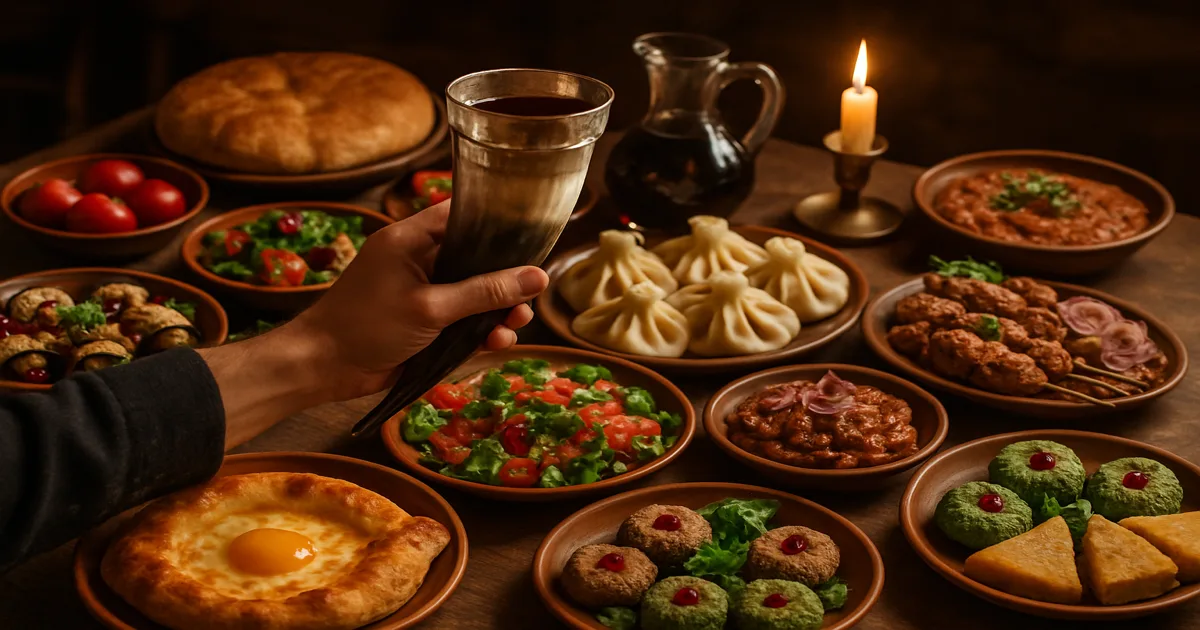
What the supra is — the Georgian feast
The supra (სუფრა — literally "tablecloth") is the Georgian feast for which the table is literally overloaded: dishes are stacked in layers, plates on top of plates. But food is not the point. The supra is about people, words, and the bond between generations. Georgians say that friendship is born at the table — and that the nation holds together there.
There are two kinds of supra. The kelekhi is the funeral feast — quiet and mournful. The keipi is the celebratory one, with songs, jokes and polyphonic singing. But even the joyful supra is not a drinking bout: people drink slowly, between toasts, always with food, and getting drunk is considered shameful, especially for a man.
The tamada: who he is and why it all rests on him
The tamada (თამადა) is the leader of the feast, the conductor of the supra. He is not a hired wedding host but an honorary figure: the tamada is chosen at the start of the meal as the most respected, wise and eloquent person at the table. Often it is the eldest in the family or a close friend of the host.
His authority at the table is almost absolute: no one drinks outside his toast, he sets the tempo, decides the order and can hand the floor to any guest. A good tamada is a philosopher and a storyteller — his toast doesn't stop at "to your health" but unfolds into a small parable with a story, a joke and a moral.
Once, in a Kakheti village, a local tamada of about seventy joined my guests' supra. He spoke a toast to parents for a good ten minutes — and half the table, tough men included, were quietly wiping their eyes. That is the power of a Georgian toast: it is not about the alcohol, but about saying out loud to each other the things that matter. He spoke no English; I translated — and it moved everyone all the same.
The order of toasts: from peace to the tamada
The order of toasts at a supra is fixed and almost ritual. It shifts a little by region and occasion, but the frame is this:
- To peace and the reason for the gathering — the opening toast.
- To Georgia, to the homeland — the land that brought everyone together.
- To parents and ancestors — one of the most important, often to the bottom.
- To the departed — drunk standing, without clinking glasses, in silence.
- To children and the future — the continuation of the family.
- To women — mothers, sisters, wives; men often drink standing.
- To friendship and to the guests — the heart of any supra.
- To the tamada and whoever made the meeting happen — the closing toasts.
Between the "obligatory" toasts, the tamada slips in his own — to love, to the native land, to those far away. No toast repeats the previous one: the tamada's art is to lead the table so the evening builds and builds.
12 key toasts translated
Here are the core Georgian toasts you will hear at almost any supra. The reply to any toast is a unified "gaumarjos!".
| Toast to | In Georgian | Meaning |
|---|---|---|
| Peace | mshvidobas | to peace in the home and the world |
| Georgia | sakartvelos gaumarjos | victory to Georgia |
| Parents | mshoblebis | to father and mother, to one's roots |
| The departed | gardatsvlilebis | to the memory of the gone (standing, no clinking) |
| Children | bavshvebis | to children and the future |
| Women | kalebis gaumarjos | to women, mothers and sisters |
| Love | sikvarulis | to love |
| Friendship | megobrobis | to friendship |
| Guests | stumris gaumarjos | to the guests (a guest is sent by God) |
| Homeland | samshoblos | to the native land |
| The tamada | tamadas gaumarjos | to the leader of the feast |
| Everyone | gaumarjos! | victory! — the answer to any toast |
Georgians have a saying: "A guest is a messenger of God" (stumari ghvtisaa). So the toast to guests is no formality: for hosts, welcoming a guest properly matters more than their own comfort. This is where the legendary Georgian hospitality comes from.
Table rules: the horn, alaverdi, to the bottom
A few things worth knowing so you don't get lost at the table:
- Kantsi (the horn) — a drinking horn used for special toasts. It cannot be set down half-full, because it has no base — so you drink it to the bottom. The horn is usually passed around the circle or given to the most honored guest.
- Alaverdi — handing over the floor. The tamada says "alaverdi to you" and the guest continues the toast on the same theme. It is a mark of trust — be ready to say a few sincere words.
- To the bottom or a sip — for the main toasts (parents, the departed, the homeland) you drink to the bottom; for minor ones you may sip. A guest is always forgiven a smaller measure.
- If you don't drink, say so early. Driving, health, principle — Georgians understand. But it is better to tell the tamada at the start than to silently refuse all evening.
- Don't clink on the "solemn" toasts, and don't cut in with your own toast without permission.
Timur took us to dinner with a family of winemakers in Kakheti, and it wasn't a restaurant — it was a real supra. The tamada, the host's grandfather, led the table for three hours so that we went from laughing to nearly crying. They let me give an alaverdi, I raised a toast to Georgia — and they hugged me like family. Honestly the best part of the whole trip.
How a tourist can give a toast
If the tamada gives you the floor, don't panic. A few simple rules work:
- Speak sincerely, not from a script. A couple of warm sentences from the heart beat any polished toast off the internet.
- Safe themes: to the hosts' hospitality, to Georgia and its land, to the roads bringing you back here again.
- End with "gaumarjos!" — the table answers in kind, and you instantly become one of them.
- Keep it short. Long speeches are the tamada's privilege; a guest needs only 3–4 sentences.
A short guest toast might be: "This is my first time in Georgia, but I feel at home. To this land, to your warmth, and to gathering at this table again. Gaumarjos!"
Where to experience a real supra
A tourist supra in a Tbilisi restaurant and a real family feast are two very different things. In the city you can hear polyphonic singing and taste the order of toasts, but the genuine supra lives in the regions — above all in Kakheti, Georgia's wine country, where the feast and the wine are inseparable.
On our Kakheti tour we stop at family wineries where the hosts lay out a proper table — with homemade qvevri wine, churchkhela and living toasts. And on the tours in Georgia you get the feast food and learn the culture of the supra from the inside, with every toast translated.
Get to a real feast with a guide
See Georgia at the table — with a local guide
Timur will introduce you to a family of winemakers, translate every toast and teach you the ways of the supra. Private tour, rated 4.9/5.