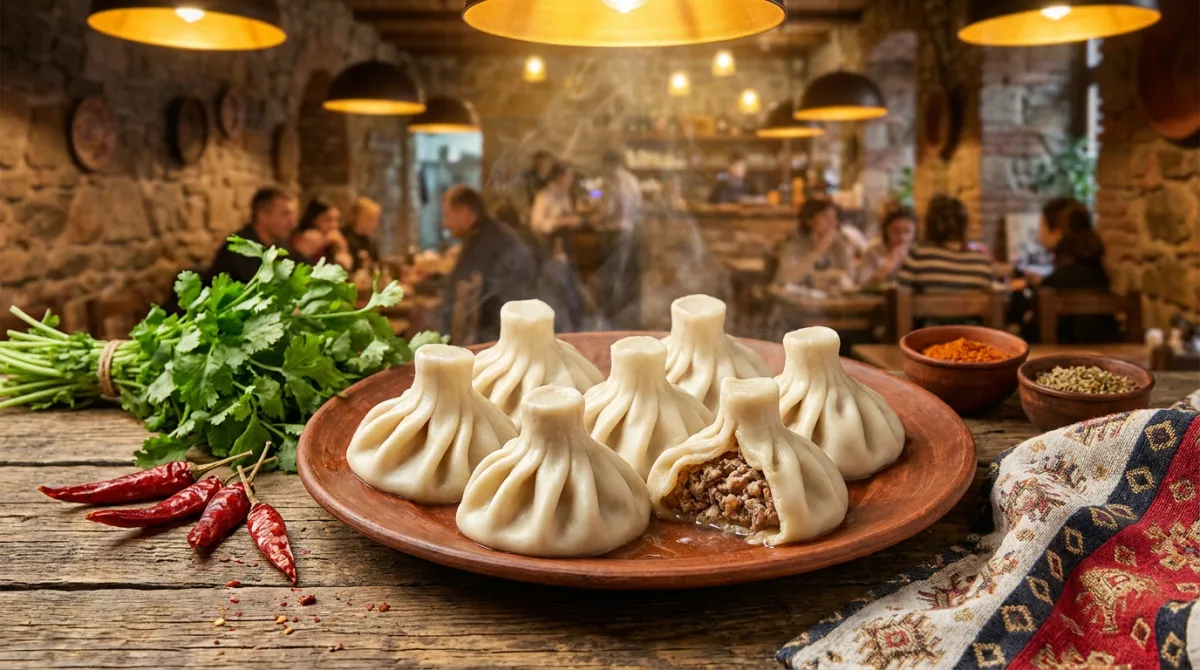
Khinkali are not just dumplings. They are a cultural code of Georgia — a source of pride, a subject of debate about fillings, folds, and the right restaurant. In 460+ tours around Tbilisi I have watched the same scene play out: tourists order khinkali with a fork, lose half the broth, and leave disappointed. This guide exists so that does not happen to you. Don't forget to get travel insurance — mandatory for entering Georgia since 2026.
History of khinkali — where the dish comes from
Khinkali originated in the mountain regions of Georgia — Mtiuleti, Khevsureti, Pshavi. One theory holds that shepherds invented them: meat was chopped by hand, wrapped in dough, and boiled in a cauldron right up in the mountains. Another theory suggests the dish arrived from the East with the Mongol invasions of the 13th century, and Georgians adapted it to their own taste.
In the mountain version — mtiuluri — khinkali are made small, with a more pungent filling and more herbs. The city version — kalakuri — appeared later: larger, milder in flavour, with thinner dough. Today Tbilisi restaurants predominantly serve kalakuri, though most menus offer both.
Khinkali became a symbol of Georgian cuisine for a reason. They require skill: a real cook folds 8–28 pleats into each khinkali — it is a mark of qualification. During the Soviet period, khinkali restaurants were places of informal gathering, a kind of Georgian pub. That tradition survives to this day.
How to eat khinkali correctly: step by step
Rule number one: no knives or forks. This is not snobbery — it is a technical necessity. Inside the khinkali is hot broth, and if you pierce it with cutlery the juice flows onto the plate. Here is the correct method:
- Pick it up by the topknot — with two fingers, firmly, so it does not fall.
- Turn it over — topknot up, base toward you.
- Bite a small hole at the base — a small, careful bite to create an opening.
- Drink the broth — tilt and draw in all the juice. This is the most valuable part of the khinkali; do not lose a drop.
- Eat the meat and dough — several bites; the khinkali is hot, there is no rush.
- Leave the topknot on the plate — it is used to count how many you have eaten. Do not put it back into another person's portion.
A normal serving is 6–10 pieces per person. Order 5 to start, then get more. Khinkali disappear surprisingly fast.
Never eat khinkali with a knife and fork — hands only. Pick it up by the topknot, bite, drink the broth, then eat. The topknot stays on the plate — it tells the waiter how many you have eaten. In a good khinkali restaurant, 8–10 folds per piece is the standard — a sign of the cook's skill. The more folds, the higher the qualification. The best establishments judge their cooks by exactly this criterion.
Classic recipe: dough, filling, folding
Khinkali dough
The dough must be firm, elastic, and egg-free — that way it does not tear during cooking and holds its shape. Classic proportions for 500 g flour: 200 ml cold water, 1 tsp salt. Sift the flour, add salted water in stages, knead for 10–15 minutes. The dough rests under a cloth for 30 minutes — it becomes softer and more pliable.
Roll the dough thin — 2–3 mm. Cut circles 10–12 cm in diameter. Too thick and the khinkali come out heavy; too thin and they tear during cooking.
Khinkali filling
The classic filling is beef and pork in equal parts. The meat is chopped with a knife by hand (not minced!) — this keeps it juicy and gives the right texture. Add to the meat:
- onion — finely chopped, in large quantity (2 large onions per 500 g meat)
- fresh coriander — chopped (can be replaced with parsley, but that is not the classic)
- water or broth — 100–150 ml per 500 g filling (this creates the broth inside)
- salt, black pepper, khmeli-suneli
The main secret is the water in the filling. It turns to steam and then to broth during cooking. The filling should be almost liquid, not a firm ball.
Folding khinkali
Place a tablespoon of filling in the centre of each dough circle. Gather the edges into pleats — from 8 to 28 or more. Pinch and twist the topknot. Each khinkali should stand upright and not leak. Folding is a separate art that takes practice.
Cooking
Use plenty of water — the khinkali must not crowd each other. Salt generously. Bring to a boil, then lower the khinkali in one at a time, holding by the topknot. Cook for 12–15 minutes after they float to the surface. Done khinkali are firm, not deformed, and the dough does not tear.
Types of khinkali — meat, cheese, mushroom, potato
| Type | Filling | Notes | Price (each) |
|---|---|---|---|
| Kalakuri | Beef + pork | Classic, large, lots of broth | 1–1.5 ₾ |
| Mtiuluri | Beef + lamb | Mountain-style, smaller, spicier | 1.2–1.8 ₾ |
| Cheese | Sulguni | Vegetarian, less juicy | 0.9–1.3 ₾ |
| Mushroom | Wild mushrooms | Seasonal, aromatic | 1–1.5 ₾ |
| Potato | Potato + onion | Lean option | 0.8–1.2 ₾ |
| Nettle | Young nettle | Spring delicacy, rare | 1–1.5 ₾ |
The juiciest and most flavourful are the classic meat kalakuri. Cheese and potato versions are a good option for vegetarians, but contain almost no broth inside. Mushroom khinkali are a genuine seasonal delicacy — if you visit in season (September–October), do not miss them.
Best khinkali restaurants in Tbilisi with prices
Over years of guiding I have tested dozens of places. Here are the ones I take tourists to — and go to myself.
Zakhar Zakharych
Address: Asatiani Street 7. A cult spot, with queues at weekends — a good sign. Classic khinkali from 1.2 ₾, a serving of 5 pieces = 6 ₾. Simple interior, loud, crowded — exactly how a proper khinkali restaurant should look. Local families come here in groups.
Pasanauri on Rustaveli
A chain of Georgian cuisine restaurants with several locations. Khinkali from 1.2–1.5 ₾, clean, fast, English menu available. Good for families with children. I recommend Pasanauri to tourists as a reliable option with acceptable quality.
Kinkhali on Leselidze
Address: Kote Abkhazi Street (Leselidze). In the heart of the Old Town. Khinkali from 1–1.5 ₾, a serving with a drink — around 15 ₾. Conveniently located if you are walking around Old Tbilisi. Quality is consistent, no tourist price inflation.
Sheshi in Saburtalo
For those who want it like a local. No tourists, no English menu, khinkali from 0.9 ₾. You need to go a bit outside the centre, but it is worth it. This is where you understand what a real khinkali restaurant actually is.
How much does a portion of khinkali cost in 2026?
Khinkali are one of the most affordable dishes in Tbilisi. Use these prices as a guide:
| Venue | Price per piece | Serving (5 pcs) | Lunch for 1 |
|---|---|---|---|
| Local khinkali house | 1–1.2 ₾ | 5–6 ₾ | 10–15 ₾ |
| Chain (Pasanauri) | 1.2–1.5 ₾ | 6–7.5 ₾ | 15–20 ₾ |
| Mid-range restaurant | 1.5–2 ₾ | 7.5–10 ₾ | 20–30 ₾ |
| Tourist restaurant (Shardeni) | 2.5–3.5 ₾ | 12.5–17.5 ₾ | 35–55 ₾ |
Exchange rate May 2026: 1€ ≈ 3 ₾. A serving of khinkali at a local place costs roughly 1.7–2€. Lunch of 10 pieces plus wine — around 7–8€. This is not a typo.
How to cook frozen khinkali at home
If you have brought frozen khinkali home — they are sold in every supermarket in Tbilisi — cook them correctly:
- Large pot, plenty of water (at least 3 litres for 10 pieces).
- Salt the water generously — 1 tbsp per pot.
- Bring to a rolling boil.
- Lower the khinkali straight from the freezer without thawing, holding by the topknot.
- After they float, cook for 15–18 minutes (frozen ones need more time than fresh).
- Remove with a slotted spoon, carefully — the broth is scalding.
The best frozen khinkali in Tbilisi: Lela and Kinkhali brands (available at Carrefour and Nikora). At home they taste about 80% as good as in a restaurant.
How khinkali differ from dumplings and manti
A question every tourist asks. Here are the main differences:
| Feature | Khinkali | Pelmeni | Manti |
|---|---|---|---|
| Size | Large (8–12 cm) | Small (3–5 cm) | Large (8–10 cm) |
| Broth inside | Yes, lots | No | No |
| Cooking method | Boiled | Boiled | Steamed |
| How eaten | By hand, topknot | Fork | Fork or hands |
| Number of folds | 8–28+ | 1 pinch | 4 corners |
| Served with | Pepper, herbs | Sour cream, vinegar | Sour cream, onion |
| Origin | Georgia (mountains) | Russia/Siberia | Central Asia |
The defining feature of khinkali is the broth inside. That is what makes them unique. The eating process is a small ritual: broth first, then meat. Pelmeni are food; khinkali are a gastronomic experience.
Timur took us to an unmarked khinkali place on Agmashenebeli. I thought khinkali were just large dumplings. I was wrong. When I bit into the first one correctly and drank the hot broth, it was a completely separate flavour experience. We ate 40 pieces between the two of us and asked for more. No forks, no topknots left on the plate — just hands and pleasure. Timur explained each type of filling and we tried all four. Best lunch of my life for 12 lari a head.
Related tours
Read also
Georgian Food Guide: 15 Dishes to Try in Tbilisi →
Adjarian Khachapuri — Recipe, Types & Where to Eat →
Chacha — Georgian Grape Brandy: What It Is & Where to Try →

Private tours in Tbilisi since 2023. 460+ tours, rating 4.9/5 from 87 Google reviews. I know every khinkali restaurant in the city personally.