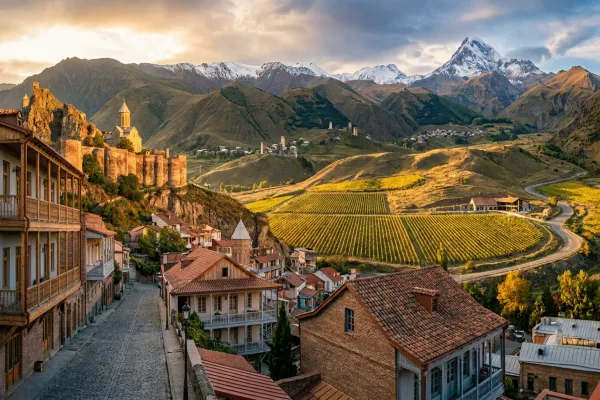
Ten days — complete immersion in Georgia. From the ancient capital to the Black Sea coast, from the world's oldest wine country to the glaciers of the Greater Caucasus. This itinerary covers 6 regions without rushing: two days in each major area means you actually experience a place rather than merely photograph it.
Route: Tbilisi → Mtskheta → Gori → Stepantsminda → Telavi → Mestia → Batumi
Day-by-Day Itinerary
Days 1–2 — Tbilisi
Two full days in the capital. The old town district of Abanotubani with its domed sulphur baths, the Narikala fortress overlooking the Mtkvari River, Shardeni Street and Rustaveli Avenue, the Dezertir (Deserters') Market, Fabrika creative hub, and the extraordinary restaurant scene that has made Tbilisi one of the most talked-about food destinations in Europe. On the second day — the Mtatsminda cable car and panoramic views, or the National Museum, or simply wandering the atmospheric courtyards of Sololaki. Tbilisi rewards slow exploration.
Day 3 — Mtskheta and Gori
First stop: Mtskheta, the ancient capital of the Kingdom of Kartli and a UNESCO World Heritage site. The Svetitskhoveli Cathedral (11th century) houses what tradition holds is Christ's robe. Jvari Monastery (6th century) perches above the confluence of the Mtkvari and Aragvi rivers — the exact view painted by Lermontov in the 19th century. Then Gori, birthplace of Joseph Stalin: the Stalin Museum is one of the strangest and most fascinating museums in the post-Soviet world. Overnight near Kazbegi.
Day 4 — Kazbegi (Stepantsminda)
The Georgian Military Highway northward through the Greater Caucasus. First stop: Ananuri Fortress (16th–17th century) above the turquoise Zhinvali Reservoir. Then Gudauri ski resort at 2,196 m with the Soviet-era Arch of Friendship and panoramic views of the main Caucasian ridge. Cross the Jvari Pass (2,395 m) and descend into Stepantsminda. The ascent to Gergeti Trinity Church (2,170 m): either a 40–50-minute hike up the trail, or a local 4WD from the village (₾20 per person). The 14th-century church above the clouds, with Kazbek (5,047 m) visible in clear weather — one of the defining images of the Caucasus.
Days 5–6 — Kakheti
Two days in Georgia's wine heartland, one of the oldest winemaking regions on earth. Sighnaghi — the "City of Love" enclosed in 18th-century Kakhetian walls. Telavi — the regional capital with a vast plane tree said to be 900 years old. The Tsinandali estate, former home of Prince Alexander Chavchavadze and now a museum and winery. Three or four family wineries where qvevri amber wine is made by the same method used for 8,000 years. If visiting in October — the rtveli grape harvest is an experience unlike any other in the Caucasus.
Days 7–8 — Svaneti
Drive west through Imereti to Mestia — a journey of 7–8 hours that crosses the centre of Georgia and is itself full of stops: Gori Fortress, the cave town of Uplistsikhe, Kutaisi and the Bagrati Cathedral. Mestia is the capital of Svaneti: a place of medieval stone towers, UNESCO heritage villages, and the Caucasian wilderness at its most dramatic. On the second day — either a hike to the Chalati Glacier, or the Koruldi Lakes with 360-degree panoramas of the Greater Caucasus range, or a day trip to Ushguli (2,200 m), the highest permanently inhabited settlement in Europe. In winter, Hatsvali and Tetnuldi are world-class ski resorts.
Days 9–10 — Batumi
Return south via Kutaisi to Batumi on the Black Sea. En route, the Prometheus Cave (12 km of stalactites and underground rivers near Kutaisi) is one of Georgia's most spectacular natural attractions. Batumi itself: the Gonio-Apsaros Fortress (Roman, 1st century AD), the Botanical Garden on the cliff above the sea, the Black Sea boulevard with its extraordinary mix of Ottoman, Soviet, and ultra-modern architecture, and the subtropical evenings that make Batumi feel unlike anywhere else in Georgia.