
The Tbilisi–Batumi train takes 5–5.5 hours across the mountains, rivers and tea plantations of western Georgia. A double-decker Stadler express, tickets from 29 GEL, and the entire coastline unrolls in the window on the approach to the sea. I take travellers on this route regularly and this guide covers everything worth knowing in advance.
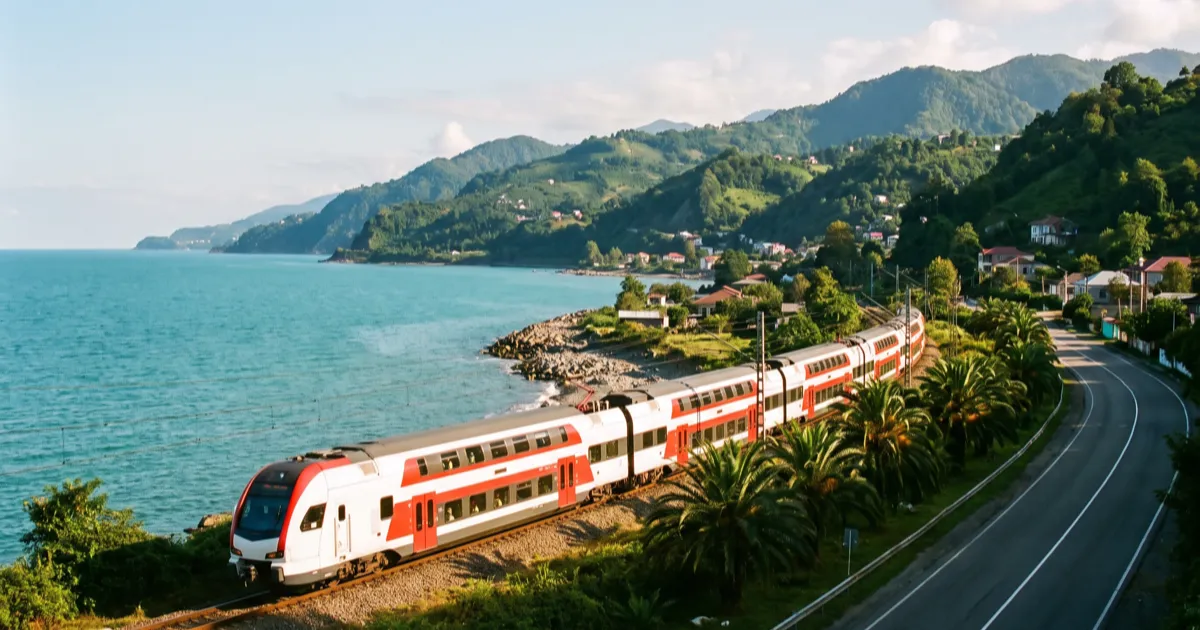
The train is the most predictable way to reach the sea from Tbilisi. No traffic jams, a fixed schedule, pocket-change fares by European standards — and the views justify every minute. If you are still deciding whether Batumi is worth it and for how many days, read is Batumi worth it from Tbilisi first, then come back here for transport.
Tbilisi to Batumi train schedule 2026
In summer (June–September) Georgian Railway runs 2–3 departures a day; in winter usually one. Exact times shift by season, so confirm on railway.ge a couple of days before travel. Approximate 2026 grid:
| Service | Departs Tbilisi | Arrives Batumi | Duration |
|---|---|---|---|
| Morning express | ~07:15 | ~12:30 | 5h 15m |
| Midday express | ~08:20 | ~13:40 | 5h 20m |
| Evening express | ~17:40 | ~23:00 | 5h 20m |
Return trains from Batumi run on similar intervals — morning, midday and evening. The evening service is handy if you want a full day at the sea and a late return without losing daylight to the journey.
Ticket prices by class
| Class | Price | What you get |
|---|---|---|
| 2nd class (economy) | from 29 GEL | 2+2 seats, A/C, sockets |
| 1st class | 45–55 GEL | Wider 2+1 seats, quieter |
| Business / VIP | 60–75 GEL | Most legroom, separate zone |
Children under 5 travel free without a seat; ages 5–10 get a discount. Unlike flights, the fare is fixed and does not rise before departure — but seats physically sell out, and in peak season evening trains go days ahead.
Second or first class — which to pick
Over five hours the difference is noticeable, though not critical. 2nd class has 2+2 seating and a shared aisle; in summer the car is full and can get noisy with families. 1st class (2+1) is quieter and roomier with wider seats, and for a 15–25 GEL surcharge you get a calm ride. Business mainly makes sense for a group that wants a separate zone. My advice: a solo traveller — 1st class on a daytime train; a family on a budget — 2nd class in the morning.
How to buy tickets online
- tkt.ge — the official platform with English and Russian interface, Visa/Mastercard payment. The ticket arrives as a PDF; no need to print — show it on your phone.
- railway.ge — Georgian Railway's own site, with the live schedule.
- Station box office — a fallback if online fails. Tbilisi Central, ground floor, open from early morning.
Buy 5–7 days ahead in summer and 1–2 days off-season. When booking you pick a specific seat on the carriage map — which brings us to the key tip.
Paying with a foreign card
tkt.ge accepts Visa/Mastercard issued outside Georgia, but the payment is sometimes declined by the issuing bank. In that case a Georgian bank card (Bank of Georgia, TBC) or cash at the box office works. If online fails, don't worry — the box office sells the same tickets at the same price, just with fewer seats left in peak season.
Which seats to pick for a sea view
This is the route's best hack. The sea appears on the right in the direction of travel on the approach to Batumi — the last 30–40 minutes, the Kobuleti–Makhinjauri stretch. So:
- Tbilisi to Batumi — take a window seat on the right (right side of the carriage map).
- Batumi to Tbilisi — the opposite, on the left, to watch the coast longer.
- Upper deck of the Stadler — higher vantage, fewer poles and trees in the way.
The first half (Tbilisi–Khashuri–Zestafoni) runs along rivers and green mountains — scenic on both sides. The sea only shows up at the very end, and only on the right, so choose your side in advance.
Luggage, bikes and pets
The baggage allowance is relaxed: suitcases and hand luggage are not weighed, and there is space on overhead racks and in stands by the doors. Large luggage — big suitcases, surfboards — is easier in 2nd class, where the vestibule has more free stands. Bicycles travel in a bag as oversized cargo; in summer confirm at the box office. Small pets travel in a carrier with a vet passport; a separate ticket for a pet in a carrier is usually not required. Always check current rules on railway.ge.
What's on the train: bistro, sockets, comfort
Five hours pass unnoticed once you know what the Stadler offers. The bistro car in the middle of the train serves coffee, tea, pastries, snacks, soft drinks and water at slightly above-city prices. There is no full restaurant, so for a family bring snacks, especially on the morning train. Sockets are at every seat (European type C/F), plus USB in newer cars — charge phone and laptop easily.
The air conditioning works well; in summer the car is cool, so a light layer helps even in the heat. Toilets are clean, one per car. There is no reliable Wi-Fi, but mobile 4G covers most of the way — download a film or podcast for the first, mountainous half where signal drops in tunnels. Overhead racks and door stands hold suitcases; a pram is easier folded by the vestibule. Overall the ride feels like a European intercity, not a post-Soviet commuter train — which is the main reason to take it.
Stations: where you leave from and arrive
In Tbilisi the train leaves from the Central Station (Tbilisi Central, 'Vagzlis Moedani' metro). Arrive 20–30 minutes early — the station is fused with a market and mall, easy to get lost in, and the platform is farther than it looks.
In Batumi the express arrives not downtown but at Makhinjauri station, 6 km north of the seafront. To the centre take a city bus (0.5–1 GEL, 15–20 min), a marshrutka or a Bolt taxi (8–12 GEL, about 10 min). Skip the touts at the exit — order Bolt in the app, cheaper and no haggling.
Train, plane or minibus — what to choose
| Option | Time | Price | Comfort |
|---|---|---|---|
| Train (express) | 5–5.5h | 29–55 GEL | ★★★★ |
| Plane | 1h + airports | 80–200 GEL | ★★★★★ |
| Minibus (marshrutka) | 5–6h | 30–35 GEL | ★★ |
| Car / taxi | 5–6h | 200–300 GEL | ★★★ |
For most travellers the train is the sweet spot of price and comfort. The plane wins on time, but once you count airport transfers the gap shrinks — and it costs 3–5× more. The minibus is for the tightest budgets only: cramped and no toilet on a five-hour leg.
When to fly and when to take the train. The plane (Vanilla Sky, ~1 hour) makes sense in winter, when the train runs once a day and often in the dark — you'd miss the views anyway. In summer the train is objectively better: daylight, coastline in the window, a fraction of the price. The minibus wins in exactly one scenario — when the train is sold out and you must leave today.
Common mistakes travellers make on this route
Over the years I see the same slip-ups — all easy to avoid:
- Sat on the wrong side. They take whatever's left and stare at a hillside instead of the sea. Book a right-side window (heading to Batumi) in advance.
- Confused the arrival station. They expect the train 'in central Batumi', but the express arrives at Makhinjauri, 6 km out. Budget 15 minutes and a Bolt.
- Cut it too fine. Tbilisi Central is fused with a market and mall — the platform is farther than it looks. Arrive 25–30 minutes early.
- Counted on buying on the spot. In summer a popular train can be sold out. Book online a week ahead.
- Took a night train for the views. The single winter train often runs in the dark. In summer choose a daytime service.
- Didn't check the schedule. Times change by season — confirm on railway.ge a couple of days before.
We took the morning double-decker express, right-side window seats — the sea opened up on the approach to Batumi and the kids were glued to the glass. Five hours flew by: A/C, sockets, coffee in the bistro car. For 29 GEL, the best way to reach the coast.
Reach the sea with a guide, hassle-free
Want to head straight to the sea with hotel pickup — take a Batumi tour from Tbilisi. To see western Georgia on the way (Kutaisi, the canyons, Prometheus Cave) there is a transfer tour with stops. What to see on the coast — the Batumi complete guide.